When Drugs Knock on Assam’s Cultural Heartland
In Majuli, awareness programmes against drug abuse have been organised at educational institutions, bringing students, teachers, police personnel and community representatives into the conversation.
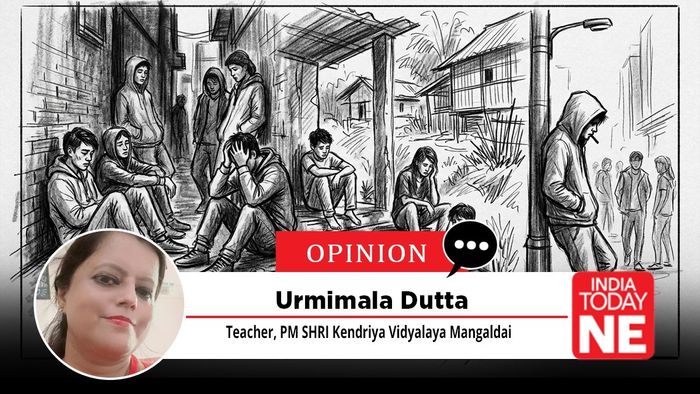
- Aug 27, 2026,
- Updated Aug 27, 2026, 2:47 PM IST
Jorhat and Majuli represent two different but deeply connected dimensions of Assam’s identity. Jorhat has long been associated with education, intellectual life and civic consciousness, with its schools, colleges, research institutions and cultural organisations shaping generations of young minds. Across the Brahmaputra lies Majuli, the spiritual and cultural heartland of Assam, where satras, naamghars, Satriya traditions and community life have preserved a remarkable civilisational inheritance. It is precisely this inheritance that makes the emerging concern over substance abuse among young people so disturbing. When places that have traditionally given Assam its intellectual confidence and cultural continuity begin confronting the drug menace among their youth, the issue can no longer be treated as an isolated law-and-order problem.
The warning signs are already visible. In Majuli, awareness programmes against drug abuse have been organised at educational institutions, bringing students, teachers, police personnel and community representatives into the conversation. Such initiatives matter not because they prove that every educational institution is facing a drug crisis, but because they demonstrate that the issue has entered the consciousness of campuses themselves. The wider Assam picture makes the concern harder to ignore. Drug-related arrests and seizures have repeatedly brought narcotics into public attention, but statistics alone cannot tell the whole story. A seizure indicates something about supply; it does not tell us how many young people are experimenting, how many are dependent, or how many families are quietly struggling to cope.
That distinction is important because the response cannot be built on panic. Drug availability, experimentation, occasional use, substance dependence and organised trafficking are connected, but they are not identical problems. Treating every young user simply as a criminal may drive the problem further underground, while treating organised traffickers as if they were merely another category of offenders fails to recognise the deliberate destruction of lives for profit. A young person struggling with dependence may need counselling, medical care and rehabilitation; the person who supplies the substance and deliberately seeks vulnerable customers requires determined investigation and prosecution. A sensible response must retain both compassion and firmness.
For many young people, the journey does not begin with a conscious decision to become addicted. It can begin with curiosity, experimentation, peer influence or the desire to fit in. Academic pressure, family tensions, loneliness, relationship problems, unemployment
and a lack of purpose can make some young people more vulnerable, although none of these factors should be treated as a universal explanation. The availability of substances is another part of the equation. What begins as “just trying it once” can, for some, develop into repeated use and eventually dependence. By the time parents or teachers recognise the seriousness of the change, the young person may already be struggling with a problem that requires professional intervention.
That is why the first line of defence must be built long before addiction becomes visible. Schools and colleges cannot wait for a student to fail examinations, stop attending classes or undergo a dramatic behavioural transformation before asking what may be happening. Teachers are not medical professionals, and educational institutions cannot be expected to diagnose addiction, but they can create conditions in which warning signs are noticed and help becomes accessible. Counselling, confidential avenues for seeking assistance, meaningful engagement with parents and reliable referral mechanisms can make the difference between early intervention and a crisis that has been allowed to deepen.
The family is equally important, perhaps more than any formal programme can ever be. Parents are often the first to notice changes in a young person’s behaviour, friendships, routine, sleep, academic performance or emotional state. Yet noticing a problem is only the beginning. A child who believes that admitting drug use will lead immediately to humiliation, physical punishment or rejection may choose silence instead. Families need to combine concern with firmness, but they must also create enough trust for a young person to say, “I need help.” Shame may conceal a problem; it rarely solves one.
The influence of friends deserves similar attention. Young people often speak to their peers before they speak to adults. The same peer network that can introduce a student to substance use can also become a powerful source of resistance. Schools and colleges should therefore encourage responsible peer leadership, enabling students to recognise risky situations, challenge the casual normalisation of drugs and guide friends towards adults and professionals when necessary. Young people are more likely to listen when the message comes from someone who understands their world.
None of this, however, should weaken the focus on the supply side. There is a fundamental difference between a young person caught in dependence and the person knowingly profiting from that dependence. The former may need treatment and rehabilitation; the latter needs determined investigation and prosecution. The trafficker who sees adolescents as a market is not merely selling a commodity. He is converting vulnerability into profit and damaging families and communities in the process. Compassion for the user and firmness towards the trafficker should therefore coexist.
Law enforcement must consequently look beyond the last person caught with a packet or a small quantity of drugs. The more important questions are where the substance came from, who supplied it, who financed the operation, how it reached the locality and who facilitates its distribution. Assam’s location within the wider Northeast makes intelligence-sharing and coordination between agencies particularly important. Narcotics trafficking does not necessarily respect administrative boundaries, and a sustained response requires cooperation across districts and jurisdictions.
Majuli, however, possesses an advantage that should not be underestimated: its community institutions. The satras and naamghars have historically been centres not only of religious life but also of social interaction, cultural transmission and collective identity. Village organisations, youth groups, sports clubs, cultural associations and educational institutions add further layers of community engagement. Together, these networks can give young people something increasingly important in an age of social fragmentation—a sense of belonging. But culture should not be romanticised as a cure for addiction. Cultural and spiritual institutions can provide moral grounding and purpose; they cannot replace doctors, psychologists or scientifically supervised treatment.
This distinction becomes particularly important when the question of rehabilitation arises. A young person who decides to escape addiction has already taken a difficult step. That person deserves access to treatment that is lawful, professional and humane. Unregulated rehabilitation centres, physical punishment, humiliation or illegal confinement have no place in a system that claims to restore lives. Recovery cannot be built by subjecting a vulnerable person to another form of abuse. Families must also be able to distinguish between genuine professional care and institutions that exploit desperation.
The mental-health dimension deserves greater attention as well. Substance use can coexist with anxiety, depression, trauma, loneliness and other psychological difficulties. That does not mean that mental illness causes every instance of drug abuse, nor that every young user requires psychiatric treatment. It does mean that a student should not automatically be reduced to the label of a “problem child”. The behaviour may be a visible symptom of difficulties that adults have failed to understand. Better counselling and referral systems in educational institutions and public-health services can help identify those difficulties before they become overwhelming.
Prevention also requires giving young people something more compelling than the temporary excitement of experimentation. Sports, NCC, Scouts and Guides, literature, music, theatre, cultural activities, volunteering and community service cannot make drugs disappear. They can, however, create friendships, discipline, confidence and a sense of achievement. A young person who finds purpose in a football field, a stage, a literary club, a
community project or a cultural institution is building an identity around something constructive. That matters because the battle against addiction is also a battle against emptiness.
The stakes are ultimately larger than the number of drug cases registered in a district. Assam’s young population represents its greatest demographic resource, but a demographic dividend exists only when young people are healthy, educated, skilled and capable of participating productively in society. Addiction can interrupt education, damage family relationships, weaken employability and leave scars that extend across generations. Every young person who is pulled away from education and aspiration represents a loss that cannot be measured merely in a police register.
The national campaign for a drug-free India therefore has a particularly important meaning in Assam. Government programmes and police action are necessary, but no campaign can succeed if it remains confined to official events. The message has to enter classrooms, homes, hostels, neighbourhoods and community institutions. Parents must know how to respond. Teachers must know when to refer. Students must know where to seek confidential help. Health services must be prepared to treat dependence. Police must pursue the networks that profit from it. Community leaders must be willing to speak about the problem without either sensationalising it or pretending that it does not exist.
For Jorhat and Majuli, the challenge carries an additional weight because of what these places represent. Jorhat’s intellectual traditions and Majuli’s cultural inheritance have contributed enormously to Assam’s sense of itself. Their young people are not merely another demographic category. They are the future teachers, researchers, artists, entrepreneurs, administrators, farmers, professionals and community leaders who will decide what survives and what changes in the next generation.
The measure of success, therefore, should not be confined to the number of arrests made or kilograms of drugs seized. It should be whether a teenager is prevented from taking the first step, whether a student struggling with dependence can seek help without being condemned, whether a parent knows where to turn, whether a school can recognise a warning sign early and whether the people supplying drugs to vulnerable young people are being pursued all the way to the networks behind them.
Assam does not need another cycle of alarm followed by silence. It needs sustained attention, intelligent enforcement, credible treatment and a community response strong enough to reach young people before the traffickers do. Jorhat and Majuli have something many places would struggle to build from scratch: educational institutions, cultural
traditions and community networks capable of giving young people both knowledge and belonging.
The drug menace is serious, but it is not inevitable. The real question is whether Assam will allow its young people to inherit its cultural legacy only as history, or whether it will give them the strength and opportunity to carry that legacy forward. In Jorhat and Majuli, the answer will be determined not merely by what the police seize or what the government announces, but by what families, schools and communities choose to do before the next young person hears the deceptively simple invitation: “Just try it once.”