When Elections Become Spectacles: Assam's Stolen Agenda
There is something quietly devastating about watching an election campaign drift away from the people it is supposed to serve. Not in a dramatic, newsworthy way. More like watching a river slowly change course l the water still flows, noise is still made, but the destination has shifted entirely.
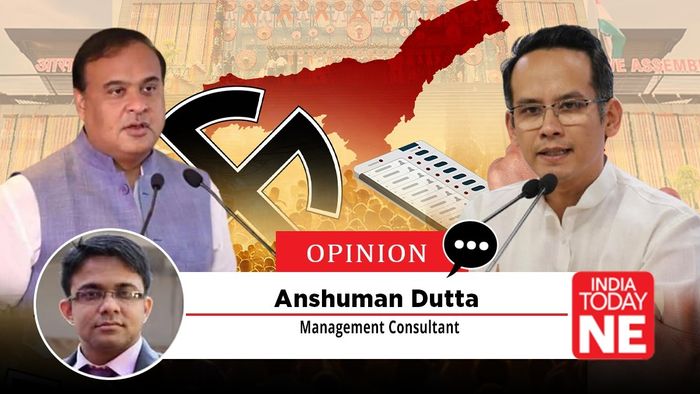
- Apr 06, 2026,
- Updated Apr 06, 2026, 2:35 PM IST
There is something quietly devastating about watching an election campaign drift away from the people it is supposed to serve. Not in a dramatic, newsworthy way. More like watching a river slowly change course l the water still flows, noise is still made, but the destination has shifted entirely.
Assam goes to the polls on April 9. And in the weeks leading up to this moment, what the state has been offered is not a debate about its future. It has been offered a spectacle.
Consider what dominated the final stretch of this campaign. A sitting Chief Minister, days before polling, trained his attention not on governance records or development promises, but on the social media posts of a 26-year-old candidate's mother. That candidate, Kunki Chowdhury, had been campaigning on floods, jobs, waste management, and urban infrastructure, the unglamorous substance of real governance. In return, she received allegations about her family's dietary choices and religious sympathies, a deepfake video targeted at her person, and the backhanded gift of national notoriety she did not seek.
On the other hand, a Leader of the Opposition told a Biswanath rally that the Chief Minister is "the most corrupt in the country" and that he will be held legally accountable when power changes hands. No policy counter. No alternative vision. Just a mirror image of the same attack culture wearing different colours.
A senior Congress leader called the Chief Minister's public language "that of a goon." The Chief Minister called the Congress leader a "registered paagal." This is the conversation Assam's voters were handed in the days before they cast their ballots.
It would be easy to dismiss this as theatre electoral high spirits, the rough and tumble of democratic competition. But that would be too charitable. What was lost in this noise was not just civility. What was lost was accountability.
Assam is a state with legitimate, urgent, and entirely unaddressed questions waiting for a political conversation.
The Brahmaputra floods are not a natural calamity anymore they are a governance failure rendered permanent by neglect. Every monsoon, the same districts, the same villages, the same families lose crops, homes, and in the worst years, lives. Embankments that should have been repaired years ago are repaired on paper and breached in practice. No serious candidate has stood before flood-affected communities in Barpeta or Dhubri and been asked, on camera, by a journalist or a rival, to account for this in specific terms.
The tea garden economy, which shapes the identity and livelihood of hundreds of thousands of workers across Upper Assam, is in a state of slow erosion. The minimum wage promise of Rs. 351 a day, which featured in political manifestos, remains unfulfilled. Tea workers received land deeds in the campaign's final days a legitimate welfare gesture, but also a reminder of how much of Assam's political economy runs on announcements made at election time and forgotten the morning after.
Youth unemployment is not a statistic in Assam it is a social condition. Educated young people from Jorhat, Silchar, and Tezpur, who completed degrees at Cotton College or Gauhati University, are navigating a job market that offers little and demands patience they are running out of. No debate stage, no public exchange between candidates, meaningfully grappled with this in terms of policy, what industries, what skill pipelines, what structural reforms.
The urban-rural infrastructure divide in Cachar, in the Barak Valley more broadly, is not a peripheral concern. It defines the life chances of people who live an hour from a functioning hospital, who send their children to schools without functioning toilets, who conduct commerce over roads that become rivers in July. The gap between what these communities need and what they received as political promises is wide enough to drive a campaign bus through.
These were campaigns waiting to be run. They remain unrun.
It would be unfair to attribute the collapse of policy discourse to cynicism alone. The structural conditions that produce this outcome are real.
When manifestos are aspirational without being specific, there is no policy difference sharp enough to argue about. Both major formations in this election released documents of intent rather than documents of accountability. Without concrete targets, timelines, or costings, manifestos become wallpaper decorative, harmless, and irrelevant to the actual campaign.
The manifestos themselves offer little shelter from this critique. The BJP's Sankalp Patra lists 31 promises under the banner of a "Secure, Developed Assam" including, once again, a flood-free Assam within five years, backed by ₹18,000 crore in the first two years. The same promise appeared in 2021. It was not kept. The tea garden wage promise now stands at ₹500 a day, an acknowledgment, buried in fine print, that the ₹351 figure from earlier commitments was never delivered. Congress countered with five guarantees weighted toward welfare transfers, cash for women, land rights for indigenous communities, a senior citizen allowance, each worthy in isolation, none addressing the structural questions of employment generation, flood infrastructure, or the urban civic deficit in Lower Assam. Both documents tell voters what they might receive. Neither asks what went wrong, or answers for it.
Assamese politics has always carried a strong current of personality-driven loyalty. At the constituency level, who you are, your caste, your community, your personal history has historically mattered as much as what you stand for. Parties do not correct for this. They exploit it.
The media ecosystem, particularly regional television and the WhatsApp political economy, rewards conflict. A candidate promising better drainage gets two minutes. A candidate questioning a rival's family gets a news cycle. The incentive to attack is not just emotional or strategic, it is structural. Outrage travels; policy does not.
And there is a simpler calculation at work. Incumbents with a governance record that does not survive scrutiny have every reason to make the campaign about the opponent. Challengers who lack credible alternative programmes have every reason to make it about the incumbent's character. When both sides retreat to this position simultaneously, the voter is left with no ground to stand on.
There is a detail from this campaign worth holding on to. In Jorhat, by most accounts, the two main candidates chose not to attack each other. A political observer attributed this to what he called "the educated population of the region who do not like people who attack their rivals." Whether or not that explains it fully, the contrast with the rest of the campaign is instructive. It is possible to contest an election differently. Some candidates chose to.
In New Guwahati, similarly both the candidates called their contest a battle of ideology and meant it. While one candidate campaigned on drinking water, artificial floods, and crumbling infrastructure. Another defended a development record. Two candidates, one real argument. No mothers dragged in. No names called.
These contests exist. They are simply not the ones that travel.
The voters of Assam across its floods and its gardens, its urban wards and its river islands deserve to be treated as adults capable of evaluating ideas. They deserve candidates who trust them enough to come before them with a real account of what went wrong and what would be done differently. They deserve a press that holds that conversation to account rather than amplifying the circus. And they deserve, at the very minimum, a campaign that takes their problems seriously enough to name them.
On April 9, they will vote. Many of them, perhaps most of them, will vote not for a policy agenda but for a candidate they recognise, a party they belong to by habit or community, or a name that felt familiar on the ballot. That is not a failure of the voter. It is the rational response to a political conversation that offers them nothing more substantive to go on.
The sad truth of the 2026 Assam assembly election is not that the candidates were unworthy or the people disengaged. It is that a state with real problems to solve spent its campaign season proving that elections, at their worst, are not about solutions at all.
They are about winning. And the distance between those two things is precisely where democracy quietly breaks down.
The author writes on politics, governance, and society in Northeast India.