When nuance becomes narrative: Why even A. R. Rahman got trapped in the fallacy machine
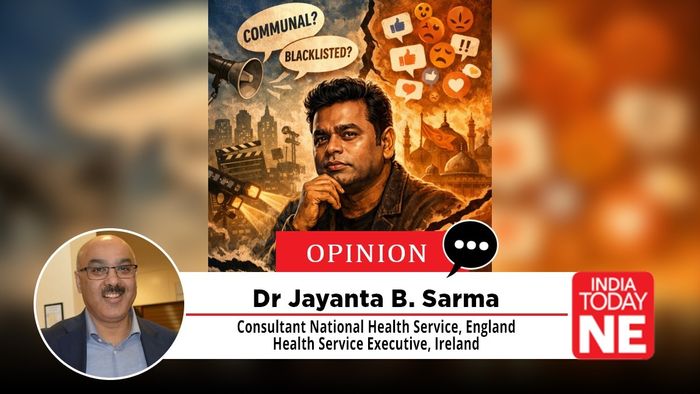
When A. R. Rahman recently suggested that the Hindi film industry might be experiencing a more “communal” atmosphere, while also stressing that it was not “in his face” and that he was going by whispers, the debate ignited anyway. The outrage did not wait for evidence. Nor, to be fair, did it wait for a careful reading.
- Jan 22, 2026,
- Updated Jan 22, 2026, 11:00 PM IST
It takes a certain kind of cultural weather for a single word to become a spark. When A. R. Rahman recently suggested that the Hindi film industry might be experiencing a more “communal” atmosphere, while also stressing that it was not “in his face” and that he was going by whispers — the debate ignited anyway. The outrage did not wait for evidence. Nor, to be fair, did it wait for a careful reading.
Yet if one wants to understand why an artist of Rahman’s stature would raise a matter he openly framed as second-hand, it helps to start not with politics but with psychology.
Why speak, even when it’s “only whispers”?
The film-music ecosystem is famously opaque. Projects are discussed, then stall; briefs change; producers swap; labels intervene; an album becomes a “single”; a score becomes a playlist; and the reasons are rarely formalised in ways artists can verify.
In such environments, human beings, celebrities included default to sensemaking. They assemble explanations from partial cues. Several well-known heuristics can push a person toward naming an atmosphere even without first-hand proof:
Sensemaking under opacity: Unclear processes force people to infer causes.
Availability heuristic: In a polarised moment, “communalisation” is a readily available explanation; it comes to mind faster than slower, structural ones.
Pattern detection & narrative bias: A mind prefers a coherent story over a pile of disconnected events.
Social proof: When the same suggestion reaches you repeatedly from different quarters, repetition starts to feel like confirmation.
Self-protective attribution: When professional recognition feels threatened, attributing some of the change to external climate can soften the sting — even if one remains unsure.
This does not make the inference true. It makes it human.
And once spoken, a “maybe” enters the public square — where fallacies thrive.
What the decade of work actually shows
If one checks Rahman’s credited full-score work from roughly 2015 to 2025, a crucial fact complicates any easy claim that he has been “shut out” of Hindi cinema: he has continued to score Hindi projects with regularity.
A reasonable tally from widely listed filmographies and discographies yields approximately 20–25 Hindi full-score credits in that period (the exact number varies slightly depending on whether one counts documentaries/series and how one classifies bilingual projects). The list includes high-visibility titles across the decade — from Tamasha (2015) and Mohenjo Daro (2016), to Dil Bechara (2020), Mimi and Atrangi Re (2021), and more recent projects such as Maidaan (2024) and forthcoming/late-listed titles in 2025.
At the same time, his output outside Hindi has been prolific — major Tamil projects, pan-Indian films, and international work. The pattern looks less like exclusion and more like a portfolio split: steady Hindi presence alongside heavy non-Hindi composition.
This matters because it reframes the debate: what might feel like “less work” may actually be “different work,” “different visibility,” or “different industry architecture.”
The fallacies that turned a hypothesis into a headline
The controversy is a textbook tour of how public discourse malfunctions with errors on multiple sides.
Post hoc ergo propter hoc (after this, therefore because of this).
Some interpreted a perceived dip in Hindi visibility as proof of a single cause — communal bias — without establishing the mechanism.
Hasty generalisation.
An industry-wide claim was inflated from indirect anecdotes, despite the speaker’s own caveats.
Availability heuristic.
A politically salient explanation outcompeted boring structural ones: streaming economics, label dominance, multi-composer albums, speed of commissioning, and the fragmentation of the “classic soundtrack” model.
Fundamental attribution error.
Opaque commercial decisions were assigned to identity and intent, rather than incentives and changing formats.
Straw man (much of the backlash).
A tentative “might” became “he alleges discrimination,” a more attackable statement than the one actually made.
False dilemma.
Either Bollywood is communal or Rahman is fabricating. The obvious third option — uncertainty in a changing industry — was treated as cowardice by some and betrayal by others.
Then came the oldest fallacy of all:
Ad hominem.
When arguments get hot, people stop contesting ideas and start litigating the person.
Was it avoidable?
The topic is not avoidable; the explosion was.
Words like “communal” are live wires in India’s public life. If you float them as a hypothesis, you may need to overcompensate with scaffolding: alternative explanations, clear boundaries, and an explicit statement of what would count as evidence. In a calmer era, his hedges might have held. In a polarised one, they were treated as provocation.
What a sober reading allows
A careful interpretation would say:
Rahman offered a hypothesis rooted in indirect signals, not a charge backed by proof.
The record of his last decade shows substantial ongoing work, including in Hindi — undermining any simplistic “blacklisting” narrative.
The industry itself has changed in ways that can produce the feeling of reduced access without any single discriminatory driver.
The deeper lesson is not about whether Rahman is right or wrong. It is about how quickly a society converts uncertainty into certainty — and how easily even the most celebrated voices, and their most celebrated critics, slide into fallacies once a narrative becomes convenient.
In the end, the real controversy may be less about one composer’s workload than about our collective impatience with nuance: a world where “maybe” is heard as “certainly,” and where whispers — from either side — become louder than facts.