When Politics Crosses the Personal Line
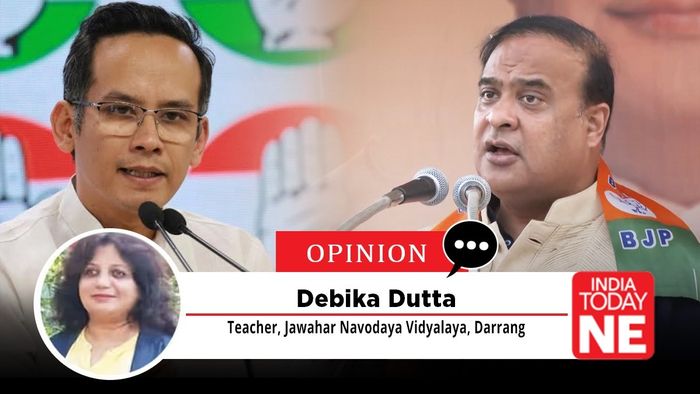
There are moments in public life when disagreement ceases to illuminate and begins to diminish. The recent remarks by Pawan Khera targeting Himanta Biswa Sarma and his wife mark one such moment—less for their immediate impact than for what they signal about the direction of political discourse.
- Apr 07, 2026,
- Updated Apr 07, 2026, 3:22 PM IST
There are moments in public life when disagreement ceases to illuminate and begins to diminish. The recent remarks by Pawan Khera targeting Himanta Biswa Sarma and his wife mark one such moment—less for their immediate impact than for what they signal about the direction of political discourse.
Democracy thrives on scrutiny. Those who hold public office must expect their decisions, affiliations, and conduct to be examined with rigour. That scrutiny is not an inconvenience; it is the very mechanism through which accountability is enforced. Yet, when the focus shifts from the public role to the private sphere, the purpose of that scrutiny becomes less clear and far harder to justify.
Families of political leaders occupy an ambiguous space. They are visible, often by association, but not vested with authority. They neither seek electoral mandates nor participate in governance in any formal sense. To draw them into the line of political fire, without compelling and demonstrable public interest, risks crossing a boundary that has long—if imperfectly—been respected in Indian politics.
It is sometimes argued that in an age of relentless media and expansive free speech, such boundaries are bound to erode. There is truth in the claim that political language has become sharper, more immediate, and less forgiving. But freedom of expression, however wide its ambit, does not absolve public figures of responsibility. Words spoken from positions of influence carry weight; they shape not only narratives but also norms.
There is, moreover, a question of utility. Personal attacks, however provocative, rarely advance public understanding. They obscure more than they reveal, displacing discussions on policy, governance, and performance—the very issues that demand attention in a functioning democracy. When politics turns inward in this manner, it risks becoming an exchange of insinuations rather than an engagement of ideas.
A related concern lies in the changing tools of political contestation. The circulation of manipulated digital content, including alleged deepfake videos involving individuals such as Kunki Choudhury, points to a parallel shift—one where technology is increasingly used to shape perception in ways that are difficult to verify and even harder to counter. Though different in form, such practices echo the same underlying tendency: the blurring of lines between legitimate critique and distortion.
The convergence of personalised rhetoric and technological manipulation presents a deeper challenge. It unsettles the basic compact between public figures and the public itself—that disagreements, however sharp, will remain anchored in some shared understanding of fact. When that anchor loosens, trust does not erode gradually; it frays, often irreversibly.
None of this is to suggest that all references to individuals connected to those in power are beyond scrutiny. There may well be circumstances where such scrutiny is warranted, particularly where questions of accountability arise. But the threshold must remain high, and the method measured. Assertions must rest on verifiable ground; criticism must be proportionate and purposeful.
Equally, the manner of response matters. Political leadership is tested not only in moments of authority but also in moments of provocation. Restraint, in such instances, is not a sign of weakness but of confidence—an assertion that the strength of one’s position does not depend on the lowering of another’s.
For a state like Assam, where political debate unfolds against a backdrop of complex social and economic challenges, the need for clarity and seriousness in public discourse is particularly acute. The diversion of attention toward the personal, or the proliferation of questionable digital narratives, serves little purpose beyond momentary spectacle.
In the end, democracies are sustained as much by habits as by institutions. Among those habits is a certain discipline in disagreement—a recognition that not everything that can be said ought to be said, and not every line that can be crossed should be. Politics will remain contentious; it need not become careless.
If public life is to retain its credibility, its arguments must rise above the temptation of the personal and the distortions of the moment. The measure of political engagement lies not in how far it can go, but in where it chooses to stop.