When reason fails: The quiet intelligence of knowing when not to argue
There is a recurring experience in human life that philosophy, ancient and modern, has struggled to fully reconcile: the failure of reason in the face of resistance. One argues clearly, even generously, yet finds no movement in the other. The facts remain intact, the logic sound—yet the encounter dissolves into frustration. This is not merely a social inconvenience; it is a philosophical problem. What is it that prevents reason from doing its work?
- Mar 27, 2026,
- Updated Mar 27, 2026, 12:01 PM IST
There is a recurring experience in human life that philosophy, ancient and modern, has struggled to fully reconcile: the failure of reason in the face of resistance. One argues clearly, even generously, yet finds no movement in the other. The facts remain intact, the logic sound, yet the encounter dissolves into frustration. This is not merely a social inconvenience; it is a philosophical problem. What is it that prevents reason from doing its work?
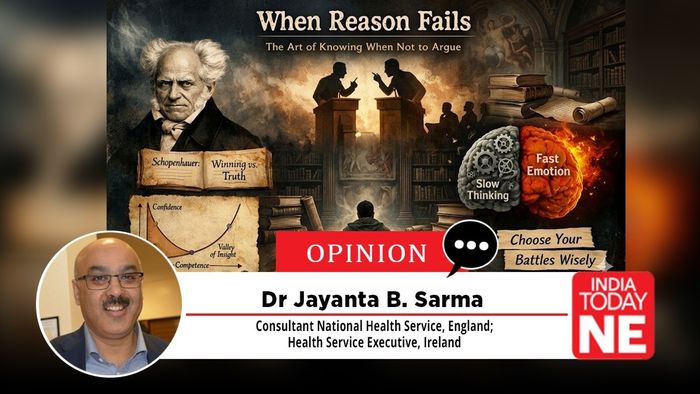
Western thought, particularly in the reflections of Arthur Schopenhauer, approaches this question through a psychological realism. The German philosopher Arthur Schopenhauer understood this long before the age of social media. In his reflections on what he called eristic dialectic; he observed that many arguments are not cooperative inquiries into truth but contests for victory. The aim is not to understand but to prevail. Once this shift occurs, the rules change. Logic ceases to be an effective tool. Rhetoric, persistence, and emotional force often take precedence.
This insight helps explain a familiar frustration: the sense that one is arguing carefully while the other person appears to be arguing tactically. Facts are introduced, but they are ignored or reinterpreted. The goalposts move. The conversation circles. What appears, on the surface, to be a disagreement about ideas is often a struggle over position, identity, or status.
Schopenhauer recognises that argument is rarely a pure search for truth. It is often a contest of will. The intellect, in such settings, becomes an instrument, not of illumination, but of assertion. One does not merely think; one defends. The opponent is not simply mistaken; he is a threat to be overcome.
This insight resonates unexpectedly with a much older and more interior tradition: the Vedāntic analysis of the human condition. In the Upanishadic vision, the central obstacle to knowledge is not ignorance alone, but avidyā structured through ahaṃkāra—the ego-sense that appropriates experience and resists dissolution. Knowledge, in this framework, is not merely the accumulation of correct propositions, but the removal of misidentification. One does not simply learn the truth; one must become capable of receiving it.
The convergence is striking. What Schopenhauer describes externally—as the will to win overriding the will to know—Vedānta describes internally as the ego’s resistance to self-transcendence. In both accounts, the failure of reason is not due to the weakness of logic, but to the conditions under which it is deployed.
Modern psychology adds a further layer of precision.The work of David Dunning and Justin Kruger showed that individuals with lower competence in a domain may overestimate their understanding, not out of arrogance alone, but because they lack the very skills required to recognise their own limitations. The implication is subtle but important: some disagreements persist not because the evidence is unclear, but because the capacity to evaluate that evidence is uneven.
Layer onto this the cognitive framework of Daniel Kahneman, who distinguished between fast, intuitive thinking and slower, reflective reasoning. Much of our everyday judgment operates in the fast mode—automatic, impressionistic, and emotionally coloured. Slower reasoning, which weighs evidence and revises conclusions, requires effort and motivation. It is not the default setting.
Taken together, these perspectives suggest a sobering but clarifying truth: reason does not fail because it is weak, but because it is not always the language being spoken.
Vedānta would recognise this as the play of manas and vāsanā—the restless mind and its conditioned tendencies—operating prior to viveka, discriminative insight. The mind does not approach reality as a blank instrument; it approaches it already shaped by attachment, fear, and habit.
Across these traditions, a shared structure emerges:
- The intellect is not sovereign
- The ego conditions perception
- Recognition of error requires capacity, not just evidence
- Reaction often precedes reflection
The failure of reason, then, is not accidental. It is intrinsic to the human condition as ordinarily lived.
What, then, is the appropriate response?
Western responses vary. Some traditions double down on argument, refining logic and rhetoric. Others, including Schopenhauer, suggest a more strategic awareness: not all disputes are worth entering, and not all interlocutors are positioned for genuine exchange.
Vedānta, however, introduces a more radical shift. It does not treat every misunderstanding as something to be corrected externally. Instead, it turns attention inward. The primary task is not to convince others, but to free oneself from compulsive engagement. The Gītā’s ideal of sthita-prajña—the person of steady wisdom—is not characterised by argumentative brilliance, but by equanimity. He acts where action is required but is not compelled to react to every disturbance.
Silence, in this context, is not defeat. It is clarity.
This does not mean withdrawal from the world. Rather, it implies a different relationship to it. One continues to engage, but without the illusion that every mind is equally ready for transformation. One offers reason where there is receptivity. Where there is not, one does not force it. This is not indifference; it is discrimination.
The ethical tension remains. If one withdraws too quickly, does one abandon responsibility? If one persists too long, does one waste energy and entrench conflict? Neither tradition offers a formula. What they offer is a principle: discernment.
Discernment (viveka) is the capacity to see not only what is true, but what is possible in a given moment. It asks: Is this a field where reason can operate? Is this a mind capable of revision? Is this an engagement that leads toward clarity—or away from it?
Modern discourse, especially in its digital form, tends to erase this distinction. Every claim invite response. Every disagreement becomes a battleground. In such an environment, intelligence is often measured by the ability to respond quickly and decisively. Yet both Vedānta and the more reflective strands of Western thought suggest a different measure.
Intelligence, at its highest, is not merely the ability to think. It is the ability to withhold thought where it serves no purpose.
This is not a retreat from reason, but its refinement. Reason, properly understood, is not an endless impulse to argue. It is a faculty guided by judgment—about context, about capacity, about consequence.
The deepest synthesis, then, is this:
- Schopenhauer reminds us that argument is often shaped by will
- Dunning and Kruger remind us that self-knowledge is unevenly distributed
- Kahneman reminds us that reflection is not the default mode of mind
- Vedānta reminds us that the ultimate obstacle is the ego’s grip on identity
Together, they point toward a disciplined realism. Human beings are capable of truth, but not always available to it.
To live wisely within this condition is not to abandon reason, nor to impose it indiscriminately. It is to recognise its proper place.
There are moments when speech clarifies.
There are moments when it inflames.
And there are moments when silence understands what argument cannot.
(Author’s Note: Dr Jayanta Biswa Sarma writes on politics, institutions, and society through the lenses of history, philosophy, and systems thinking, drawing on both Indian and Western intellectual traditions. Artificial intelligence tools may be used in preparing this article as research and editorial aids. All arguments, interpretations, and final editorial judgement remain the author’s responsibility)