‘Who is Himanta Biswa Sarma, really?’
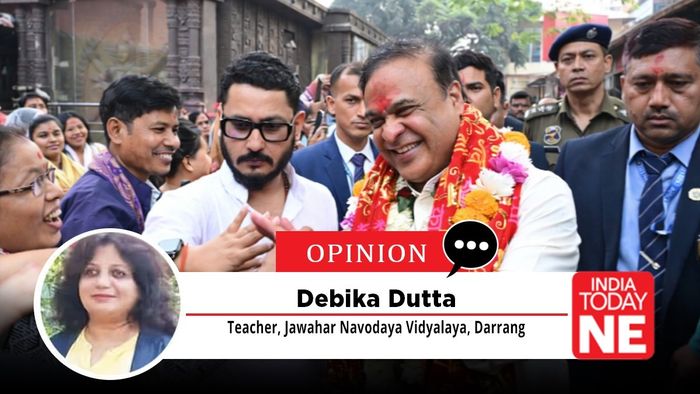
“Who is Himanta Biswa Sarma?” Congress MP Gaurav Gogoi’s recent remark was intended as a political slight, a rhetorical device aimed at puncturing what critics often describe as an overbearing public persona. Yet the question refuses to remain rhetorical. In Assam’s contemporary political life, it demands a serious answer, one rooted not in personality or provocation, but in record, consequence, and the exercise of power over the last decade.
- Feb 01, 2026,
- Updated Feb 01, 2026, 12:30 PM IST
“Who is Himanta Biswa Sarma?” Congress MP Gaurav Gogoi’s recent remark was intended as a political slight, a rhetorical device aimed at puncturing what critics often describe as an overbearing public persona. Yet the question refuses to remain rhetorical. In Assam’s contemporary political life, it demands a serious answer, one rooted not in personality or provocation, but in record, consequence, and the exercise of power over the last decade.
Since his entry into the Bharatiya Janata Party in 2015, Himanta Biswa Sarma has emerged as one of the most influential figures in the state’s politics. This influence has not been consensual, nor has it been subtle. He is admired by supporters for administrative urgency and decisiveness, and criticised by detractors for confrontation and centralisation. But few would dispute that Assam’s political and governance landscape today bears his unmistakable imprint, and that his decisions have materially changed both the pace and direction of the state’s development.
Any credible assessment must begin with the criticisms. Sarma is frequently accused of concentrating authority excessively in the executive, of personalising governance, and of blurring the boundary between political rhetoric and institutional restraint. Civil liberties groups have questioned his aggressive law-and-order posture, while political opponents argue that administration under him often appears performative and combative. Even neutral observers acknowledge that his leadership style leaves limited space for dissent or ambiguity.
These criticisms are real and grounded. Sarma has consciously rejected the convention of administrative anonymity. He governs visibly and vocally, claiming political ownership of both policy outcomes and enforcement actions. The concern, therefore, is not whether he is assertive, that much is evident, but whether such assertiveness strengthens governance or risks eroding democratic balance. Assam’s history of insurgency, ethnic tensions, and institutional inertia provides essential context for evaluating these decisions.
To examine that question fairly, one must return to the political rupture of 2015. Sarma’s departure from the Congress was initially read as a personal fallout within a party already showing signs of organisational fatigue. In retrospect, it marked a structural shift in Assam’s politics. He was not a marginal figure leaving a declining party; he was among its most effective organisers, deeply familiar with the state’s bureaucratic culture, electoral sociology, and power networks. His move did not merely weaken the Congress; it fundamentally recalibrated the Bharatiya Janata Party’s prospects in a state where it had long struggled for relevance.
The 2016 Assembly election, which ended fifteen uninterrupted years of Congress rule, was the first visible consequence of this realignment. Sarma’s role extended far beyond campaigning. He was central to coalition-building, candidate selection, and the crafting of a political narrative that combined development with assertion. More importantly, governance thereafter became a political test rather than a ceremonial obligation. Delivery, not longevity, emerged as the new measure of legitimacy. The very expectations of accountability in Assam’s administration shifted, signalling that future leaders would be measured by tangible outputs rather than political rhetoric alone.
Critics often argue that Sarma’s governance relies more on visibility than substance. The record, however, complicates this claim. In healthcare, historically one of Assam’s weakest sectors, the emphasis shifted decisively towards institutional capacity. Medical colleges were expanded across districts, tertiary care facilities strengthened, and state-backed health insurance schemes such as Atal Amrit Abhiyan and Ayushman Assam sought to reduce catastrophic out-of-pocket expenditure. These initiatives are not without shortcomings, and no serious observer would deny implementation gaps. Yet they reflect a structural intent to embed healthcare access within the state rather than treat it as a matter of chance or geography. They also demonstrate a departure from episodic attention towards continuous policy engagement.
Education reforms generated sharper resistance. Measures aimed at enforcing administrative discipline were criticised as centralising and insufficiently consultative. These concerns merit acknowledgement. At the same time, they must be weighed against decades of stagnation, uneven access, and declining standards. The expansion of universities, model colleges, and professional institutions, particularly beyond Guwahati, signals an attempt to correct long-standing regional imbalance. Whether the balance between reform and consensus has always been optimal remains open to debate, but the sector’s renewed centrality to public policy is difficult to ignore. Sarma has repeatedly argued that structural corrections require decisive intervention, a position that, while controversial, prioritises outcomes over process inertia.
Law and order remain the most contentious arena of Sarma’s tenure. Critics view his approach as coercive and his language as unnecessarily combative. Supporters counter that Assam’s long history of insurgency, ethnic violence, and organised crime required a state willing to assert authority unambiguously. What distinguishes Sarma is not merely firmness, but personal political ownership of enforcement outcomes. He has chosen not to distance himself from controversy, accepting both credit and criticism directly. Whether one endorses this model or not, it is a deliberate political strategy rather than an institutional accident.
Infrastructure development offers a less disputed ledger. Roads, bridges over the Brahmaputra, urban renewal projects, and expanded air connectivity have altered both physical mobility and economic expectation. Improved coordination with the Union government has accelerated execution, placing Assam more centrally within national development frameworks. Critics argue that central support explains the pace; supporters respond that political capital is itself a resource, one Sarma has deployed effectively to the state’s advantage. These infrastructural gains, while measurable, also carry symbolic weight, altering perceptions of Assam’s connectivity and integration with national development.
Welfare initiatives such as Orunodoi, aimed at providing direct financial assistance to women-led households, have also attracted mixed interpretations. Skeptics see electoral calculation; proponents see targeted social intervention in a state where women have historically borne disproportionate economic vulnerability. Both readings contain elements of truth. What is undeniable is the administrative reach these schemes have achieved, embedding the state more visibly into everyday household economies and signalling a new approach to social policy that combines accountability with scale.
At the core of the criticism against Himanta Biswa Sarma lies a deeper unease: his refusal to separate politics from governance. He does not govern quietly, nor does he retreat behind bureaucratic opacity. For some, this undermines institutional dignity; for others, it restores accountability in a system long shielded by diffusion of responsibility. Sarma’s approach forces both bureaucrats and citizens to confront a direct relationship between leadership and outcomes, a principle rarely tested in Assam’s recent history.
It is in this context that Gaurav Gogoi’s question acquires unintended weight. Assam has already answered it, not through slogans or sentiment, but through electoral outcomes, administrative reforms, and observable policy delivery. Himanta Biswa Sarma is a product of the state’s accumulated impatience with drift, a leader who privileges decisiveness over deliberation and visibility over understatement. His record cannot be dismissed by rhetorical questioning alone.
History will judge him not by rhetorical sharpness or political polarisation, but by the durability of institutions once his authority recedes. That judgment remains open. But to reduce his role to a rhetorical dismissal is to ignore a decade of political and administrative reconfiguration.
In contemporary Assam, the question is no longer who Himanta Biswa Sarma is, but what his politics has made possible and what it has demanded in return.