Why Collaboration Across Academia, Industry, and Policy Matters to Combat Micronutrient Deficiencies in India
India has made significant progress in ensuring food reaches those who need it most. Yet the persistent challenge of micronutrient deficiencies affecting millions of women and children tells us that food security alone is not enough. Hidden hunger often persists despite adequate calorie intake, making nutrient density, bioavailability, and dietary diversity central to achieving nutrition security.
- Sep 22, 2026,
- Updated Sep 22, 2026, 7:55 PM IST
India has made significant progress in ensuring food reaches those who need it most. Yet the persistent challenge of micronutrient deficiencies affecting millions of women and children tells us that food security alone is not enough. Hidden hunger often persists despite adequate calorie intake, making nutrient density, bioavailability, and dietary diversity central to achieving nutrition security.
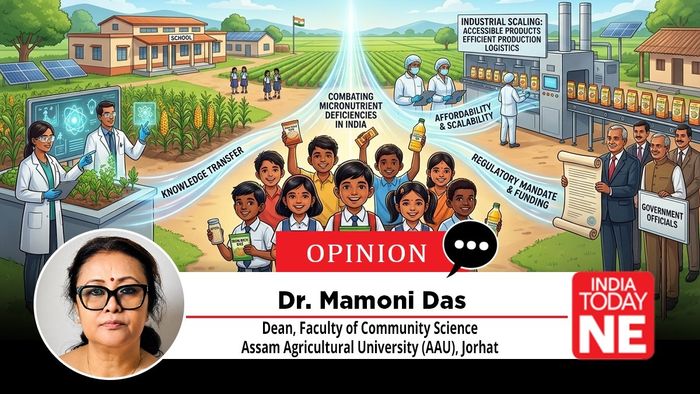
Addressing this requires more than isolated policy directives or scientific breakthroughs—it demands a collaborative ecosystem where academia, industry, and policymakers work together to transform India's food landscape.
The prevalence of deficiencies in iron, folate, vitamin A, vitamin B12, and zinc underscores the complex interplay between dietary quality, food consumption practices, and health status. Scientific research must translate knowledge on nutrient-rich foods, fortification, bioavailability, and sustainable food systems into solutions that are safe, affordable, culturally acceptable, and scalable. Industry converts innovations into accessible products, while policymakers provide regulatory frameworks for population-level impact.
The Power of Partnership: Linking Research to Policy and Industry
Agricultural universities like Assam Agricultural University are uniquely positioned at the heart of this ecosystem. With expertise spanning in farming systems, food processing, nutrition, etc., they understand local food systems, cropping patterns, and dietary cultures. In biodiversity-rich Assam, indigenous cereals, pulses, leafy vegetables, fruits, and small indigenous fish have traditionally supported healthy diets. This agrobiodiversity represents an underutilised asset in India's fight against hidden hunger.
Studies on ricebean, composite flour formulations, small indigenous fish such as Amblypharyngodon mola, traditional fermented foods and other underutilised food resources are examples of this approach. Small indigenous fish, for instance, are traditionally consumed in many communities and can contribute important nutrients to the diet. Scientific studies help us understand their nutritional value and explore ways in which such familiar foods can be promoted as part of diversified and nutrient-rich diets.
However, good science confined to academic journals does not solve hidden hunger. The food industry brings scale, distribution networks, and consumer insights. Policymakers provide regulatory frameworks and reach through massive public programmes like ICDS, PM POSHAN, and the Public Distribution System. The National Conclave on Food Fortification, organized by PATH and AAU, exemplified this collaboration, bringing together researchers, policymakers, and industry professionals to translate findings into scalable, industry-ready technologies.
For Assam and the North-Eastern region, rich in food biodiversity, this partnership offers extraordinary opportunity. Purple and red rice with their anthocyanins and bioactive compounds, traditional fermented foods like *apong*, ethnomedicinal plants, and underutilised agricultural resources are part of a rich heritage. With the right combination of science, entrepreneurship, and policy support, these resources can become part of a new generation of nutrition solutions.
The journey from local food resource to scientific evidence, from evidence to innovation, and from innovation to public health impact cannot be undertaken by any one institution alone. It requires trust, dialogue, and shared responsibility. Academia must remain connected to real-world needs; industry must invest in evidence-based innovation; policymakers must create pathways for validated solutions to reach those who need them most.
A Shared Responsibility for a Healthier Future
The path forward requires joint research projects, translation platforms, public-private advisory councils, and shared databases on food composition. We need stronger regulatory frameworks, investment in monitoring and evaluation, and greater consumer awareness to ensure nutritious foods are accepted and consumed. Nutrition education, food innovation, and implementation research must receive greater investment so that scientific advances translate into healthier diets.
Ultimately, combating micronutrient deficiencies is not simply about adding more nutrients to food. It is about making better use of the foods, knowledge, and biodiversity that already exist around us, while applying modern science to improve nutritional value, safety, and accessibility. When academia, industry, policymakers, and communities work together, research becomes a force for healthier people, stronger food systems, and more sustainable livelihoods.
India possesses remarkable diversity of indigenous foods, traditional knowledge, and scientific capability. The question is not whether we have resources to address hidden hunger, but how well we can bring them together into solutions people can actually use. Our indigenous rice varieties, small fish, fermented foods, and underutilised plants are not remnants of the past—with careful scientific study and responsible innovation, they can become part of the future of nutrition.
The fight against hidden hunger is about changing how we think about food itself—from filling the stomach to nourishing the body; from focusing only on calories to valuing dietary diversity; from treating indigenous foods as traditional resources to recognising them as drivers of modern nutrition innovation. Nutrition security is achieved when families can access food that is safe, affordable, diverse, and culturally acceptable. Reaching that goal requires science, trust, collaboration, and a willingness to learn from both modern research and traditional knowledge.
If we bring together academia, industry, policy, and communities, India's rich food heritage can become a powerful resource for addressing hidden hunger—ensuring that food on our tables nourishes children, strengthens families, supports farmers, and builds healthier lives for generations to come.