Why Majuli still resists the noise of modernity
Some places are reached by roads, others by readiness of mind. Majuli belongs to the latter, where faith, memory, and restraint shape a way of life rather than a destination.
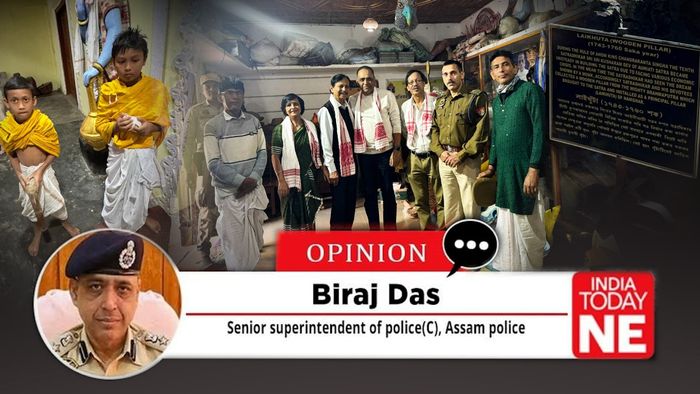
- Jan 03, 2026,
- Updated Jan 03, 2026, 8:41 PM IST
My visit to Majuli in December 2025 was official in purpose, yet deeply personal in experience. It was my first visit to Majuli, even though it lies close to my hometown Dergaon, when compared to many other places in Assam. Proximity, however, is not always measured in kilometres. Sometimes it is measured in time, memory, and the readiness of the mind to receive a place.
I reached Majuli from Duliajan via Dibrugarh on 22 December, crossing the mighty Bogibeel Bridge for the first time in my life.
That crossing stayed with me long after the vehicle moved ahead. The Brahmaputra flowed vast and unhurried beneath, the sky stretched endlessly above, and the road moved forward with quiet certainty. It felt symbolic, almost instructive. Some journeys are not meant to impress the eyes. They are meant to awaken the mind and steady the soul.
As the vehicle moved from Amolapatty, Dibrugarh, towards Bogibeel Bridge, crossing the sacred stretch locally known as “Ai Thaan” in Dibrugarh, something stirred deep within. Ai Thaan refers to spiritually important sites, particularly the historic Koli Aai Than, associated with Ahom-era beliefs and the worship of a revered female deity. It is a place where faith has endured centuries of change, holding its ground silently.
What arose there was not excitement. It was a memory. A sudden, inexplicable thrill ran through my heart, the kind that arrives without warning and leaves silence behind. Stories had been heard since childhood that my grandmother, Late Gangeswari Das, and Late Lohit Kakati had solemnised their “Gandharva Vivah” at this very place.
Society had not been kind to that decision. My grandmother, in particular, faced many consequences throughout her life for listening to her inner calling rather than social approval. Those consequences were not momentary. They followed her quietly for years, shaping circumstances, relationships, and silences. Criticism, judgement, and isolation were borne without protest. Standing there decades later, her presence was felt not as sorrow, but as resilience. It felt as if the place itself carried echoes of courage, choice, and quiet defiance.
History itself stands as witness that such unions are not unusual. Even in the great epic, King Dushyanta and Shakuntala faced consequences after a Gandharva Vivah. Society often remains silent when someone suffers, yet becomes harsh and vocal when a person chooses to follow the voice of the soul. While crossing Ai Thaan, it felt as if my grandmother’s courage had flowed silently through generations, much like the Brahmaputra itself. Calm on the surface, powerful underneath, bearing consequences without losing direction.
Crossing the “Nagakhelia Gaon” playground brought another layer of memory. A childhood moment returned from a time when I was barely four years old. There had once been a visit to watch a cricket match with a few seniors from Amolapatty, Dibrugarh. A part of early childhood, up to Class IV, was spent in Dibrugarh. That forgotten image surfaced suddenly, as if time itself had paused, turned back, and gently touched the shoulder.
After crossing Bogibeel, a social visit was made to “Sripani, Ghai Deurigaon” under Sisiborgaon Police Station of Dhemaji district. One of my close friends, Harilal Shankar, belongs to this village. Though he now resides in Guwahati for livelihood, his ancestral home remains alive with warmth. His sister lives there with her son, daughter-in-law, and grandchildren, holding together generations under one roof.
The welcome received there cannot be described merely as hospitality. Clean air, open skies, and surroundings untouched by hurry defined the place, far removed from urban hullabaloo. Lunch was already prepared on arrival. Organic vegetables, simple non-spicy recipes, and careful hands came together to serve the meal. What was placed before us was not just food. It felt like prasad. There was no display, no excess, no attempt to impress. Only sincerity, affection, and quiet joy. In that moment, it became clear that this simplicity is the true wealth of rural Assam, untouched by artificial refinement and free from unnecessary consequences of excess.
From “Misingbazar Chowk”, travelling through the Bogibeel–Majuli END Road, we reached “Mili Tinali” in Majuli. Inspector Debajit Hazarika, along with his subordinate officers, was waiting and guided us to the Police Guest House. Gratefulness is due to Inspector Debajit Hazarika not only for coordination, but also for thoughtfully arranging the visits to the satras, which shaped the most meaningful part of the journey. I also remain thankful to SSP Shri Horen Tokbi, APS, for his kindness, cooperation, and considerate hospitality throughout the stay.
Two nights were spent in Majuli, and departure followed on the morning of 24 December 2025. Alongside official responsibilities, there was an opportunity to experience what truly defines Majuli, its spiritual institutions, its people, and its way of life. Majuli today may be physically connected by road, but in spirit it still carries the essence of a river island. It remains distinct. It moves at a rhythm that modern speed has not yet managed to disturb completely, though the pressures of time and development are beginning to leave their consequences at the edges.
Among everything experienced, the satras left the deepest impression. These institutions are not merely centres of worship. They are living schools of culture, discipline, art, philosophy, and restraint. Faith here is not delivered through sermons alone. It is transmitted through daily conduct, silence, routine, and service.
To understand Majuli, one must understand the spiritual movement that shaped Assam itself. The satras trace their origin to Srimanta Sankardev, the Mahapurush who transformed Assamese society through the Neo-Vaishnavite movement. Along with his foremost disciple Madhabdev, Sankardev laid the foundations of a spiritual path rooted in devotion, inner discipline, equality, music, art, literature, printing, and textile traditions. The creation of the “Brindavani Bastra” stands even today as living evidence of this civilisational depth.
The Ahom kings, particularly during the later period, recognised the moral and cultural strength of this movement. Royal patronage allowed satras to flourish, making them centres not only of religion, but also of education, social reform, theatre, literature, and music. Majuli gradually emerged as the spiritual heartland of this tradition, where faith was preserved not in stone monuments, but in living practice, protected from the harsh consequences of power struggles and temporal politics.
The visit to Samaguri Satra was unforgettable. The masks created there are not merely artistic objects. Nobody has seen the divine physically, yet the depiction of the divine through these masks is so profound and soothing that I am in acute shortage of vocabulary to express the feeling. Seeing the “Dashavatara” of Lord Vishnu in mask form was overwhelming. Each mask acts as a storyteller, carrying expressions of myth, devotion, and collective memory drawn from the Ramayana, the Mahabharata, and traditional Assamese Bhaona.
Watching the artisans work felt like witnessing meditation in motion. There was no urgency, no distraction. Only hands moving with purpose and eyes filled with quiet concentration. Art here is not separate from prayer. Art itself becomes prayer, free from commercial consequences and untouched by performance anxiety. Gratitude is due to SI Dreamy Saikia for suggesting the visit to “Samaguri Satra”, which added immeasurable depth to the journey.
By good fortune, I also met Prasanta Bordoloi along with his family and friends. A respected figure in Assamese modern music, his presence felt symbolic. It reminded me that the cultural lineage of Assam still lives through individuals who quietly carry forward its ethos. Conversations there did not compete with time. They flowed naturally, layered with shared memories, mutual respect, and an unspoken understanding of responsibility towards heritage and its consequences if neglected.
Equally moving was the visit to “Auniati Satra”, one of the most influential satras of Assam, historically supported by Ahom royalty. As evening approached, the atmosphere transformed. Light softened. Silence deepened. Then prayers began. Young disciples played the doba, tal, and bahi tal in perfect rhythm. The recitation of Hari Naam filled the air. It did not feel like sound entering the ears. It felt as if it rose from within the heart, gently touching the soul.
Goosebumps followed, not due to emotion alone, but due to recognition. Recognition that this form of devotion is not performed. It is lived. Discipline, simplicity, and humility reflected years of internal training. There was no display, no attempt to impress, no fear of consequences. Only devotion expressed through balance and restraint, exactly as envisioned by the Mahapurush.
In that moment, it became clear why Majuli is not merely a geographical name. It is a spiritual space. Nature here does not stand separate from prayer. The river, the sky, the trees, the satras, and the people exist in quiet harmony. At times, it feels as if this environment has been preserved by someone from a different dimension, silently ensuring that balance is not entirely broken. This is metaphorical, yet the feeling remains deeply real.
Life in Majuli moves slowly, yet it is never stagnant. Each movement has meaning. Each silence carries depth. The residents live with dignity and calm acceptance. Faith here is not loud. It does not seek validation. It is present in behaviour, speech, and the way strangers are welcomed. Simplicity here is not lack of resources. It is a conscious choice, born from understanding the long-term consequences of imbalance.
Majuli teaches that simplicity is not absence. It is an abundance of clarity. Spirituality is not an escape from life. It is deeper engagement with it. Nature is not something to be conquered or controlled, but something to be listened to patiently.
During the stay, it became evident that Majuli does not impose itself on visitors. It does not demand admiration. It allows settling, slowing down, and observation. Noise carried within gradually dissolves. Openness, when present, receives insight in return.
When departure finally came, official notes and responsibilities were carried back, as duty demands. But more importantly, something less visible travelled along. Silence that spoke without words. Memories that felt older than the self, yet deeply personal. A renewed sense of faith emerged, not in ritual alone, but in human resilience, discipline, and quiet goodness, developed through lived spirituality and its consequences over generations.
The teachings of Mahapurush Sankardev remind us that spiritual power is not abstract. It has an immense influence over the human mind and body. Legends speak of how the Mahapurush could swim across the mighty Brahmaputra even during floods. Such acts do not rely on physical strength alone. They require mastery over fear, breath, and mind. That mastery can only be attained through deep meditation, steady practice, and spiritual discipline, where the consequences of distraction no longer dominate.
True spirituality, as taught by the Mahapurush, trains the mind to remain steady when the body trembles, and calm when the world turns chaotic. This inner strength allows humans to transcend limitations that otherwise appear impossible.
Some places impress instantly and fade quickly. Others do not announce their impact. They remain within, working slowly, reshaping thought and perspective over time. Majuli is one such place.
It is not just a destination connected by roads and bridges.
It is a living classroom of the mind and soul.
It reminds us that spirituality holds immense power over human thought, fear, and endurance.
When the mind is trained, the body follows.
When the soul is anchored, even a raging river becomes crossable.
Experiencing the overall ambience of Majuli finally clarified why it is said,
“Bhakati Bhagawantor Mul.”