Why NEET-style paper leaks thrive beyond poor exam security
India's recurring exam paper leaks may be more than a failure of security—they could be a symptom of a much deeper economic crisis. This piece argues that unless the country tackles the forces driving desperate competition for a handful of jobs and degrees, the leaks will keep returning.
- Jul 08, 2026,
- Updated Jul 08, 2026, 2:56 PM IST
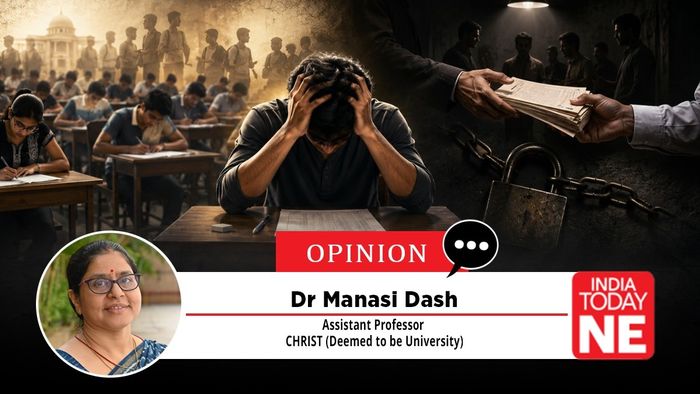
Over the past two decades, 45 cases have been linked to exam paper leaks, of which only two have led to convictions. The recent shock came on May 15 with the retest on June 21 of the medical entrance exam (NEET-UG 2026) due to alleged irregularities in the examination process conducted on May 3, 2026. There are lots of discussions on institutional gaps surrounding the problem. Lack of accountability and transparency, weak security measures, inadequate monitoring and auditing, presence of insiders, gaps in cybersecurity, delayed legal enforcement, strong cheating network, and corruption are among the few highlighted reasons for the paper leak.
Now the worrying question is, "Has the supply of question paper created the demand,” or “Demand for question paper has created the supply”. Although the first one is supported by Say’s Law in economics, the second one seems to have higher weight here. According to Sutton (2010), “Most burglars and other prolific thieves steal to raise money, and to do so they need to sell whatever they steal. To obtain money by stealing things, the prolific and relatively ‘successful’ thief must routinely complete two objectives without getting caught. The first objective is to steal valuable items. The second objective is to sell or trade the stolen goods”. It clearly implies two kinds of crimes, one attached to the supply of QP, and the other associated with the buyers. Though both are equally responsible, usually more focus is given to the first one. If these kinds of crimes need to be prevented, then policymakers have to focus on both sides. Out of different preventive efforts, focusing on “hot products (those consumer items that are most attractive to thieves)” is one critical measure (Clarke & Webb, 1999). Hot products attract theft as their demand is very high.
In the Indian scenario, 56.2% of the workers are self-employed, 23.6% are regular salaried employees, and 20.2% are casual workers. If we look into industry-wise distribution, 43% are in agriculture (PIB,2026). The overall unemployment rate among persons aged 15 years and above is 5.2% (PIB, 2026). But, approximately 80% of the employment happens in the informal sector with very minimal or no job security. As per IMF data, the per capita income in India is 2810 USD, whereas the world average is 15680 USD. In this economically stressful environment, an average Indian aspires his/her child to be financially secure in future.
As per the State of Working India (SWI), 2026 report, the transition from education to employment remains a major challenge, particularly for graduates. Around 40% of the Indian graduates are unemployed, and only a small share secure stable salaried jobs within a year of graduation. The report also mentioned that financial barriers continue to restrict access to higher education, particularly in professional fields such as engineering and medicine. Moreover, unless one has graduated from a reputed institution, the chances of getting a job become very limited. This creates the demand for getting into medical, IITs, reputed institutions, and government jobs, etc., making them ‘Hot products’. The 45 cases of examination irregularity are an outcome of this demand.
If we focus on solutions, such as making the examination more secure and digitised, it will be a short-term fix. But if policymakers are really interested in uprooting this problem, then the focus should be on job creation across different sectors. It's high time to focus on manufacturing and vocational education along with services.
It is observed that economic development follows a sequence of agriculture-manufacturing-service. But in the case of India, service took priority over manufacturing. Comparing the employment in the service and manufacturing sectors between 1999-2000 and 2009-10, Ramaswamy & Agrawal (2012) suggested that India needs to focus more on manufacturing for large-scale employment, as it carries stronger backward linkages with the potential to grow as fast as services.
Indian government realised it and started ‘Make in India’ in 2014. Under this, multiple initiatives are taken, among which the Indian semiconductor mission is a critical step. As rightly pointed out by NITI Aayog (2026), the biggest strategic risks to Viksit Bharat are a growing dependence on imported black-box technologies, especially semiconductors, which are used in almost everything. India Semiconductor Mission (ISM-1) started in 2021, and ISM-2 is proposed. India took more than a decade to decide where to focus more, which has created a massive increase in the number of educated unemployed.
In such a scenario, the demand for a secure job and a professional degree carries paramount importance. The crowd in front of any coaching centre (training for competitive exams related to Govt jobs as well as medical and engineering) speaks for itself. In this process, a young mind is being trapped from multiple directions. Apart from financial and emotional sufferings, the students as well as parents receive a lot of setbacks from society when they fail in the exam.
All these social and economic factors lead to a high demand for the question papers, and criminal activity is triggered. The ability to buy these papers is not the main concern. The supply lies in the hands of a few who have access to information and the availability of QP.
The probability of getting caught is less in the case of a buyer than a seller. This could be the reason why the buyer takes the risk. These two parties buy and sell, but the whole country suffers. Undoubtedly, both groups need serious punishment. But only legal punishment will not be enough to resolve the matter; all the stakeholders need to understand their ethical responsibility and act proactively.
There is an urgent requirement to revisit the policies, putting immense effort into their success so that the country becomes independent and job opportunities are diffused across all sectors. This may reduce the overconcentration of demand in a few govt jobs and professional degrees. A significant demand reduction may stop the supply of the stolen goods.
References:
Clarke, R. V. G., & Webb, B. (1999). Hot products: Understanding, anticipating and reducing demand for stolen goods (Vol. 112, p. 999). London: Home Office, Policing and Reducing Crime Unit, Research, Development and Statistics Directorate.
Ramaswamy, K. V., & Agrawal, T. (2012). Services-led growth, employment and job quality: A study of the manufacturing and service sectors in urban India. Indira Gandhi Institute of Development Research, Mumbai.
Sutton, Michael. Stolen Goods Markets. US Department of Justice, Office of Community Oriented Policing Services, 2010.
https://publications.azimpremjiuniversity.edu.in/6848/1/SWI%202026%20-%20Web.pdf
https://www.pib.gov.in/PressReleasePage.aspx?PRID=2246009®=3&lang=1
https://www.pib.gov.in/PressReleasePage.aspx?PRID=2261386®=3&lang=1