Will Manipur's Next Generation Inherit Peace or Pain?
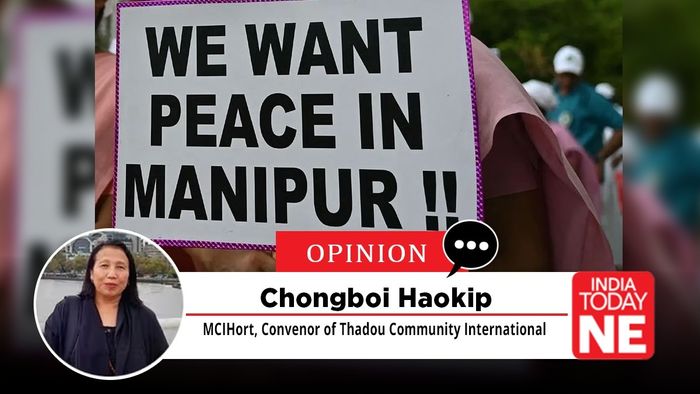
For more than three years, the children of Manipur have been growing up inside a storm none of them chose. As someone born and raised in this state, I cannot stay silent while watching an entire generation absorb lessons that no parent ever set out to teach. Every life lost in this conflict is not only a private grief for one family — it is also a quiet lesson handed down to every child who is watching how the grown-ups around them choose to respond.
- Jun 15, 2026,
- Updated Jun 15, 2026, 6:26 PM IST
The Church of God should condemn any form of violence, and promote love and peace – Rev. Dr. V. Sitlhou – last comment on the Thadou Tribe group (Facebook), dated 24 April 2026.
For more than three years, the children of Manipur have been growing up inside a storm none of them chose. As someone born and raised in this state, I cannot stay silent while watching an entire generation absorb lessons that no parent ever set out to teach. Every life lost in this conflict is not only a private grief for one family — it is also a quiet lesson handed down to every child who is watching how the grown-ups around them choose to respond. The question we now face is simple, but it will define the next fifty years: will today's children inherit peace, or will they inherit our pain?
The Weight of What the Young Have Already Inherited
Irrespective of ethnicity, behind every reported act of violence is not just a grieving family, but sons, daughters, nieces, and nephews who will carry that memory for the rest of their lives. For instance, Rev. Dr. Vumthang Sitlhou (V. Sitlhou), a highly respected Thadou pillar working tirelessly for peace, was killed in an ambush alongside two other Thadou pastors — a loss that left children in his community, and well beyond it, asking questions no child should ever have to ask. Not long after, six Naga brothers were brutally killed, and of course, there are other victims too, adding another wound to a state already struggling to breathe. These were not abstract casualties of "conflict." They were people whose life's work was to build, to heal — and the gap left by their absence is one the next generation will feel for decades to come.
That same night on the ambush, many of us could not sleep. Grief travelled across oceans and mountains, reaching Thadou families worldwide who mourned together even from a distance. In that darkness, the words of Isaiah 41:10 (NIV) brought comfort: "So do not fear, for I am with you... I will strengthen you and help you." It is a promise worth passing down — not fear, but strength; not despair, but help that is always near, even when the night feels endless.
The last comment - I came across from (L) Rev. V. Sitlhou on the Thadou Tribe group (Facebook), dated 24 April 2026 - "The Church of God should condemn any form of violence, and promote love and peace!" Nothing is impossible for God, who prompted me to appreciate Rev. V. Sitlhou’s comment on the 12th May, just before his fateful day – am unsure if he ever read my reply, and will know only in God’s perfecttime. When I woke up the next morning and saw his name among those ambushed, I struggled to understand what had happened.The Lord comforted me through 2 Timothy 4:7 NIV - “I have fought the good fight, I have finished the race, I have kept the faith.”
Children need truth, not silence or premature ethnic blame. A transparent and impartial investigation is essential for lasting peace, as without truth and justice, grief turns into suspicion and long-term division.
No Child Should Grow Up Watching Their Identity Disappear
Children learn who they are partly by watching whether the wider world respects who their family says they are. The right of communities like the Thadou to define their own identity, language, and institutions — without that identity being absorbed, erased, or relabelled by others — is not a small or symbolic matter. To grow up being told, by people outside your own community, what your name should be, or history belong to, is its own quiet wound, even where no physical violence is involved. Children notice when their community's name is treated as something that can simply be reassigned.
Respecting each community’s right to self-identify is a fundamental expression of dignity and essential to lasting peace. True peace embraces diverse identities rather than erasing them, and it is a value that future generations should inherit and uphold.
What Will We Pass On: Peace or Pain?
True peace is not the same as appeasement, and it cannot simply be handed to children as a slogan. It does not mean silence in the face of pain or injustice. It means honesty about the past, room for grief and accountability, and a shared commitment that today's suffering will not become tomorrow's excuse for more violence.
For over three years, the voices pulling toward continued conflict have often been louder than the voices pulling toward peace — and children hear both. But history reminds us that no conflict, however bitter, lasts forever. The World Wars ended. Civil wars once thought permanent eventually gave way, imperfectly but really, to coexistence. Manipur's conflict will end too. The only real question is how much more will be lost before that day comes — and whether what is left behind will look more like peace, or more like an open wound passed quietly from one generation to the next.Peace requires the courage to reject revenge, break cycles of violence, and reach across divides. By modelling this courage, communities can inspire future generations to choose reconciliation over fear and retaliation.
Let Children Inherit Clarity, Not Confusion
The Thadou community's call for recognition is not a new demand born of the current conflict — it is a question with deep roots, one that today's young people deserve to see answered clearly rather than inherited as unfinished business. As far back as 1997,Thadou organisations opposed being grouped under “Any Kuki Tribe,” arguing that distinct languages, customs, and histories deserve recognition on their own terms, and warning that blurred categories could store up tension for the future. Nearly three decades on, that warning has proven painfully accurate. The Thadou community traces its presence in the Manipur's first census in 1881. Children deserve to grow up knowing their community's name is not something left for others to decide.
Thadou Convention Guwahati, 2024 - Thadou is a distinct ethnic group of people. Thadou is not Kuki, or underneath Kuki, or part of Kuki, but a separate, independent entity from Kuki. Any organisation, individuals or elected representative that incorporates "Thadou" but espouses Kuki and mis-portrays Thadou as Kuki or a part of Kuki is illegitimate and does not represent Thadou people and interest.
When Tokens Replace Trust, Children Learn the Wrong Lessons
It is encouraging to meet people who already understand that Manipur is home to far more than three broad ethnic groups -"Kuki, Meitei, Naga”, but a multi-ethnic state with more than thirty distinct ethnic communities. However convenient, it erases smaller communities and hides large parts of the state's social fabric — and it teaches children a simplified map of their own home that leaves many of their neighbours invisible. Healing for the next generation means accepting for the sake of our future generations, as it is a multi-ethnic state.
And of course, leadership should be based on competence, integrity, and service to all, not ethnicity, as merit-based representation promotes unity while token allocation risks division.It questions whether ethnic-based political appointments—such as deputy chief ministers and even the chief minister—are necessary or appropriate in a state with many diverse communities, suggesting this approach may be inconsistent and problematic given the number of ethnic groups involved.
Stopping the Cycle Before It Reaches the Next Generation
For many families in Manipur, faith remains the bedrock from which the call to peace springs, and it is often through faith that children first learn what forgiveness looks like in practice. "Blessed are the peacemakers, for they will be called children of God" (Matthew 5:9). "Love your neighbour as yourself" (Matthew 22:39). These are not gentle, sentimental teachings — they are among the hardest instructions ever given, because they ask us to extend love precisely where we have every human reason to withhold it.
Mr. Haominlun Sitlhou, son of the late Rev. Dr. V. Sitlhou, has forgiven those responsible for his father's death — a remarkable act that reflects his father's legacy and offers young people a living example of what reconciliation can look like in practice. At the same time, forgiveness by individuals does not remove the government's responsibility to bring those responsible to justice. Our communities cannot be truly safe — and our children cannot truly feel safe — while those responsible for these killings remain free.The focus should be on breaking the cycle of violence without forgetting past wrongs, choosing reconciliation that prevents further loss of life for future generations.
Reflection — Peace or Pain, the Choice Is Ours
Children across Manipur are closely observing how adults speak about other communities, and they will either inherit the conflict or the decision of the current generation to end it.
May God bring healing to every heart in Manipur — to those grieving loved ones, those living in fear, and those burdened by anger or guilt. May the truth surrounding every act of violence, including the killing of Rev. Dr. V. Sitlhou and others, be fully revealed through honest investigation. May each community’s right to its identity, language, and faith be respected. And may the people of Manipur, in all their diversity, find the courage to move toward one another rather than apart — holding the future of their children above the pain of the past.
Can development projects bring sustainable development when basic security and the protection of life remain major concerns?Let this generation be the one that chooses peace, so that the next generation never has to inherit the pain!
For I know the plans I have for you,” declares the Lord, “plans to prosper you and not to harm you, plans to give you hope and a future – Jeremiah 29: 11 NIV.
Statement: I do not support illicit poppy cultivation. I support sustainable alternatives that strengthen society and help affected farmers in Manipur. I stand firmly behind the Manipur Government's "War on Drugs" campaign. As a strong, united community, we must work alongside government agencies that are helping farmers abandon illegal poppy farming. We, the people of Manipur, can eliminate unlawful poppy cultivation through collective effort. I call upon the entire Manipur community to unite as one team in this fight against illegal cultivation of poppy, working together to create sustainable livelihoods and a healthier future for all.
About the author: Chongboi Haokip, MCIHort, is an international development consultant specialising in agriculture, horticulture, trade facilitation and sustainable development. She can be reached at chongboi4community@gmail.com.Join me on X @ChongboiUK.