BJP leaders criticise opposition over women’s reservation bill, highlight impact on states like Sikkim
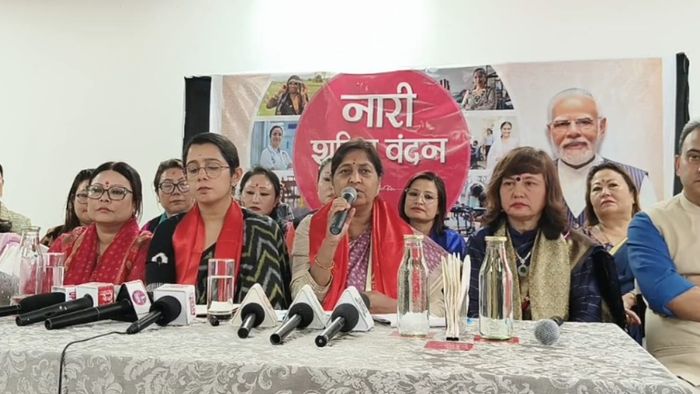
Senior leaders of the Bharatiya Janata Party (BJP) and its youth wing addressed a press conference in Sikkim, where they criticised opposition parties over the failure to move forward on the Women’s Reservation Bill. They said the developments in Parliament had disappointed women across the country and raised concerns about political priorities.
- Apr 19, 2026,
- Updated Apr 19, 2026, 6:38 PM IST
Senior leaders of the Bharatiya Janata Party (BJP) and its youth wing addressed a press conference in Sikkim, where they criticised opposition parties over the failure to move forward on the Women’s Reservation Bill. They said the developments in Parliament had disappointed women across the country and raised concerns about political priorities.
Speaking at the press conference, BJP Yuva Morcha National Vice President Neha Joshi said that Sikkim presents a strong example of women’s participation in the workforce. She said that nearly 40 per cent of the labour force in the state consists of women, which is higher than the national average. She added that despite such progress at the grassroots level, women continue to face challenges in getting fair representation in decision-making bodies.
Joshi said April 17 could have been an important day for the country if the necessary steps for implementing the Women’s Reservation Bill had moved ahead. However, she alleged that opposition parties diverted the discussion away from women’s issues and instead focused on topics like regional and religious divisions. According to her, this shift weakened the purpose of the debate.
She also criticised the conduct of some opposition leaders in Parliament, stating that their reactions after the bill did not go through were not appropriate. She claimed that such actions sent a wrong message to women who are expecting more opportunities in politics.
Rajya Sabha Member of Parliament Seema Dwivedi also spoke at the event and shared her personal experience in politics. She said she started her political journey at a young age and has seen repeated discussions on women’s reservation over the years, but implementation had always been delayed.
Dwivedi said that when the bill was passed in 2023, it brought hope to many women. However, she expressed disappointment over the recent developments and alleged that opposition parties worked together to block further progress. She said that women voters play a major role in elections and deserve equal participation in governance.
She explained that the process of implementing reservation depends on the completion of a national census and a delimitation exercise. According to her, these steps are required under the Constitution before any changes in seat allocation can take place. She added that the government has indicated that women’s reservation could be implemented by 2029 once these processes are completed.
Dwivedi also raised the issue of representation, noting that India’s population has increased significantly over the decades, but the number of seats in Parliament has remained the same. She said this affects proper representation, especially in constituencies with very large populations.
Referring to the situation in smaller states, Joshi said that regions like Sikkim may also be affected due to the current situation. She said that if the proposed changes had moved forward, there could have been more opportunities for women from such states to enter legislative bodies.
The leaders also clarified that bringing an ordinance to implement the bill is not possible, as constitutional amendments require a specific process. They said that any changes must follow the framework laid down in the Constitution, including census data and delimitation by a commission.
Dwivedi further said that the bill was meant for all women across parties and communities. She alleged that some women leaders in opposition parties may have opposed it due to party instructions rather than personal views.
Addressing concerns about delimitation, Joshi said that the Constitution allows the Delimitation Commission to consider factors beyond just population. She said similar decisions were taken in the past to ensure balanced representation among states.
The BJP leaders said that the issue has now become important for women across the country, who are closely watching political developments. They expressed hope that the matter will move forward in the future within the constitutional framework.