Sikkim signs MoU with BHASHINI to deliver government services in local languages
The Sikkim government on Wednesday, August 19 signed a Memorandum of Understanding (MoU) with the Digital India BHASHINI Division under the Ministry of Electronics and Information Technology to make government services more accessible in local languages, initially focusing on Nepali, Bhutia and Lepcha.
- Aug 19, 2026,
- Updated Aug 19, 2026, 6:27 PM IST
The Sikkim government on Wednesday, August 19 signed a Memorandum of Understanding (MoU) with the Digital India BHASHINI Division under the Ministry of Electronics and Information Technology to make government services more accessible in local languages, initially focusing on Nepali, Bhutia and Lepcha.
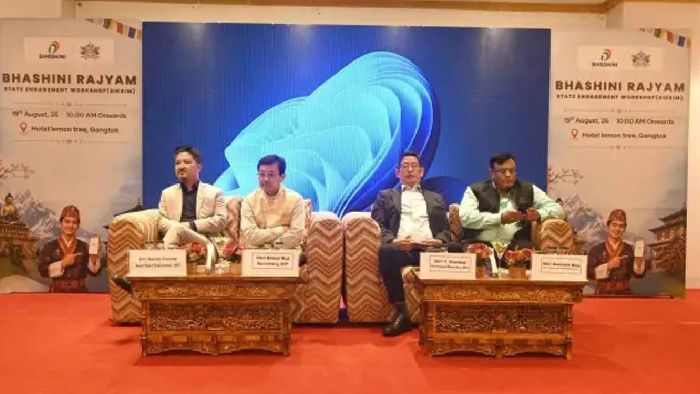
The agreement was signed during a one-day BHASHINI Rajyam State Engagement Workshop in Gangtok, organised jointly by the Department of Information Technology, Government of Sikkim, and the Digital India BHASHINI Division. The workshop brought together government officials and language experts to explore the use of Indian language technologies in governance, citizen services, research and innovation.
Chairman of the Department of IT Navraj Gurung, Secretary Bimal Rai, Principal Director T Samdup, CEO of the Digital India BHASHINI Division Amitabh Nag and Director Prem Vijay Basnet attended the inaugural session.
Gurung said the partnership would enable Sikkim to participate in India's digital transformation while preserving its linguistic identity. He said technology should enable government services to communicate with citizens in their own languages, particularly in rural and remote areas where language barriers can limit access to public services.
Rai said language had remained a gap in Sikkim's digital governance efforts despite the expansion of online services. Under the partnership, the State will initially work with BHASHINI to make official communications and forms available in Nepali, Bhutia and Lepcha, with the eventual aim of extending the initiative to public services.
He urged departments with direct citizen engagement, including Health, Education, Agriculture, Rural Development and Urban Development, to participate actively in the initiative and ensure that relevant information is available in languages understood by citizens.
Nag highlighted the role of artificial intelligence and language technology in reducing linguistic barriers to digital access. During the workshop, he demonstrated the BHASHINI platform by delivering part of his address in English while the application generated a live translation in Nepali.
He said sectors such as tourism, organic farming, pharmaceuticals, clean energy and culture in Sikkim could benefit from the technology. Nag also encouraged startups and innovators in the State to develop applications using the BHASHINI platform and urged communities to contribute to strengthening regional language datasets and models.
Basnet said the initiative had been under preparation for nearly a year and that the MoU marked an important milestone, with implementation now becoming the key focus. Sikkim will adopt a phased approach, beginning with a limited number of services in Nepali, Bhutia and Lepcha.
A dedicated team from the Department of IT will work with BHASHINI experts to train officials and build institutional capacity. Authorities will also monitor translation quality and accuracy, particularly given the sensitivity and distinctiveness of local languages. Services will be tested with users before wider rollout and refined based on feedback.
Samdup, in his welcome address, highlighted Sikkim's linguistic diversity and said the partnership could help bridge the language gap in government services by making portals, forms and e-services more accessible to people, particularly in rural and remote areas.
The technical sessions covered the BHASHINI Udyat initiative, including the National Hub for Language Technology, its architecture, application programming interfaces and integration options. Participants were also introduced to ARPAN, the BHASHINI service layer covering translation, transcription, speech-to-speech and video translation tools.
Other sessions focused on BHASHINI App Mitra, BHASHINI Mitra and BHASHINI Pravakta, with discussions on applications in education, banking, governance and entrepreneurship. Participants also explored opportunities for hackathons, research, startup engagement and greater citizen participation in developing regional language datasets.
The workshop concluded with discussions on practical use cases and a "low-hanging fruit" approach to identify areas where BHASHINI technologies could be adopted in the near term. Joint Director Ashim Tamang delivered the vote of thanks.
Officials from various State departments and language experts from the Education Department participated in the workshop.