SKM youth lead cleanliness drive on Dzongri–Goechala trekking route in Khangchendzonga National Park
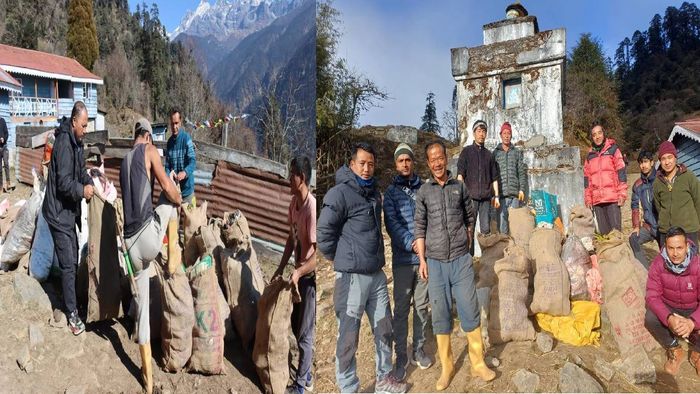
A group of young volunteers from the ruling Sikkim Krantikari Morcha (SKM) has undertaken a large-scale cleanliness drive along the Dzongri–Goechala trekking corridor inside the Khangchendzonga National Park (KNP), aiming to remove plastic waste and restore the pristine character of one of Sikkim’s most revered trekking routes.
- Dec 28, 2025,
- Updated Dec 28, 2025, 4:36 PM IST
A group of young volunteers from the ruling Sikkim Krantikari Morcha (SKM) has undertaken a large-scale cleanliness drive along the Dzongri–Goechala trekking corridor inside the Khangchendzonga National Park (KNP), aiming to remove plastic waste and restore the pristine character of one of Sikkim’s most revered trekking routes.
The Dzongri–Goechala trail, among the most popular Himalayan trekking routes, lies within the UNESCO World Heritage-listed KNP. Regarded as spiritually sacred by local communities, the region attracts thousands of trekkers from India and abroad each year. However, the increasing footfall has also led to a visible rise in plastic and non-biodegradable waste along certain stretches of the trail.
According to SKM officials, the initiative was sparked after SKM Youth President Lakpa Moktan recently trekked to Goechala and observed plastic bottles, food wrappers and other waste scattered across the alpine landscape. Disturbed by the sight, he urged local youths to take collective responsibility and address the issue on the ground.
Responding to the call, dozens of young volunteers participated in the clean-up operation, collecting large quantities of discarded plastic packaging, empty bottles and food wrappers along the route. The collected waste was later segregated and sent for proper disposal, officials said.
Observers noted that the volume of waste recovered highlights how irresponsible dumping has begun to affect even remote and protected areas. While the national park remains largely unspoiled, littering has emerged as a growing concern in high-traffic trekking zones.
Local residents attribute the problem mainly to careless visitor behaviour. Trekkers often carry packaged food and bottled water but fail to carry their waste back, leaving trash behind that harms both the fragile ecosystem and the sanctity of the trail.
Community members emphasised that the issue goes beyond environmental damage. In Sikkimese culture, mountains, rivers and forests are considered sacred, and polluting these spaces is viewed as a violation of cultural and spiritual values.
To address this, the message “Leave nothing behind but footprints, take nothing but photographs” is being promoted as a guiding principle for visitors. Local leaders stressed that responsible tourism practices are essential to preserve the region’s ecological and cultural heritage.
Additional Political Secretary to the Chief Minister of Sikkim, Tshering Wangchuk Lepcha, praised the SKM youth for their initiative, describing it as a reflection of the state’s environmentally conscious and disciplined youth. He said national parks and trekking routes are not merely tourist attractions but symbols of Sikkim’s identity, which can be protected only through responsible behaviour.
Tour operators and trekking guides have also extended support to the campaign, noting that littered trails damage Sikkim’s reputation as a clean and green destination. They called for sustained awareness drives and stricter monitoring to curb littering.
Environmental groups have welcomed the effort and urged authorities to institutionalise regular clean-up programmes. Some have advocated encouraging trekkers to use reusable bottles and bags, while others have suggested imposing stricter penalties for littering.
The Dzongri–Goechala route, often described as a crown jewel of Himalayan trekking, passes through dense forests, alpine meadows and high-altitude viewpoints offering panoramic views of Mount Khangchendzonga. For many, the journey is as much a spiritual experience as it is an adventure—one that locals say must be protected through collective responsibility.