Dolaithabi and the False Morality of “No Resettlement Without Mutual Agreement"
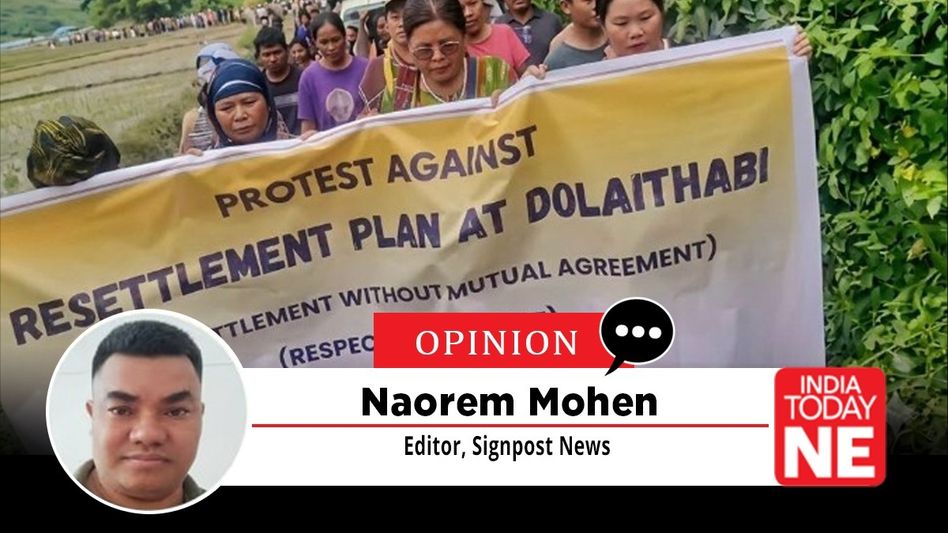
The slogan raised by Kuki Inpi Saikul against the return of displaced Meitei families to Dolaithabi must be rejected because no community has the right to convert another citizen’s homestead into a matter of ethnic negotiation. Mutual agreement cannot mean that the original inhabitants of Dolaithabi must seek political clearance before returning to their own homesteads.

- Jun 29, 2026,
- Updated Jun 29, 2026, 12:55 PM IST

The slogan raised by Kuki Inpi Saikul against the return of displaced Meitei families to Dolaithabi must be rejected because no community has the right to convert another citizen’s homestead into a matter of ethnic negotiation. Mutual agreement cannot mean that the original inhabitants of Dolaithabi must seek political clearance before returning to their own homesteads.
The protest organised by Kuki Inpi Saikul seeks to place the return of displaced Meitei families to their own homes under the approval of another community. It treats lawful return as a negotiated concession. It gives moral cover to the continued displacement of people whose houses were burned and whose village life was destroyed. This cannot be accepted.
Dolaithabi is not a new colony. It is not an expansion into another community’s land. It is not an administrative experiment. It is the native village area of displaced Meitei residents who were forced to leave during the violence that erupted in Manipur in May 2023.Along with residents of Yengkhuman, Ekou, Thangal Surung, Leitanpokpi and other affected settlements, they have remained displaced for more than two years, waiting for the State to make return possible.
On July 13, 2025, displaced residents reportedly met the Imphal East Deputy Commissioner seeking clarity on when they could safely return to their villages. The meeting failed to provide a concrete answer. Three days later, on July 16, 2025, nearly 100 internally displaced persons attempted to return towards Dolaithabi but were stopped by security forces near Pukhao Tezpur, about 2.5 km from the village, on the ground that the area remained sensitive.
Despite the restrictions and the risks involved, some IDPs managed to reach Dolaithabi by swimming across the Dolaithabi Dam to inspect the remains of their homes. They returned after seeing what was left. This was not an act of provocation. It was the desperate journey of people who had waited too long to breathe the air of their birthplace again.
After the incident, a group of IDPs again met the Imphal East DC. Speaking to the media, Rajkumar Prem, one of the displaced residents, said the DC had assured them that their safe return would be facilitated within two months. That assurance was not an ordinary administrative remark. It was given to people living with displacement, grief, uncertainty, and deep humiliation. It carried moral weight.
Prem’s words showed the depth of despair. He warned that if the assurance was not fulfilled, he would return home and take his own life. Such a statement should have shaken the conscience of the administration. A citizen should not have to threaten self-destruction to make the State act on his right to return home.
He described the devastated condition of Dolaithabi. Of the 37 to 38 houses in the village, most were reportedly burned down or demolished. Their paddy fields, he alleged, had been cultivated by Kukis. After seeing his house for the first time in more than two years, he became emotional and struggled to describe what he felt. He and others rested for a while at their birthplace, savouring the familiar air and surroundings before returning once again to displacement.
Another displaced resident, Sapam Mangol, who had been taking shelter at Sawombung relief camp, expressed disappointment at the government’s inability to facilitate resettlement. His question remains unanswered: if the government allocates funds for rebuilding burned and destroyed houses but does not allow the displaced to return, where will those houses be built?
That question strikes at the heart of the failure.
Rehabilitation cannot be reduced to paper schemes, budget announcements, and construction targets. A house is not rehabilitation if its owner cannot live in it. Reconstruction is meaningless if security forces prevent residents from reaching their village. Compensation is incomplete if land, fields, and livelihood remain inaccessible. The State cannot claim progress while citizens remain in relief camps, waiting for assurances that do not turn into action.
The reported assurance of safe return within two months from July 2025 has still not translated into effective resettlement. This delay weakens public confidence and gives space for pressure groups to frame lawful return as a negotiable political issue. The government’s inaction has allowed the language of “mutual agreement” and “buffer zones” to be weaponised against displaced families. This is why the slogan raised by Kuki Inpi Saikul must be challenged.
Where exactly are the legally declared buffer zones in Manipur? Who has the right to stop a citizen from returning to his or her own land? What kind of mutual agreement is being demanded after homes have already been burned and families have already been displaced? These questions cannot be brushed aside.
The so-called buffer zones in Manipur are not constitutional boundaries. They are not revenue boundaries. They are not new district borders. They are not legally notified ethnic frontiers. Rather, they are created by some Kuki CSOs after May 2023 to claim Meitei's land in sensitive fringe areas. This distinction is crucial.
A security buffer is meant to prevent violence. It is not meant to cancel land rights. It is not meant to create a permanent ethnic border. It is not meant to turn Meitei villages, Kuki villages, or Naga villages into abandoned zones where original inhabitants can never return. If an imaginary fictitious buffer zone begins to prevent lawful residents from returning home, then the buffer has ceased to be a security mechanism. It has become an instrument of enforced displacement.
That is why the slogan “respect buffer zones” is dangerous when used against resettlement. It converts a temporary displacement into a political claim. It implies that because security forces are deployed between communities, original residents must remain outside their homes indefinitely. This is not peace. This is the administrative freezing of violence.
The second question is even more important. Who has the right to stop resettlement on one’s own land?
The answer is clear. No civil society organisation, no ethnic body, no village group, no pressure group, and no armed formation has the right to stop a displaced person from returning to his or her own verified homestead. The only legitimate authority in such a process is the State, acting through law, security assessment, land verification, and rehabilitation policy. Even the State cannot deny return permanently. Its duty is to make return safe.
If a displaced Meitei family has legal or customary residence in Dolaithabi and the surrounding areas, its return cannot depend on the consent of Kuki Inpi Saikul. The same principle must apply everywhere. A Kuki family displaced from its home cannot be told that its return depends on Meitei approval. A Meitei family displaced from Dolaithabi cannot be told that its return depends on Kuki approval. A Naga village cannot be made hostage to competing ethnic claims. Citizenship cannot be reduced to permission from another community. This is the moral failure of the Saikul slogan.
It speaks of mutual agreement, but it does not first acknowledge the prior wrong: homes were burned, people were displaced, and families were pushed into camps. What is the meaning of mutual agreement after destruction? Does it mean the displaced must negotiate with those who object to their return? Does it mean a victim must obtain approval before rebuilding a burned house? Does it mean one community can use the consequences of violence to bargain over another community’s right to residence? Such logic cannot be allowed to stand.
Mutual agreement is meaningful when communities discuss coexistence, security protocols, market access, road movement, farming arrangements, and confidence building. It is meaningful when both sides agree not to attack, not to provoke, not to harbour armed elements, and not to obstruct civilian life. But mutual agreement cannot mean that the original inhabitants of Dolaithabi and adjoining Meitei villages must seek political clearance from Saikul before returning to their own homesteads. That would be a mockery of justice.
Kuki groups have the right to demand justice for their dead, their displaced, and their destroyed settlements. Meiteis have the same right. Nagas too have repeatedly voiced their concerns over insecurity, accusations, territorial anxieties, and political manipulation. Manipur’s tragedy is not owned by one community. Pain is widespread. Loss is widespread. Fear is widespread. Justice, therefore, cannot be monopolised.
This is why slogans such as “No Peace, No Resettlement” and “Justice Before Peace” become morally hollow when they are used to block another displaced community’s return. If justice is demanded only for oneself and denied to others, it is not justice. It is selective victimhood. If peace is used as a condition to delay another family’s return home, it is not peace. It is pressure politics.
The Dolaithabi issue must be seen in this light. The displaced Meitei residents are not asking for revenge. They are asking for return. They are not demanding occupation of fields and hills from Saikul. They are asking to rebuild their own houses in Dolaithabi. They are not asking for ethnic domination. They are asking for restoration of ordinary life. Opposing such return through slogans is not a contribution to peace. It is an attempt to normalise displacement.
The State government and central security establishment must also be held accountable. If Dolaithabi remains unsafe, the government must explain why it remains unsafe after more than three years of conflict. If Kuki armed elements are present in nearby hill ranges, they must be removed. If agricultural fields of displaced families have been occupied or cultivated by others, the authorities must verify and restore possession. If houses were burned, they must be rebuilt. If roads are unsafe, they must be secured. If returnees face threats, protection must be provided. The government cannot hide forever behind the word “sensitive.”
A sensitive area still belongs to citizens. A fringe village still has lawful residents. A relief camp cannot become a permanent substitute for home. A security arrangement cannot become a silent reward for those who created displacement.
Dolaithabi is now a test of whether Manipur will permit violence to redraw settlement patterns. If the displaced residents are not allowed to return because another community objects, the message will be disastrous. It will mean that burning homes can produce political leverage. It will mean that displacement can be converted into a territorial argument. It will mean that the victim must negotiate his return while the aggressor benefits from the delay. No responsible government can permit such a precedent.
The correct approach is not reckless return without security. It is lawful return with full protection. The government must verify original residents, reconstruct homes, restore land access, deploy accountable security forces, prevent armed movement from all sides, and establish a grievance mechanism for neighbouring communities. But the destination of the process must be clear: displaced citizens must return to their own homes.
There can be dialogue on security. There can be dialogue on confidence building. There can be dialogue on preventing future clashes. But there can be no dialogue on whether a lawful resident has the right to return to his own homestead. That right is not negotiable. Kuki Inpi Saikul’s slogan must therefore be rejected in principle.
There is no legally permanent buffer zone that can extinguish a citizen’s right to land and residence. There is no ethnic veto over resettlement. There is no moral legitimacy in demanding mutual agreement after homes have been burned unless the first agreement is to accept the right of the displaced to return.
Dolaithabi must not become a symbol of surrendered governance. It must become a test case for lawful rehabilitation. If Manipur cannot restore displaced families to their own homes in Dolaithabi, every other promise of peace will sound hollow.
Justice begins with truth. The truth is simple: a burned home does not cease to belong to its owner. A displaced family does not lose its right because another community raises slogans. And resettlement in one’s own homestead is not a favour to be granted by mutual agreement. It is a right that the State is duty bound to protect.