Why Himanta Biswa Sarma endorses a painting of ULFA Chief who challenges India’s sovereignty
The question is no longer whether Himanta Biswa Sarma misspoke, but whether a constitutional office-holder can publicly elevate the leader of a banned insurgent group without consequence. Where that line lies—and who gets held to it—is now the real story.

- Jul 10, 2026,
- Updated Jul 10, 2026, 9:43 PM IST

- A botched Zubeen Garg mural repaint in Guwahati triggered public outrage
- Sarma said the revised image resembled Che Guevara, not the singer
- He then suggested artists paint ULFA-I chief Paresh Baruah instead
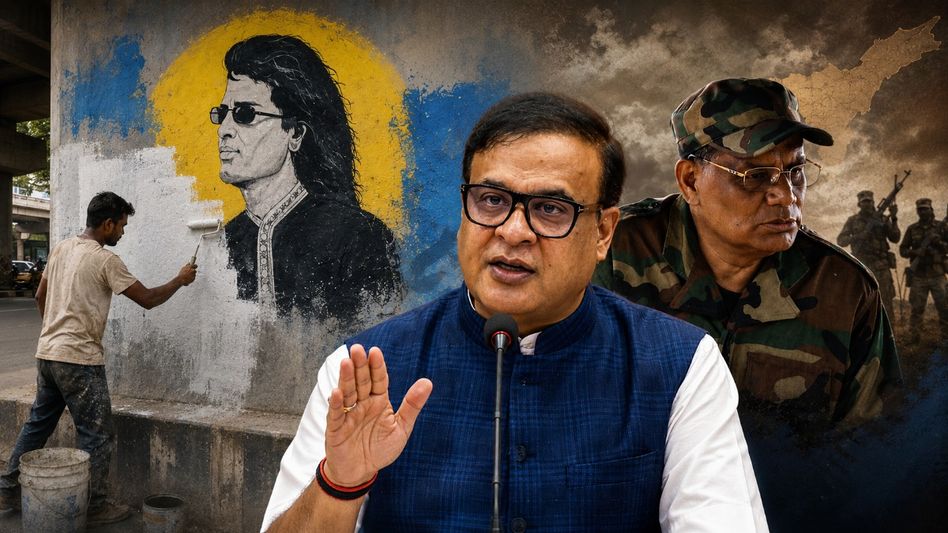
Assam Chief Minister Himanta Biswa Sarma has a new problem, and it isn't about murals. It started with a mural of singer Zubeen Garg, painted on a Guwahati flyover by an artist reportedly linked to the Students' Federation of India. During a beautification drive, workers — by Sarma's own account, Zubeen fans themselves — failed to recognise the face and partially erased it. Public anger followed. The mural was repainted. Sarma still wasn't satisfied: the new version, he said, looked less like Zubeen Garg and more like Che Guevara.
That complaint could have ended as a footnote about reference photographs and artistic license — Sarma did announce that a single approved image would now govern all future Zubeen murals, with artists barred from flyovers or facing arrest if they deviated. But he didn't stop there. He asked, more pointedly, why Guwahati's walls carry Che Guevara's face at all, given the Argentine revolutionary "has no connection with Assam." And he offered an alternative: if artists want a homegrown revolutionary to paint, they should turn to Paresh Baruah — "not Che Guevara."
That is not a name a sitting Chief Minister gets to drop casually. Baruah is the commander-in-chief of ULFA-I, the United Liberation Front of Asom-Independent, banned under India's Unlawful Activities (Prevention) Act. His organisation's founding objective is armed secession of Assam from India, and under his leadership it continues to reject the 2023 peace accord that brought ULFA's pro-talks faction into the mainstream. Baruah remains a fugitive, believed to be operating from sanctuaries outside the country. He is not, in any official sense, a revolutionary to be commemorated. He is a wanted man leading a banned insurgency.
Sarma, meanwhile, took the oath prescribed under the Third Schedule of the Constitution — a promise to "bear true faith and allegiance to the Constitution of India" and to discharge his duties "without fear or favour, affection or ill will." That oath doesn't come with an asterisk for off-the-cuff remarks at a press interaction. When a Chief Minister speaks in his official capacity, the words belong to the office, not just the individual standing behind the microphone.
Supreme Court lawyer Upmanyu Hazarika sees exactly this gap as the real story. Speaking to India Today NE, he argued that by naming Baruah as Assam's answer to Che Guevara, Sarma "effectively elevated him to the status of a revolutionary" — deserving of murals, of public memory, of the kind of visual reverence usually reserved for figures a state wants its citizens to admire. That, Hazarika says, "shows a lack of responsibility expected from a Chief Minister," and it sits oddly next to the inconvenient fact that Sarma's own government keeps ULFA-I banned under the very law that criminalises support for it. "What message is the head of the state sending out?" he asked. "That Paresh Baruah is someone who needs to be deified and glorified."
He points out, too, that the UAPA is written broadly enough to treat active incitement of support for a banned organisation as aiding and abetting its activities — which means, in his reading, the remark could arguably invite scrutiny under the very law Baruah's outfit is banned by.
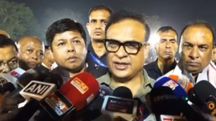
Himanta Biswa Sarma has pushed back hard against that reading. Asked about the remark, he told India Today NE: "I made it clear that we do not endorse anything Paresh Barua does. Our zero-tolerance policy towards ULFA is known to all. What I said was that we know Paresh Barua, but we do not know someone from Cuba. I never said anyone could paint his mural. I only said: do not bring Cuba into this. Anyone painting a mural of Paresh Barua will be prosecuted."
His defence, in other words, is one of framing: this was never an invitation, only a comparison — and the same law Hazarika invokes against him, he points out, is the one he'd use against anyone who took the comparison literally.
That clarification narrows the question but doesn't erase it. Sarma is right that "we know Paresh Barua, but we do not know someone from Cuba" is a different sentence than "go paint his mural" — and he's on record now saying prosecution, not celebration, would follow. But the original remark didn't arrive with that caveat attached. It arrived as a name offered in place of Che Guevara's, in a context where the entire conversation was about whose face belongs on Assam's walls. Listeners are entitled to hear what was said, not only what was meant afterwards.
The irony writes itself once you look at how the law has actually been used in Assam. In 2022, police arrested 19-year-old Barshashree Buragohain under the UAPA over a poem — a poem that never named ULFA-I, but was read by investigators as implicitly sympathetic to the outfit. If a stanza without a single reference to the organisation could draw that kind of scrutiny, it's worth asking what the same law would make of a flyover mural depicting the outfit's active commander. The state has been willing to prosecute ordinary citizens for the faintest shadow of an endorsement. Its own Chief Minister just floated one in broad daylight, on the record, to a room full of reporters.
None of this is unfamiliar territory for Sarma. He has previously called Baruah "an intellectual and educated person," offered him safe passage to spend a week in Assam, and said he speaks to him every three or four months through intermediaries — all of it framed, consistently, as outreach toward eventual peace talks. His supporters will read Friday's remark the same way: a Chief Minister trying to talk a holdout insurgent commander toward the table, the kind of engagement governments routinely undertake with adversaries they hope to eventually disarm.
But talking to an adversary in private and proposing his face for public murals are not the same act, and the distance between them is exactly where this controversy lives. One is negotiation. The other is glorification. Whether Sarma meant it as rhetorical flourish or genuine proposal may matter for how history reads his intent — it doesn't change what the words did in the room. He blurred that line himself, in his own voice, as the constitutional head of the state.