
Why Koirengei Airfield in Manipur Must Be Preserved?
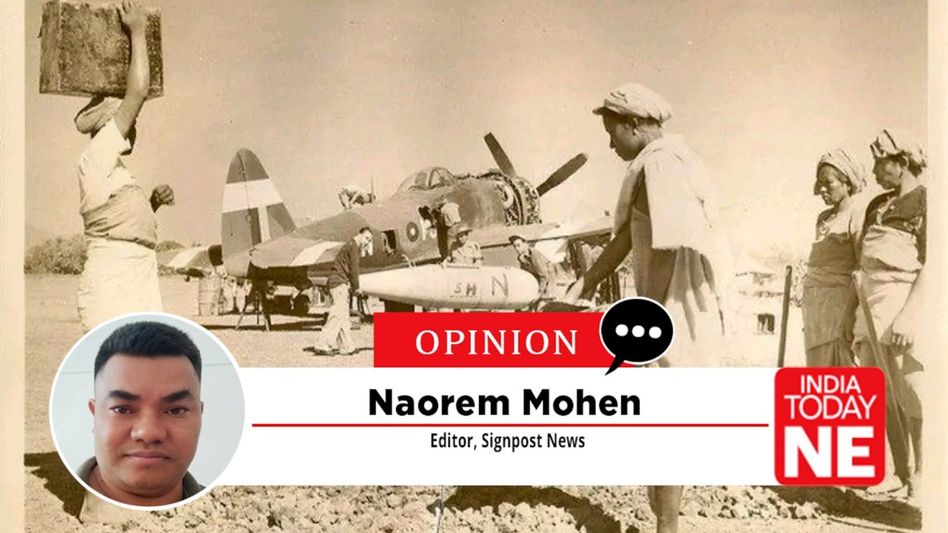
Koirengei Airfield in Manipur stands as far more than a weathered strip of tarmac on the outskirts of Imphal. For the people of Manipur, it is not just a piece of land. Rather, it is a historic World War II airfield that became operational in 1942, a living witness to global history etched into the soil of Northeast India.

- Jan 29, 2026,
- Updated Jan 29, 2026, 11:27 AM IST

Koirengei Airfield in Manipur stands as far more than a weathered strip of tarmac on the outskirts of Imphal. For the people of Manipur, it is not just a piece of land. Rather, it is a historic World War II airfield that became operational in 1942, a living witness to global history etched into the soil of Northeast India.
This site played a central role during the Battle of Imphal, served as a vital wartime lifeline through relentless aerial operations, bore witness to the harrowing Burma refugee exodus, and later emerged as a powerful symbol of Manipur’s democratic transition and integration into independent India.
It carries layered memories of sacrifice, survival, compassion, and nation-building—memories that belong not only to Manipur but to the entire nation and, indeed, to the broader narrative of the Second World War in Asia.
To preserve Koirengei is to safeguard a tangible link to these intertwined stories. However today, the airfield remains occupied by security forces and lies within a densely and thickly populated civilian area, where urban pressures, military needs, and encroaching development threaten its integrity.
This call echoes broader sentiments, including those from war historian Christopher Johnson, son of an Allied soldier who served at Imphal during WWII. Christopher has emphasized the Koirengei airfield's irreplaceable role.
He writes, "The importance of this airfield cannot be overstated, for without the Imphal Main airfield the war in south east Asia may well have had a different outcome.
For three months in 1944 this vital airfield was the only route in and out of Imphal to keep the British and Indian troops supplied with all their needs to resist the Japanese invasion of India. My father was camped at the end of the runway for six weeks as he dealt with the reinforcements being flown in before he himself was flown out to Comilla as the siege of Imphal began to bite.
It would be such a tragedy if this important piece of Manipuri heritage was lost to decay or development. I have stood at the end of this runway during one of my visits to Manipur and marvelled at the logistics involved at the time to move thousand of tons of supplies and thousands of men on this airfield.
To those in authority, I ask them to think very carefully about the future of this unique place."Johnson's personal connection, rooted in his father's experience highlights the airfield's global resonance, while highlighting the risk of its loss through neglect or repurposing.
Former Chief Minister N. Biren Singh has also passionately advocated for its protection, posting on social media: "For the people of Manipur, Koirengei Airfield is not just a strip of land, it is a historic World War II airfield that became operational in 1942 and a living witness to global history.
It played a central role during the Battle of Imphal, served as a vital wartime lifeline through aerial operations, witnessed the Burma refugee exodus, and later emerged as a symbol of Manipur’s democratic transition."
He continued with a direct appeal. "At present, Koirengei Airfield is occupied by security forces and lies within a densely and thickly populated civilian area. In this context, I respectfully urge the Hon’ble Defence Minister Shri Rajnath Singh Ji and concerned authorities to kindly hand over Koirengei Airfield to the State of Manipur and consider relocating the security forces, so that this irreplaceable historic site may be preserved as a Heritage & Memorial Landscape for future generations.
Preserving Koirengei is the preservation of India’s collective memory. Development and heritage can, and must, move together, with respect, sensitivity and vision," He added,
The urgency stems from Koirengei's multifaceted history, beginning with the human flood of 1942. Japan's rapid conquest of Burma triggered one of the largest civilian exoduses in history, with hundreds of thousands—primarily Indians, Anglo-Indians, and others—fleeing northward in the "Forgotten Long March." Administrative records like the Civil List for Burma (September 1942) list civil servants who perished, many noted as "Died at Imphal Camp."
The Imphal plain, including the nascent Koirengei site, became a chaotic transit and relief hub, processing thousands daily amid starvation, disease, and monsoon devastation. Manipur was the important gateway for nearly 190,000 refugees fleeing the Japanese invasion of Burma in 1942.
This is where history sheds its abstract detachment and becomes profoundly intimate, achingly human. In the final, grueling miles of their escape, refugees—emaciated, fever-racked, their bodies pushed beyond the limits of endurance—simply could walk no farther. Their legs buckled under the weight of starvation, malaria, dysentery, and unrelenting monsoon mud.
At that moment of utter collapse, when the jungle seemed poised to claim them forever, it was the local people of Manipur who stepped forward as literal lifelines. Men and women from the Maring, Khongjai, Tangkhul, Meitei, and other hill communities—ordinary villagers, farmers, porters, mothers, and young men—hoisted these strangers onto their backs, shoulders, or makeshift stretchers fashioned from bamboo and cloth.
They carried them mile after punishing mile, sharing scarce rice, wild greens, and water, offering shelter in their homes when possible, and refusing to abandon them even as exhaustion threatened their own strength.
These acts were not orchestrated relief efforts or official orders; they were spontaneous eruptions of compassion across ethnic, linguistic, and cultural boundaries at a time when survival instincts might have counseled self-preservation.
In doing so, Manipuri villagers became human bridges, living conduits spanning the chasm between certain death in the Burmese jungles and the fragile promise of refuge in the Imphal Valley.
Their backs bore not just bodies but the weight of an empire's collapse, the terror of invasion, and the raw vulnerability of displaced humanity.
Without these unsung carriers, the death toll of the 1942 exodus would have been far higher; with them, the journey's end at places like Koirengei became a testament to shared humanity rather than mere statistical survival.
Among the many stories whispered through generations, one stands out as particularly iconic, blending personal memory with the broader legend of resilience. A young Anglo-Burmese girl, Helen Anne Richardson—later to become the legendary Bollywood dancer and actress known simply as Helen—found herself on the treacherous Khongkhan Thana route during the flight from Burma.
Exhausted beyond words, too weak to continue on her own feet after weeks of trekking through disease-ridden paths, she was carried to safety on the back of a Tangkhul man named Robinson. This single act of kindness, performed by a stranger whose own life was already stretched thin by war's disruptions, ensured that Helen survived to reach the Imphal area, where medical care was given at the Dibrugarh hospital and eventual relocation to Calcutta awaited.
Robinson's name, like those of thousands of other helpers—anonymous porters, village women who nursed the sick, families who shared their last handful of rice—never appeared in British dispatches, military logs, or official refugee rosters.
However it lives on, etched into family lore and oral histories, and forever linked to the foundational story of a woman who would one day grace the silver screen as one of Indian cinema's most enduring icons.
For every documented or legendary figure like Helen, there were hundreds—perhaps thousands—of other souls whose final, faltering steps toward Koirengei Airfield were made possible only through the sturdy, compassionate backs of Manipuri villagers. These were not grand heroic gestures captured on film or medal citations; they were quiet, everyday acts of decency performed under the most harrowing conditions.
A mother pausing to feed a delirious child not her own; a young man shouldering an elderly refugee across a swollen stream; an entire village turning out to provide dry shelter for a night. Each instance added to a collective tapestry of mercy that turned the Imphal plain from a graveyard-in-waiting into a place of tentative rebirth.
Besides, memoirs like Kuldip Nayar's Beyond the Lines depict Imphal as an "ocean of humanity—starving, sick, dying," with the airstrip offering distant hope. Eugenie Fraser's accounts portray refugees as "human debris of empire," sorted and waiting. Amitav Ghosh's The Glass Palace evokes the "capillary action of fear" drawing people to hubs like Koirengei.
By 1944, Koirengei transformed into the strategic heart of the Battle of Imphal. As part of the Imphal-Kohima campaign—often called Britain's greatest WWII land victory—the airfield was crucial among all-weather strips (Imphal Main, Palel, Tulihal). Frank Owen's official history notes defense hinged on troop will, Slim's leadership, and these airfields.
By the end of June 1944, the Allies had evacuated roughly 43,000 noncombatants by air from the Imphal Valley. Many of these aircraft flew to and from airfields in upper Assam, such as those near Dibrugarh (like Dinjan) and Dimapur, which acted as the logistics and medical rear for the Imphal front.
Robert Lyman's work also details IV Corps HQ operations here, airlifting 400+ tons daily and evacuating 13,000 casualties. Pilots faced "controlled terror" under shellfire, per Henry Probert's The Forgotten Air Force. Geoffrey Evans described the hum of survival amid generators and aircraft.
The Indian National Army (INA) viewed Koirengei as a critical strategic target. Major General Shah Nawaz Khan, commander of the Subhas Brigade, led forces that advanced deep into the region during the 1944 Imphal campaign. His recollections, echoed in historical accounts of the INA's role, emphasized the imperative to seize the airfields—including Koirengei (Imphal Main)—to sever Allied supply lines and isolate the British-Indian forces.
Capturing these hubs would have crippled the airlift lifeline that sustained the defenders through months of siege. This objective directly connected Koirengei to the broader INA narrative, most symbolically through the flag-hoisting ceremony at nearby Moirang on April 14, 1944, where INA troops under Japanese coordination raised the tricolor as a declaration of provisional Azad Hind authority.
The two sites—Moirang's memorial ground and Koirengei's logistical heart—remain inseparable in the story of anti-colonial resistance intertwined with the global war effort.In the aftermath of the battle, Koirengei evolved into a theater of political transition, marking the shift from imperial victory to postcolonial nationhood.
Viceroy Lord Wavell's inspection flight and landing on August 6, 1944, served as deliberate political theater: by touching down at the epicenter of the recent triumph, he visually reinforced the Allied success for Indian and international audiences, transforming a hard-won military outcome into a bolstered narrative for the embattled British Raj.
Nearly a decade later, Jawaharlal Nehru's visits to Manipur in the early 1950s—including key stops in the Imphal area during his frontier tours—carried even greater symbolic weight.
As historian Sarvepalli Gopal describes in his authoritative biography of Nehru, such journeys to remote border regions were "rituals of possession," deliberate acts by which the new republic asserted sovereignty over peripheral territories. Landing at or near a former colonial military installation like Koirengei doubly signified this overwrite: it reclaimed a space once vital to defending the empire, repurposing it for republican ceremony and integration.
Nari Rustomji, in his reflections on India's northeastern frontiers, highlights the site's masterful selection for such events—it acknowledged Manipur's recent wartime sacrifices while staging its peaceful incorporation into independent India on ground that had once anchored imperial defense.
After civilian aviation shifted to the newer Tulihal Airport in 1959, Koirengei gradually receded from active use but never from collective memory. Today, the site remains largely intact across approximately 74 acres, preserving partial sections of its original runway—once 4,900 feet long and 138 feet wide.
However, it faces mounting pressures, like ongoing military occupation, including barracks and facilities used by units of the 57 Mountain Division, limits public access and shapes its current reality. Civilian encroachments compound the challenge, notably a portion occupied since the post-war era by Manipur Public School, which has utilized parts of the grounds for school activities.
In the densely populated Imphal East district, urban expansion adds further strain, with occasional proposals to repurpose unused areas for parking near oil depots and godowns or even permanent cantonment conversion.
Despite these hurdles, no formal heritage designation protects the airfield under national or state frameworks, leaving it vulnerable to competing land-use demands in a rapidly growing urban area. Preservation momentum has built steadily since 2020, when the Manipur state government—led then by Chief Minister N. Biren Singh—formally requested the Ministry of Defence to transfer the site, envisioning its redevelopment as a war tourism destination featuring museums, memorials, and educational spaces to highlight its WWII significance.
Civil society organizations have amplified these calls; notably, the People's Alliance for Peace and Progress, Manipur (PAPPM), submitted a memorandum directly to Prime Minister Narendra Modi in August 2025, urging that Koirengei not be turned into a military cantonment but instead declared a protected heritage site and transformed into a WWII Heritage and Peace Park.
The proposal includes museum facilities, memorial spaces, cultural infrastructure, and integration into a regional heritage circuit linking Imphal with Kohima and other battle sites—promoting education, tourism, local employment, and reconciliation while drawing on precedents like the 2004 demilitarization and revitalization of Kangla Fort.
In preserving the fading contours of Koirengei, we honor not only the refugees who endured unimaginable trials but, equally, these Manipuri saviors whose names history largely forgot.
Their story reminds us that in the darkest chapters of global conflict, it is often local, grassroots humanity—unrecorded, unrewarded—that sustains life and restores hope.
To forget them is to diminish the full measure of what happened here; to remember them is to recognize that compassion, too, is a force that shapes nations and endures across generations.
MORE NEWS












Copyright©2026 Living Media India Limited. For reprint rights: Syndications Today
