
Three MPs, Eleven Days, One Last Chance
If you want to see the real power of Delhi, watch what happens the moment any Manipuri politician or activist steps off the plane at Indira Gandhi International Airport. The bitterness that boiled for months back home evaporates in minutes.

- Dec 04, 2025,
- Updated Dec 04, 2025, 4:23 PM IST

If you want to see the real power of Delhi, watch what happens the moment any Manipuri politician or activist steps off the plane at Indira Gandhi International Airport. The bitterness that boiled for months back home evaporates in minutes.
The MLA who was roaring on Imphal’s streets, threatening to topple the government, suddenly becomes best friends with the very minister he was abusing twenty-four hours earlier. They hug, they dine, they laugh over soibum eromba at Manipur Bhavan, and every “rebel” and “opposition” label is quietly folded away.
Civil-society leaders who were ready to burn effigies in Khwairamband Keithel shake hands with the Chief Minister’s emissaries in Connaught Place hotel lobbies. For two decades this has been the pattern. Delhi is the great neutraliser: here there are no Kukis, no Meiteis, no Valley, no Hills—only Manipuris.
That is exactly why the Winter Session of Parliament, now racing toward its close on 19 December, is the one place where this same magic must finally happen inside the House, not just outside it.
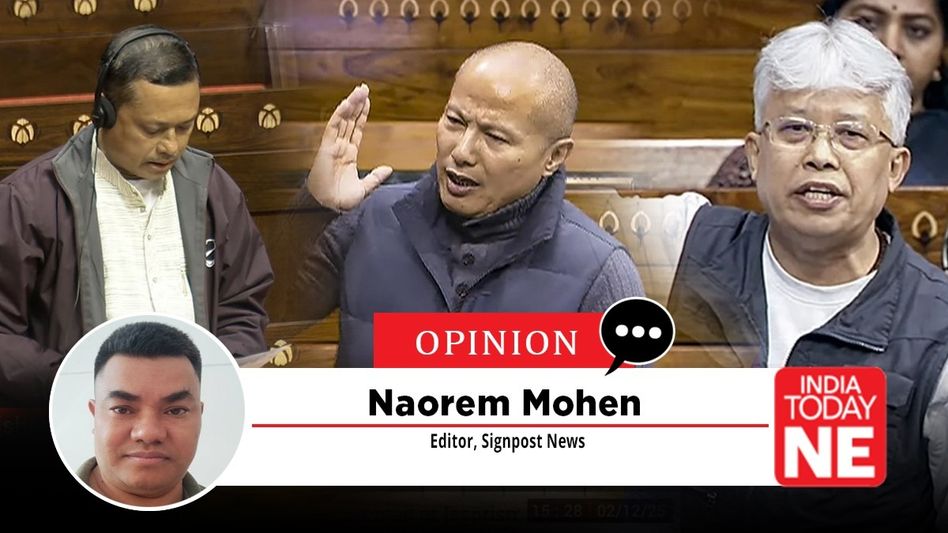
We have three MPs—Rajya Sabha member Maharaja Leishemba Sanajaoba (BJP), Lok Sabha members Dr. Angomcha Bimol Akoijam (Congress) and Alfred Kanngam Arthur (Congress)—three voices representing 3.2 million people in a Parliament of 788.
Three voices, if raised together even once, could force the nation to look east again.These are not Congress tragedies or BJP tragedies. These are oxygen tragedies—the kind that kill quietly when no one breathes for you.
All that is asked of our three MPs is the simplest, smallest, most urgent act imaginable: sit together once. One table, one hour, one shared list of questions. Nothing more.Because if even that single hour proves impossible, the last flicker of faith that Delhi can still save us will die with the final sitting on 19 December. And seventy thousand people under tarpaulin roofs will finally understand that no one is coming.
With barely eleven sittings left before Parliament rises on 19 December, seventy thousand displaced Manipuris are staring at yet another hollow festival season. For the third year running they already missed Ningol Chakkouba at their own hearths, and will not light Christmas candles this month. Their question is no longer angry; it is exhausted: “Will anyone in Delhi even mention our names before the session ends?”
The highways remain silent borders drawn by fear. A one-way ticket out of Imphal still costs more than most families earn in a month. An Assembly we elected with hope in 2022 is locked in cold storage. Farmers have watched three planting seasons turn to dust. Hundreds of places of worship stand ruined, some still occupied, their bells and conches silenced forever.
Manipur today has exactly three seats in the Parliament. That is 0.38 percent of the total strength of 788. Less than half of one percent.Three voices that, if raised in harmony for even one week, would be impossible to ignore.Three voices that, left separate, cancel each other out and become silence.
In a House where Uttar Pradesh alone has 80 MPs and Tamil Nadu 39, our numerical weight is almost invisible. In such a situation, coordination is not a luxury; it is oxygen. Yet we continue to behave as if we have the luxury of division.
The Winter Session is painfully short. The opposition MP will struggle for even five minutes of debate time. The ruling-party MP enjoys direct access to ministers and a longer leash in the Upper House. If these two advantages are combined, Manipur suddenly punches far above its weight. If they remain separate, we remain inaudible.
The struggle to have Manipuri recognised as a classical language is a painful case study in missed opportunities.
As early as 22 September 2020, Rajya Sabha MP Leishemba Sanajaoba stood in the Upper House and made a compelling case. He reminded the government of the four criteria for classical status, pointed out that Manipuri met every one of them, and lamented that no Tibeto-Burman language had ever been included. “If these four criteria are the defining factors,” he asserted, “Manipuri should be among the classical languages of the country.”
Four years later, on 3 October 2024, the Union Cabinet approved classical status for Marathi, Pali, Prakrit, Assamese and Bengali—bringing the total to eleven—but once again left Manipuri out.
The very next day, Maharaja Sanajaoba posted an emotional appeal on Facebook: “I am very EMOTIONAL & SHOCKED today.” He revealed that he had been lobbying for four to five years, but admitted, “due to lack of POLITICAL PRESSURE, LOBBY & INACTIVE from our side, we have lost a golden chance this time.” He vowed to keep fighting “till my last day of tenure.”
Fourteen months after that public anguish, on the opening day of the current Winter Session - 1 December 2025 - Lok Sabha MP Dr Angomcha Bimol Akoijam tabled Unstarred Question No. 152 asking what fresh steps the government now proposed. The written reply was cold and unexpected: no proposal has been received from the Manipur government. Same door, same lock, same answer—five years after the first plea in Parliament.
Today is 4 December. The session ends on 19 December. Eleven sitting days remain.Eleven days before thousands of internally displaced people spend a third Christmas in relief camps in the hills. Eleven days before another mother from Moreh chooses between medicine for her child and a ₹30,000 flight ticket to Delhi. Eleven days before another farmer in Sugnu writes off a third harvest. Nine hundred and forty-six days have passed since the violence erupted on 3 May 2023.
A message from an IDP from Sugnu to Outer Manipur MP Alfred Kanngam Arthur is very emotional. They did not vote for a party.They voted for a promise: that a son of the soil would finally speak for the valley victims too.Today, those very voters are still the forgotten IDPs of your own constituency.
Valley segments like Wabagai, Kakching, Hiyanglam, Sugnu, Jiribam and parts of Thoubal gave MP Alfred landslides that stunned every analyst. Displaced Meitei families from Moreh, Jiribam, Churachandpur, Kangpokpi foothills and Sugnu crossed the ethnic line because they believed their new MP would speak for their pain with the same urgency he speaks for the hills.
They are still waiting to hear the names of their ruined villages spoken on the floor of the Lok Sabha.Eleven days, one table
Three MPs. Two from the Opposition who can ask uncomfortable questions without fear of the whip. One from the treasury benches.
As the Winter Session of Parliament enters its crucial final days, the nation cannot afford to look away from Manipur any longer. Eleven days. One quiet room. Divide the remaining days the way families in relief camps divide the last handful of rice—carefully, strategically, for the common good.
More than 70,000 Indian citizens have remained displaced for over two and a half years, democratic governance lies suspended, and the state’s highways and skies remain hostage to crisis. It is the minimum the nation owes Manipur that the following ten issues are raised forcefully on the floor of both Houses before Parliament rises:
A calendar-bound, security-guaranteed return-and-resettlement plan for all 70,000+ displaced persons, with clear deadlines and full protection by central forces.
Immediate restoration of the elected Legislative Assembly and an end to indefinite President’s Rule, so that constitutional democracy is revived in the state.
Free and safe movement for every Indian citizen on NH-2 and NH-37 without blockades, extortion, or fear.
Immediate capping of exorbitant air fares on Imphal routes and strict enforcement of UDAN obligations by airlines.
A special economic rehabilitation package for farmers, traders, small businesses, and daily-wage families who have lost everything since May 2023.
A comprehensive White Paper detailing the chronology of the crisis, funds allocated and utilised, rehabilitation status, and a transparent roadmap ahead.
Official recognition of Manipur as a hill state (90% hilly terrain) with all attendant special financial benefits and central assistance.
Issuance of a new dedicated UID IDP card to ensure seamless access to relief and government schemes for the displaced.
Dedicated employment and job initiatives, including reserved government posts and skill-development programmes exclusively for Manipur’s IDPs.
Immediate voter registration drives in relief camps and guaranteed political representation and voting rights for all displaced citizens.
The people of Manipur have waited long enough. These are not mere administrative details; they are questions of justice, dignity, and the unity of India.
An elected Assembly—60 MLAs we chose with hope in March 2022—has been in cold storage for over a year under President’s Rule while decisions about our lives are taken by bureaucrat officers who have never heard a bullet whistle past their ears at night.
Back home, in the relief camps and the foothills, we are no longer willing to watch the same old drama: fire and fury in Imphal, hugs and handshakes in Delhi, and zero results for the people.
Manipur has no more tears left to cry.
It only has eleven days left to hope!
MORE NEWS


Copyright©2026 Living Media India Limited. For reprint rights: Syndications Today
