
A Tangled Border, A Fractured State: How a Fence in Manipur Deepens India's Divisions
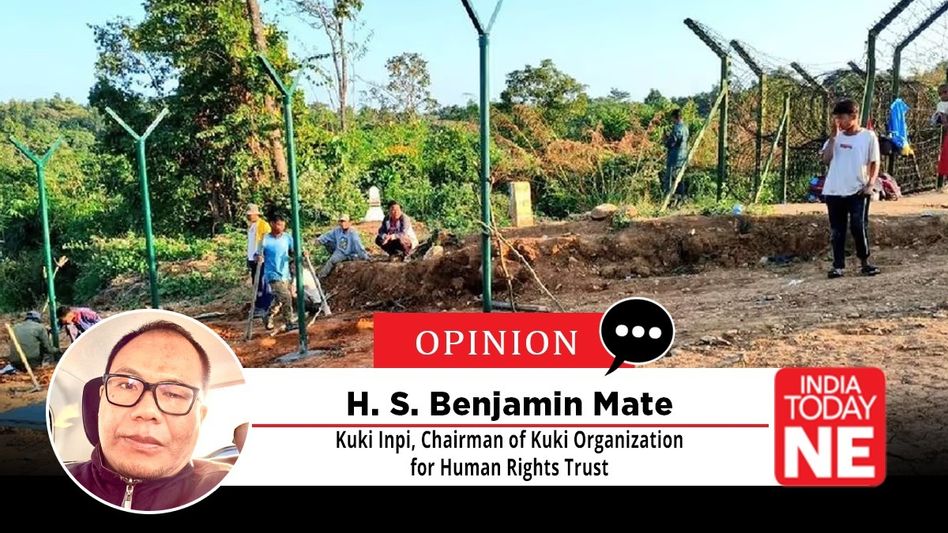
Last week, in the remote hills of Manipur’s Chandel district, unidentified individuals cut through 100 to 200 feet of newly erected steel fencing along the Indo-Myanmar border.

- Dec 09, 2025,
- Updated Dec 09, 2025, 1:43 PM IST

Last week, in the remote hills of Manipur’s Chandel district, unidentified individuals cut through 100 to 200 feet of newly erected steel fencing along the Indo-Myanmar border.
This act of sabotage, the second of its kind this year, is more than a security breach; it is a raw, physical manifestation of a profound conflict. It represents the fierce resistance of indigenous communities who find their ancestral world being violently bisected by a policy born not of consistent principle, but of political expediency and ethnic majoritarianism.
For decades, the 1,643-kilometer Indo-Myanmar border was a line on a map, not a wall on the land. Recognising the ancient ties of the Naga, Kuki-Chin-Mizo, and other tribes that straddle it, India maintained a Free Movement Regime (FMR), allowing limited cross-border movement. The border remained unfenced by design—a rare acknowledgment that human geography often defies the rigid logic of the nation-state.
Today, that logic has been brutally reasserted. A massive, billion-dollar fencing project is underway, and the FMR has been scrapped. The official reason is national security. The real story, however, is one of a cynical political reversal that exposes how border policy can be weaponised in internal ethnic conflicts, sacrificing vulnerable communities at the altar of majoritarian consolidation.
The Great Reversal: From "Loss of Land" to "National Security"
The political journey of the Meitei-led establishment in Manipur, particularly former Chief Minister N. Biren Singh, on this issue is a textbook case of hypocrisy.
· Then (Pre-2023): Vehement Opposition. For years, Meitei political and civil society leaders were the fiercest opponents of fencing. Organisations like the United Committee Manipur (UCM) and the Information Centre for Hill Areas Manipur (ICHAM) led protests, claiming fencing would cause a "loss of Manipur's land" to Myanmar. ICHAM's former president, N. Boy Rajendro, recently reiterated this longstanding position, stating the group never obstructed work but consistently raised alarms about territorial loss. Their campaign was so potent it successfully pressured the central government to halt fencing projects for years.
· Now (Post-2023): Aggressive Advocacy. Following the catastrophic ethnic violence that erupted in Manipur in May 2023—primarily between the valley-dwelling Meitei and the hill-dwelling Kuki-Zo tribes—the same political forces executed a perfect about-face. Former CM Biren Singh, facing intense criticism, rebranded himself as a hardline nationalist. He now aggressively lobbies New Delhi for complete, rapid fencing and the abolition of the FMR, blaming "illegal immigration" and cross-border movement for the state's woes.
The rationale shifted seamlessly from protecting territory to protecting the nation, revealing the underlying motive: the consolidation of Meitei political power. Having failed to prevent fencing when it was a Congress-led central government initiative, the Meitei leadership now champions it under a BJP-led regime, aligning with its national security narrative to deflect blame for the homegrown disaster in Manipur.
Also Read: The Manufactured Scarecrow: How Delimitation, Demography, and State Bias Fuel Ethnic Cleansing in Manipur
Lives Divided: The Human Cost of a Hard Border
For the central government, the border is a security project. For the Naga and Kuki-Zo peoples, it is an existential threat to their very being.
· Severed Families and Culture: The border arbitrarily splits ethnic homelands. Nagas, for instance, assert their traditional lands extend to the Chindwin River in Myanmar. The fencing and end of the FMR brutally cut through shared villages, burial grounds, farmlands, and marriage networks that have existed for centuries.
· Unheeded Voices: This profound disruption is being imposed without meaningful consent. As recently as August 2025, a delegation of Naga leaders from the United Naga Council met with central government officials in New Delhi. They pleaded for the reinstatement of the FMR and a halt to fencing, arguing it "contradicts the spirit of the Indo-Naga peace talks." The meeting ended inconclusively, with the government citing inflexible "national security concerns". This dismissal reinforces a pattern of the Centre siding with the political interests of the dominant community in Manipur while ignoring the pleas of the affected tribes.
The fence is not just metal and wire; it is a symbol of their disenfranchisement. The sabotage in Chandel and earlier in Moreh is a desperate form of communication from communities that feel their voices have no place in the halls of power.
A Blueprint for Further Strife
The Manipur government's instrumental use of the border issue sets a dangerous precedent for India's diverse and delicate federation.
1. The Erosion of Trust: When a state government's policy stance flip-flops based entirely on which party is in power at the Centre and what serves its immediate ethnic interest, it destroys any possibility of a consistent, principled social contract with minority communities.
2. The Securitization of Identity: By framing complex socio-political issues like migration and ethnic tension purely as security threats requiring hard borders, the state abandons its responsibility to address root causes: historical grievances, land rights, and political representation. It legitimizes majoritarian rhetoric.
3. A Flawed "Solution": The fence, as the sabotage shows, may be unenforceable. It will not stop determined movement but will instead create a lucrative black market for smuggling and corruption, enriching armed groups on both sides. It treats the symptom while inflaming the disease.
The Path Not Taken: Beyond the Barbed Wire
A sustainable solution for the Indo-Myanmar border cannot be found in fencing contracts or security briefings alone. It requires a courageous political shift.
India must initiate an inclusive, transparent consultation process with all border communities—Nagas, Kuki-Zo, Mizos, and Meiteis—to design a regime that balances legitimate security needs with inalienable human and cultural rights. This could mean:
· A Smart, Differentiated Fence: Instead of a blanket wall, implementing monitored, technology-aided fencing only at identified high-traffic smuggling and infiltration points, while leaving community corridors open.
· A Reformed FMR: Reinstituting a modernized movement regime with biometric tracking for indigenous communities, transforming an informal practice into a formal, regulated right.
· Addressing the Core: Acknowledging that the border crisis in Manipur is a direct spillover from the internal ethnic crisis. Lasting peace requires credible judicial accountability for the 2023 violence and a recommitment to political dialogue over land, resources, and identity.
The severed fence in Chandel is a warning. It signals that a policy built on political opportunism and imposed without consent will be met with resistance. India can choose to see this as a law-and-order problem, deploying more troops to guard a hated barrier. Or it can see it for what it is: a plea to remember that a nation's strength is measured not by the height of its walls, but by the justice of its foundations.
The future of India's vibrant and troubled Northeast will be determined by which choice it makes.
MORE NEWS












Copyright©2026 Living Media India Limited. For reprint rights: Syndications Today
