Are We Ready to Dilute Meitei Civilization for a Pan-Manipuri Identity?
As a Meitei, I've always felt the weight of our history, not as a mere ethnic story of ancestry and customs, but as something deeper, more enduring. Our chronicles stretch back centuries, our script once captured cosmology and medicine on fragile leaves, our rituals reenact the very creation of the world.

- Feb 12, 2026,
- Updated Feb 12, 2026, 11:58 AM IST

As a Meitei, I've always felt the weight of our history, not as a mere ethnic story of ancestry and customs, but as something deeper, more enduring. Our chronicles stretch back centuries, our script once captured cosmology and medicine on fragile leaves, our rituals reenact the very creation of the world.
However today, in the wake of violence that has torn families apart since 2023 and with a new Chief Minister urging us to rebuild "Manipuri" as a collective identity, a quiet question arises. Are we being asked, perhaps subtly, perhaps necessarily to soften or subsume that civilizational depth into a broader, pan-state label?
Is "Pan-Manipuri" unity possible without dilution?The distinction matters. In anthropology and history, scholars distinguish civilizations from ethnic groups. Civilizations, as Fernand Braudel, Shmuel Eisenstadt, and Bruce Trigger describe, are large-scale, durable cultural formations with complex political organization, literate traditions, institutionalized religion, technological adaptations, shared symbolic systems, and adaptive continuity across generations.
Ethnic groups, per Fredrik Barth and Anthony Smith, emphasize shared descent, language, practices, and self-identification, often nested within larger civilizational contexts. Arnold Toynbee stressed institutional resilience and cultural memory as key markers. Civilizations evolve as historical processes, not confined to modern borders.
Applying this lens, the Meitei of Manipur emerge not as a peripheral ethnic enclave but as bearers of a distinct civilization, one forged in the Valley yet radiating influence through trade, diplomacy, and ritual networks to neighbouring kingdoms like Burma, Bangladesh, China, Ahom, Cachar and Tripura etc.
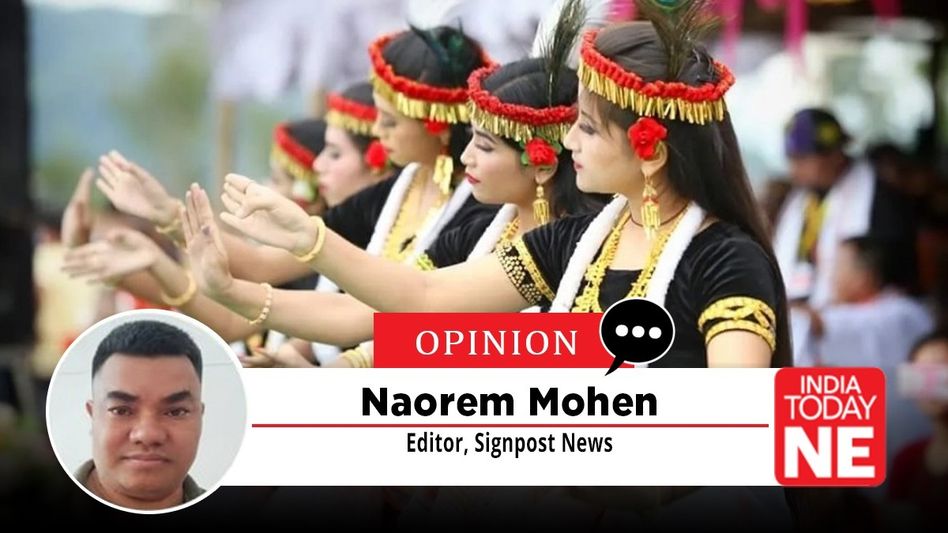
Our cultural formation shows remarkable continuity. Festivals like Lai Haraoba, Yaoshang, and Cheiraoba are more than celebrations; they are living mechanisms of reproduction, preserving cosmological narratives about deities, ancestors, and ecological balance.
Manipuri dance, especially Raas Leela and Lai Haraoba-linked performances, carries codified aesthetics, theological symbolism, and historical patronage which have received recognition within the broader corpus of South Asian classical dance.
Historically, Meitei culture never existed in isolation. Through trade, migration, diplomacy, and shared rituals, we connected with regions now in Myanmar, Assam, Tripura, and Bangladesh, forming a regional cultural sphere. This outward engagement speaks to a civilization interacting dynamically with neighbors, not a closed ethnic pocket.
Politically, evidence of sustained statehood is compelling. The Cheitharol Kumbaba chronicles royal successions and events over centuries, demonstrating institutional memory and historiographical sophistication.
The Loyumba Shinyen (12th century CE) codified administrative rules, occupational roles, social obligations, and authority, often seen as an early constitutional framework with differentiated governance.The Meitei kingdom conducted diplomacy and commerce with Burmese polities, Takhel and the Ahom kingdom, embedding Manipur in precolonial networks across South and Southeast Asia. This level of organization transcends tribal or segmentary models.
Literacy anchors much of this. The indigenous Meitei Mayek script supported puyas, manuscripts on history, cosmology, rituals, medicine, astronomy, and administration. Institutions like the Pandit Loishang and Maichou scholars preserved and transmitted knowledge, mirroring literate traditions in other civilizations. Chronological record-keeping in chronicles shows intellectual depth beyond oral custom.
Religion provided symbolic infrastructure. Sanamahism features a pantheon of umang lai, ancestral spirits, ritual specialists, and ceremonies emphasizing harmony with nature. The 18th-century royal adoption of Vaishnavism added Krishna devotion and Raas Leela without erasing household and Umang lai practices, a classic layering that sustained stability and moral frameworks.
Ethical traditions reveal reflective thought. Embedded in oral literature, proverbs, rituals, and texts, Meitei philosophy stresses reciprocity, restraint, responsibility, and ecological respect. The twentieth-century figures like Naoria Phulo sought to systematize these, indicating discourse that aligns with civilizational patterns of ethical codification alongside state and religion.
Materially, wet-rice cultivation with hydraulic systems, textiles, metallurgy, equestrian culture, and martial arts flourished. Sagol Kangjei, the precursor to modern polo, exemplifies organized sport, animal husbandry, and craftsmanship, markers of complexity. Trade diffused technologies from Burma, China, and beyond.
In the case of the Meitei, the presence of sustained political institutions, literate traditions, organized religion, and cultural continuity raises profound questions about the adequacy of a purely ethnic classification.
Colonial ethnography often reduced sophisticated polities across South and Southeast Asia to simplified "tribal" or ethnic labels for administrative convenience, obscuring indigenous sovereignty and historical depth. Postcolonial scholarship has increasingly challenged these framings, arguing they served governance ends rather than reflecting reality.
For the Meitei, the evidence, centuries of documented royal governance in the Cheitharol Kumbaba, an indigenous script and puya manuscripts preserving knowledge across domains, the layered yet enduring Sanamahism providing symbolic and moral infrastructure, and unbroken ritual and artistic continuity collectively complicates any narrow ethnic lens.
These features align far more closely with the hallmarks of civilizations than with the more localized, kinship-focused definitions of ethnicity.
At the same time, anthropologists rightly caution that civilization and ethnicity are not mutually exclusive categories; they often intersect and overlap depending on the analytical perspective adopted. Societies can embody ethnic self-identification while simultaneously sustaining civilizational traits.
In this light, the Meitei can be viewed not as one or the other, but as an ethnic community deeply embedded within a broader civilizational trajectory—one shaped by historical adaptation, regional interaction, and resilient continuity.
Now, the question isn't whether unity is needed. Manipur's fractures demand it, but whether affirming Meitei civilizational depth threatens or enriches that unity. "Pan-Manipuri" could mean a civic umbrella where distinct heritages contribute.
We don't need to denounce our heritage to embrace shared belonging in the Manipuri identity, even though those communities did not have any role in the making of Meitei civilization itself.This is not about denying the enriching diversity of Manipur as a whole, nor is it a rejection of peaceful coexistence. It is about refusing to accommodate or rewrite our own history in a way that suggests Meitei civilization was co-created or dependent on newly arrived groups in modern egalitarian story of shared origins.
If unity demands silence on Meitei nation formation, script, or Sanamahism's continuity, it becomes dilution. True Pan-Manipuri identity should celebrate layered histories. Meitei civilization as one thread in a richer tapestry.
We can affirm Meitei civilization while building a Manipuri future where no identity is silenced, only enriched.The answer to the question isn't a simple yes or no. It's a call to careful acceptance, pride in depth, openness to inclusion, and refusal to let political necessity erase what makes us who we are.
Therefore, let's appreciate CM Yumnam Khemchand Singh for his visible and courageous efforts to foster peace in a deeply fractured Manipur. His repeated calls to "forget the nightmares" of the past two years, forgive, and move forward for peace, development, and economic revival reflect pragmatic leadership in a state scarred by over 300 deaths and 70,000 displacements.
Sidelining the appeasement optics for a moment, his emphasis on rebuilding a shared "Manipuri" identity is a deliberate framing aimed at countering divisiveness.
It signals that collective state belonging can bridge valley-hill divides without denying distinct histories. This is crucial for confidence-building, resettlement of IDPs, and reopening highways and trade routes.
This doesn't mean abandoning Meitei civilizational depth, the chronicles, script, rituals, and ethical traditions we discussed remain vital anchors of identity. Rather, it suggests strategic flexibility. Affirming heritage privately or culturally while publicly embracing "Manipuri" to enable dialogue and healing.
Many in the Meitei community may see this as a necessary compromise for the greater good, especially when IDPs pin hopes on his leadership for return and normalcy.
Khemchand's approach, outreach to all sides, forgiveness appeals, security assurances deserves credit as a foundational step toward peace. Whether it fully succeeds depends on reciprocal trust from all communities, but his intent to sideline divisiveness for unity is a commendable effort in turbulent times.
What are your thoughts, does this shift feel like wisdom or a necessary trade-off?
The views expressed in this article are those of the author and do not necessarily reflect the views of India Today NE or its affiliates.