
Assam thunderstruck: How Post Malone’s sonic storm marked a new dawn for the Northeast
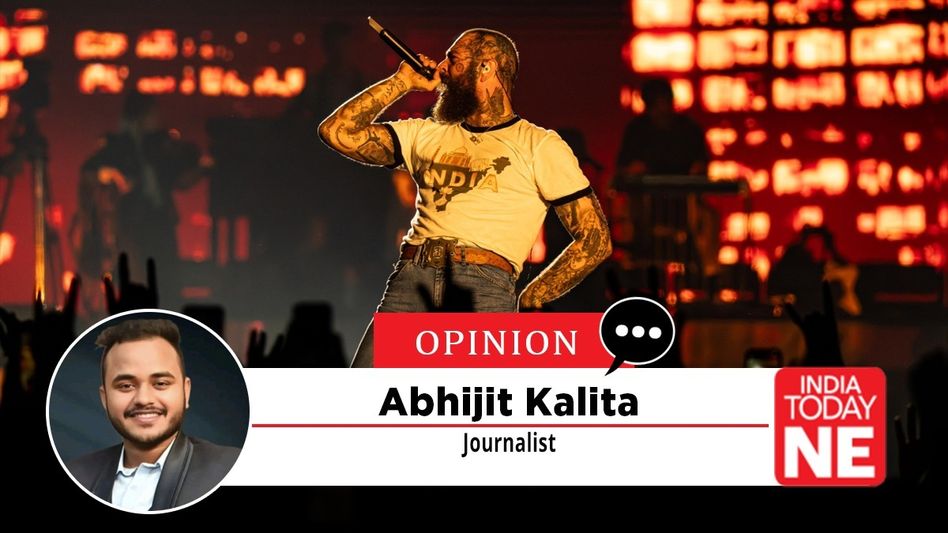
When global music superstar Post Malone walked onto the stage in Assam, the roar that followed was not just applause for an artist—it was a declaration that the Northeast has risen to claim its space on the world’s cultural map. The concert, spectacular in scale and emotional in its resonance, now stands as a defining moment in Assam’s cultural transformation. It symbolised not only the arrival of a global icon but also the emergence of a region quietly but confidently asserting its identity before the world.

- Dec 13, 2025,
- Updated Dec 13, 2025, 3:09 PM IST

When global music superstar Post Malone walked onto the stage in Assam, the roar that followed was not just applause for an artist—it was a declaration that the Northeast has risen to claim its space on the world’s cultural map. The concert, spectacular in scale and emotional in its resonance, now stands as a defining moment in Assam’s cultural transformation. It symbolised not only the arrival of a global icon but also the emergence of a region quietly but confidently asserting its identity before the world.
Post Malone, born Austin Richard Post on July 4, 1995, in Syracuse, New York, grew up with a deep love for music influenced by his father, who exposed him to a wide range of genres including rock, hip-hop, and country. After moving to Texas during his teenage years, Post began experimenting with music production and songwriting, eventually developing his signature blend of melodic rap and soulful vocals. His career took off in 2015 when he uploaded the track “White Iverson” to SoundCloud, a song that quickly went viral for its unique sound and emotional depth. The overnight success not only earned him a major-label deal but also marked the beginning of his journey toward becoming one of the most influential and genre-blending artists of his generation.
Over the years, his music has become the soundtrack of a generation grappling with loneliness, ambition, heartbreak, freedom, and identity. Malone’s capacity to blend hip-hop, pop, rock, country, and alternative music placed him at the crossroads of genres, and at the forefront of global music innovation. His songs—“Circles,” “Congratulations,” “Sunflower,” “Rockstar,” and many others—are the result of relentless experimentation, emotional vulnerability, and artistic risk-taking.
In that sense, it is fitting that such an artist performed in Assam—a land known for its layered identity, unwavering resilience, and cultural diversity. The night of the concert was more than an event, it was an emotion shared by thousands. Young people who had grown up listening to Post Malone on YouTube, older generations curious about global music shifts, and families whose children dragged them along—all came together under the same sky.
The lighting, stagecraft, sound engineering, and crowd discipline reflected a region ready for world-class platforms. The energy was electric, the atmosphere euphoric, and the audience’s participation powerful enough to match any international arena. Assam didn’t just host Post Malone—it embraced him.
And Malone responded in kind. His performance was not about spectacle alone; it was deeply personal. His acoustic moments silenced the crowd, and his high-energy anthems made the ground tremble. The Northeast, often underrepresented in national narratives, found itself reflected in the global spotlight—loud, proud, and impossible to ignore.
Some may dismiss a concert as just another show, but that would be a mistake. What Assam witnessed has broader implications—economic, cultural, social, and psychological.
For decades, major international concerts in India have been concentrated in Mumbai, Delhi, Bangalore, and sometimes Goa. The choice of Assam for a global superstar’s performance marks a decisive shift. It reflects growing confidence among organisers, investors, and international artists that the Northeast is no longer a peripheral venue but a promising frontier.
Large-scale international concerts bring diverse economic benefits—hotel occupancy spikes, local transport thrives, restaurants witness surges, and ancillary markets flourish. Assam’s tourism brand gains immeasurable mileage from global social media coverage, fan-made videos, and international press mentions. Such visibility cannot be bought; it must be earned—and this concert did exactly that.
For the youth of Assam, seeing a global artist perform in their home state is empowering. It validates their aspirations, connects them to global cultures, and breaks the psychological distance between the Northeast and the rest of the world. Exposure to world-class event production also inspires local musicians, technicians, event managers, and creators.
For too long, the Northeast has remained a cultural curiosity in mainstream Indian imagination—acknowledged, yet marginalised. Large international events help break that pattern. When thousands gathered for Post Malone, they weren’t just celebrating music—they were celebrating belonging. They were celebrating recognition.
But beyond economics and entertainment lies a deeper editorial question: Why did this concert matter so profoundly to people?
Possibility that Assam can stand shoulder-to-shoulder with global cultural hubs.
Possibility that the Northeast will no longer be the ignored corner but a thriving centre of creativity. Possibility that young people in the region can dream global dreams without leaving home.
Post Malone’s music, built on themes of struggle, reinvention, and emotional honesty, resonated with a region that holds similar stories. His arrival here was not random; it was symbolic.
If Assam sustains this momentum, the Post Malone concert could be remembered not as an isolated event but as the beginning of a new era. An era where film festivals, global music tours, international art fairs, and cultural exchanges become commonplace. An era where the Northeast becomes a preferred cultural destination in India and beyond.
But that future will not build itself. It requires policy support, improved infrastructure, investment incentives, and continued willingness to experiment. It requires confidence, ambition, and consistency.
In the end, Post Malone’s concert was much more than lights, sound, and celebrity presence. It was a powerful reminder that culture has the strength to rewrite narratives. That a night of music can spark new beginnings. That global artists and remote regions are separated only by imagination—until someone bridges the gap.
MORE NEWS












Copyright©2026 Living Media India Limited. For reprint rights: Syndications Today
