
Beyond Boycott: Khongjom Day as Opportunity for Peaceful Dialogue between Government and COCOMI
A wise and far-sighted government would see the COCOMI boycott call not merely as confrontation, but as an opportunity to craft a win-win strategy that serves both the administration and the people represented by civil society organisations

- Apr 22, 2026,
- Updated Apr 22, 2026, 2:24 PM IST

In a significant development just one day before the sacred Khongjom Day, the Government of Manipur has extended a formal invitation to COCOMI for a high-level meeting. The letter issued from the Office of the Chief Minister on 22nd April 2026, signed by Secretary to Chief Minister Neilenthang Telien, conveys the desire of Chief Minister Yumnam Khemchand Singh for a meeting between a High-Level Delegation of the Government of Manipur — led by the Hon’ble Home Minister and including two senior MLAs — and COCOMI to discuss the prevailing situation in the state.
It requests COCOMI to convey a convenient time for the meeting. This outreach marks an important step towards engagement at a time when Manipur continues to grapple with deep-seated challenges.
A wise and far-sighted government would see the COCOMI boycott call not merely as confrontation, but as an opportunity to craft a win-win strategy that serves both the administration and the people represented by civil society organisations. Rather than treating the boycott as a challenge to authority, the ruling dispensation can use it as a mirror to introspect and recalibrate its approach. True leadership lies not in suppressing dissent but in converting public pressure into collaborative action for the greater good of Manipur.
Therefore, CM Khemchand government’s invitation for a high-level meeting, issued just a day before Khongjom Day, presents exactly such an opportunity. If COCOMI genuinely wishes for peace and development in Manipur, they must positively respond to this invitation and engage constructively with the high-level delegation led by the Hon’ble Home Minister. Dialogue is not a sign of weakness; it is the mature path of statesmanship that our forefathers would have expected from us in times of crisis.
Accepting the invitation would demonstrate that COCOMI is not only raising voices of protest but is also ready to shoulder responsibility for finding solutions. Let us, therefore, envision Khongjom Day as a powerful and symbolic platform where Chief Minister Yumnam Khemchand Singh and representatives of COCOMI and other civil society organisations can come together in the presence of the martyrs’ memorial.
Although, the stand taken by the COCOMI Women’s Wing to boycott BJP politicians and leaders from the upcoming Khongjom Day observance on April 23 deserves our sincere appreciation for its firmness and emotional honesty. In these dark and uncertain times, when the soul of Manipur feels battered and betrayed, such a clear assertion from the women’s wing of COCOMI reflects the pent-up anger, frustration, and deep sense of abandonment that ordinary Manipuris — across communities — have been nursing for nearly three years now.
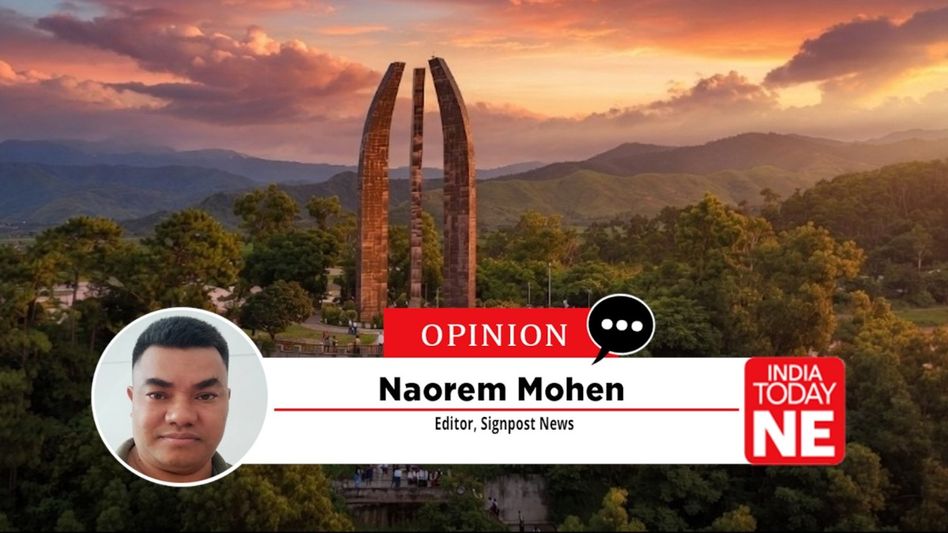
April 23 is not merely a commemorative date. For every true son and daughter of this land, it is a sacred remembrance. It marks the final, heroic stand at Khongjom during the Anglo-Manipur War of 1891, when our forefathers and foremothers fought valiantly against overwhelming British colonial forces.
The battle may have ended in defeat for the Manipuri forces, but it etched an undying spirit of resistance into our collective memory. That day, brave warriors from the valley and hills laid down their lives defending the sovereignty and dignity of Manipur. Meitei soldiers, Pangal, Naga and even some Kuki forefathers who saw the British as a common threat to the land they all called home.This shared history is important.
In 1891, the pain of foreign occupation and the fire of resistance cut across community lines. The suffering was collective. Families lost sons, brothers, and fathers. Women bore the brunt of grief and uncertainty. The British eventually installed a puppet king and reduced Manipur to a princely state under their indirect control, but the spirit of Khongjom remained a quiet flame of patriotism that later inspired generations.
Today, in 2026, that flame feels dimmed by our own internal wounds. The ethnic violence that erupted on May 3, 2023, has dragged on for almost three years. Over 300 lives lost, more than 70,000 people displaced, villages burned, and communities living in segregated zones under heavy security.
Relief camps still house thousands who cannot return home. Trust between communities has eroded dangerously. The state feels fractured — valley versus hills, Meitei versus Kuki, with Nagas and Pangals often caught in the painful middle, watching their shared home bleed.
It is against this backdrop that the COCOMI Women’s Wing, through convenor W. Luwangleima, has called for barring “puppet politicians” — specifically BJP MLAs, party leaders, and those in the present government, including Chief Minister Yumnam Khemchand Singh — from participating in the Khongjom Day ceremonies at the Khongjom War Memorial Complex.
They have contrasted the warm welcome some women in Wangjing gave the Chief Minister during a Block Development Office inauguration with the resolute blockade by women protesters on the Imphal-Thoubal stretch who have endured harsh conditions to make their voices heard. The message is sharp: this is not the time for ceremonial functions and photo opportunities while the real crisis remains unaddressed.
One can understand where this anger comes from. The prolonged unrest has seen repeated allegations of inadequate government response, policy failures, and a perception that decisions are influenced more by external calculations than by ground realities. COCOMI has spoken of the crisis resembling a proxy conflict and has demanded direct intervention from Prime Minister Narendra Modi and the BJP-led central government. They accuse certain elected representatives of failing to safeguard local interests. In such a charged atmosphere, the decision to socially boycott leaders perceived as disconnected from public suffering feels like an act of democratic assertion by civil society.
However, it must also reflect with a balanced heart. Boycotting only the BJP and its leaders may indeed be born out of the immediate pain and the failed outreach attempts by the government to convince the people and civil society organisations. The reinstatement of the elected government in February 2026 under Chief Minister Khemchand Singh, after a period of President’s Rule, was meant to signal a fresh beginning. There have been cautious peace meetings, coalition efforts including representation from different communities, and appeals for dialogue. But clearly, for many, these steps have not been enough to heal the wounds or restore confidence.
We cannot sit in judgment easily on what is right or wrong in such complex times. Whom to trust and whom not to trust has become one of the most agonising questions in contemporary Manipur. Political parties across the spectrum — BJP, Congress, NPP, NPF and others — have their share of supporters and critics. Each side carries its own narrative of victimhood and betrayal. The ongoing crisis has deepened divisions, and every community feels it has suffered.
But one thing remains crystal clear, beyond all political calculations: Khongjom Day belongs to the land and its people, not to any political party. It is a day when every Manipuri — Meitei, Pangal, Naga, and those Kukis whose ancestors participated in the resistance — must pay homage to the brave forefathers who sacrificed everything for the freedom and honour of this soil.
The situation in 1891, with its colonial aggression and loss of sovereignty, carries haunting parallels to the suffering we witness in 2026 — internal conflict, loss of lives, displacement, and a deep sense of insecurity about the future.
Instead of allowing this auspicious and solemn occasion to become yet another arena for boycott and counter-protest, can we rise to a higher calling? Can we transform our collective anger and grief into a renewed flame of patriotism and commitment? Can Khongjom Day 2026 become the moment when we rekindle the spirit that once united our ancestors against a common adversary?
In the sacred shadow of those who sacrificed their lives in 1891, they can make a joint public commitment — a commitment to formulate and implement accountable, transparent, and genuinely people-centric policies that address the root causes of the current crisis. This could include concrete roadmaps for the safe and dignified return of displaced persons, impartial delivery of justice, equitable development projects that reach both valley and hills, and security measures that protect every community without bias.
Chief Minister Khemchand Singh, in particular, must rise to the occasion by publicly thanking COCOMI and other civil society bodies for their constant and unrelenting pressure on the Centre. It was largely due to the sustained agitation, protests, and democratic mobilisation by these organisations that President’s Rule was eventually lifted and a popular elected government reinstalled in February 2026. Acknowledging this contribution openly would be an act of statesmanship and would help rebuild trust.
In this spirit of mutual recognition, every stakeholder must now shoulder responsibility to bring lasting peace to the state. The government has the machinery of administration, the elected mandate, and access to central resources. Civil society organisations like COCOMI command the trust and moral voice of large sections of the people.
Student bodies, Meira Paibis, local clubs, and faith-based groups each bring their own influence and grassroots reach. If all these forces align even partially towards the common goal of healing Manipur, the results could be transformative. Peace is not the sole duty of the Chief Minister or the ruling party; it is a shared sacred duty of every Manipuri who claims love for this land.
If we fail to seize this moment, the opportunity may slip away like something ephemeral — a fleeting morning mist that vanishes with the first harsh rays of the sun. The window for meaningful reconciliation is narrow. Prolonged unrest has already exacted a terrible human and economic cost.
Another cycle of blame, boycott, and counter-boycott could push the state deeper into despair, making future dialogue even more difficult. History will not forgive us if we allow the sacrifices of 1891 and the suffering of 2023-2026 to become mere footnotes in a story of endless division.
Imagine if, on April 23, at the War Memorial, leaders from every political party — BJP, Congress, NPP, NPF, and others — irrespective of who is in power or opposition, stood together and took a solemn public oath. An oath to heal Manipur. An oath to revive the shared bonds that have historically held this diverse land together. An oath to protect the future of our children and grandchildren from the cycles of violence and hatred. An oath to put the land above party and personal interest.
This does not mean ignoring accountability. The demands for justice, rehabilitation of the displaced, safe return to homes, and genuine resolution of underlying issues — land rights, constitutional protections, security, and equitable development — are legitimate and cannot be swept under the carpet. The pain of the last three years is too raw. Women who have blocked roads in protest, young people who have lost faith in governance, mothers who have lost children — their voices must be heard.
But perpetual confrontation without dialogue only prolongs the suffering. People have already endured enough — far too much. The economy stutters, education and healthcare suffer, daily life remains disrupted in many areas, and fear lingers. Fresh incidents of violence, ambushes, and shutdowns continue to erupt, reminding us how fragile the peace remains.
Let every stakeholder — government, opposition, civil society organisations like COCOMI, student bodies, meira paibis, and traditional institutions — take a conscious step back from hardened positions. Let there be genuine space created for honest, unconditional negotiations and dialogue. Not the performative kind, but the difficult, painful conversations that address root causes without denying anyone’s humanity or historical belonging.
Manipur’s strength has always lain in its composite culture. Our forefathers in 1891 did not ask which community a warrior belonged to before fighting side by side. They fought for Manipuri identity and dignity.Today, we owe it to them to rediscover that unity of purpose.
Let Khongjom Day not be remembered in future history books only for political boycott and division. Let it be recalled as the day when Manipuris, despite their differences, recommitted themselves to the idea of a peaceful, inclusive, and prosperous Manipur — a Manipur where every community feels secure, where justice is not selective, and where development reaches every corner without discrimination.
To the brave women of COCOMI and all those standing firm in protest: your voice has been heard. Your pain is valid. Your demand for accountability resonates powerfully. But let us also appeal to the larger Manipuri heart — the same heart that produced heroes at Khongjom — to channel this energy into constructive rebuilding alongside those in positions of governance.
To the political class, across parties: the people are watching. This is your moment to prove that you serve Manipur first, not Delhi or any other external power. Step forward with sincerity. Heal the wounds. Restore trust. Protect the land.
To every ordinary Manipuri — in the valley, in the hills, in relief camps, in distant cities: tomorrow, on April 23, bow your head at whatever memorial or in whatever corner you find yourself. Remember the sacrifices of 1891. Feel the pain of 2023-2026. And resolve that our future generations shall inherit a better Manipur — united in diversity, strong in spirit, and at peace with itself.The situation in 1891 was no less dark than today.
Our ancestors showed courage and resilience. We can do the same. Let Khongjom Day 2026 become an important turning point — not of further division, but of reawakened patriotism, collective commitment, and a shared resolve to serve our own people through dialogue, accountability, and genuine cooperation.
MORE NEWS











Copyright©2026 Living Media India Limited. For reprint rights: Syndications Today
