Can India Ever Win Its War on Drugs? Silence, Complicity and the North East
Open drug use in Guwahati exposes the limits of crackdowns across the North East. Rising seizures, disputed complicity claims and entrenched silence sharpen demands for deeper reform.

- Nov 12, 2026,
- Updated Nov 12, 2026, 5:25 PM IST

- Myanmar's expanding opium and methamphetamine production feeds porous border routes
- Mizoram, Assam and Manipur report major seizures, arrests and deaths
- Thounaojam Brinda's allegations of official protection remain disputed and unproven
A footpath in Ganeshguri
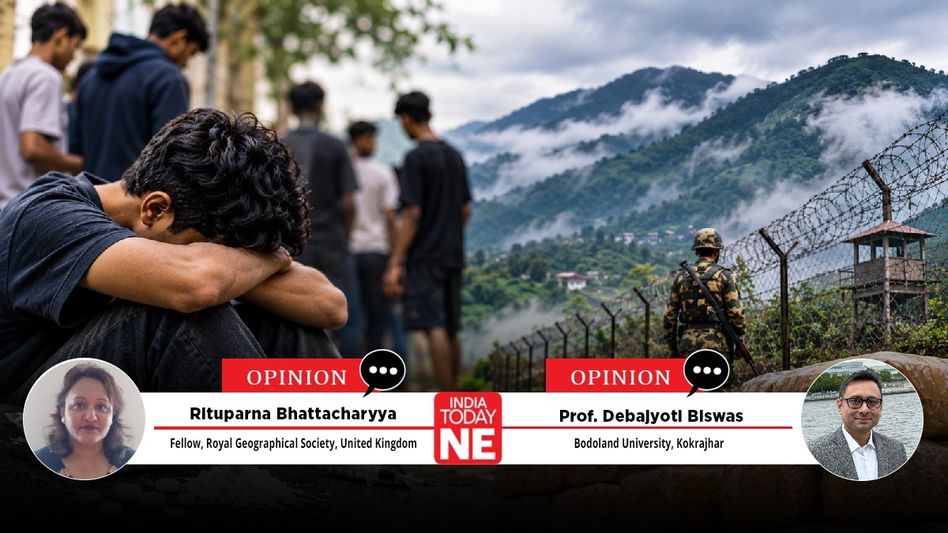
It was an ordinary day at Ganeshguri bazaar in Guwahati. The first author had stopped on the footpath to buy a few small things from a roadside vendor, the kind of errand that fills the margins of a busy day. A few feet away, a cluster of adolescent boys had gathered. They were thin, poorly dressed, and unmistakably from poor families. One of them was passing around a small packet of powder, tipping a pinch into each outstretched palm with the casual generosity of a child sharing chocolates at a birthday party.
There was no furtiveness, no lookout, no attempt to hide. That was what unsettled the first author most. The exchange had the rhythm of routine.
The first author could not walk away. She instead turned and rebuked them, told them that what they were taking would destroy their bodies, hollow out their futures, and break their mothers' hearts. They looked at her with a mixture of embarrassment and indifference, the look adolescents reserve for adults who do not understand how the world works. Then they drifted off.
Rituparna knew, even as she spoke, that nothing would change. Those boys would find another corner. The packet had come from somewhere, and the hands that supplied it were not standing on that footpath. Her scolding was a small, personal act against a vast, organised economy. It rather drove her to ask a question we both the authors have not been able to put down since: can the drive against drugs in India, and particularly in Manipur, Assam and the wider North East, ever succeed? Or is the war on drugs a war the state has quietly decided not to win?
Living next door to the Golden Triangle
Geography is the first and least negotiable fact of this story. North East India shares a long, porous and mountainous border with Myanmar, the heartland of the Golden Triangle. Manipur alone shares roughly 398 km of that frontier. Mizoram, Nagaland and Arunachal Pradesh share the rest. Beyond it lies a country in civil war, where the collapse of central authority since the 2021 coup has turned opium and synthetic drugs into a currency of survival for armed groups of every stripe.
The numbers from across the border are sobering. According to UNODC data cited in a recent Sangai Express column, Myanmar's opium-poppy cultivation rose 17 per cent in 2025 to about 53,100 hectares. Chin State, which borders Mizoram and Manipur, recorded a 26 per cent rise. Poppy was detected for the first time in the Sagaing Region near India. Alongside heroin, industrial-scale methamphetamine tablets, the notorious "WY" or "World is Yours" pills, now pour across the border.
On the Indian side, the seizure figures look impressive. Mizoram seized drugs worth over Rs 846 crore between January and August 2026, registered 635 cases under the NDPS Act and arrested 930 people, 111 of them foreign nationals, mostly from Myanmar, according to an IANS report. In the same period, 45 people in Mizoram died from drug use, after 118 deaths in 2025. Assam claims seizures worth more than Rs 3,253 crore and 26,537 arrests since 2021, according to data posted by Chief Minister Himanta Biswa Sarma in July 2026. Manipur's Chief Minister Yumnam Khemchand Singh told the police's Raising Day in October that about 3,000 acres of poppy had been destroyed in a year, with 307 NDPS cases and 467 traffickers arrested.
Yet a seizure is not a victory. It is evidence that the supply is still flowing. Assam's own figures show annual arrests rising from 4,175 in 2021 to 4,901 in 2025, and the yearly value seized rising from Rs 383.64 crore to Rs 473.46 crore. If a five-year war were working, one would expect the market to shrink. Instead, the numbers tell us that it is growing, or at the very least, that it is not retreating.
The human cost is written in the region's bodies. The national survey Magnitude of Substance Use in India (2019) found opioid dependence at 3.26 per cent of the population in Mizoram, 3.09 per cent in Nagaland, 2.65 per cent in Arunachal Pradesh and 1.80 per cent in Manipur, far above the national average. The same survey's state tables count more than 34,000 people who inject drugs in Manipur and nearly 34,000 in Nagaland. Assam's prevalence rate is lower, but its sheer population means more than 17,000 people inject. For a region of roughly 4 per cent of India's population, the North East carries a vastly disproportionate share of its addiction, HIV and overdose burden.
The Lady Super Cop and the question nobody wants answered
If the numbers raise doubts, the testimony of Thounaojam Brinda turns them into an accusation. Brinda, a former Additional Superintendent of Police in Manipur's Narcotics and Affairs of Border (NAB) bureau, earned the nickname "Lady Super Cop" for doing what officers in the region are rarely allowed to do: going after the people at the top of the chain.
On 19 June 2018, she led a raid on the Chandel residence of Lhukhosei Zou, a former Autonomous District Council chairman and then a member of the ruling BJP. According to The News Minute, the team seized heroin, 2,80,200 "World is Yours" methamphetamine tablets, Rs 57 lakh in cash and Rs 95,000 in demonetised notes. Zou and seven others were arrested.
What followed is a case study in how the war on drugs is fought within the state itself. In a 2020 affidavit before the Manipur High Court, Brinda alleged that she had been pressured to drop the case, naming the state BJP vice-president and alleging the involvement of the then Chief Minister, N. Biren Singh. "Zou was a powerful man, and he was vehemently protected by the head of the government," she told The News Minute. The Chief Minister denied the allegations and, according to the Human Rights Defenders Alert, filed a defamation case in July 2020 against her and 11 newspaper editors and publishers. She also faced contempt proceedings in the High Court over her social-media criticism of a bail order.
In December 2020, a Special NDPS Court in Manipur acquitted Zou and six others. The next day, Brinda returned her Chief Minister's Medal for Gallantry, asking that it be given to "a more deserving and loyal police officer". The State later appealed the acquittal, and recovering drug users petitioned the Supreme Court for the right to challenge it too.
Brinda has never confined her criticism to one community. In a 2023 interview with The Week, she said the trafficking networks "comprise individuals from all communities" and that "affluent individuals from various communities actively finance the poppy business", while poor farmers sit at the bottom of the cartel. She also asked why militants under Suspension of Operations agreements, technically in the State's custody, were allegedly collecting drug taxes.
In a recent appearance on Hills Hornbill Express, circulated widely as a social-media reel, Brinda goes further. She alleges that both the Government of India and the Government of Manipur are participants in drug trafficking. That is her claim, not an established fact, and both governments would be expected to reject it outright. But it cannot simply be dismissed. It comes from an officer who personally led a landmark drug seizure, who saw that case collapse, and who paid a professional and personal price for speaking. When someone with that record says the State is not merely failing to stop the trade but taking part in it, the question deserves an independent inquiry, not a defamation suit.
Manipur: when a drug war becomes an ethnic war
In May this year, writing in these pages on the third anniversary of Manipur's conflict, Rituparna argued that the state had settled into an entrenched, low-intensity civil war. More than 260 lives had officially been lost, and over 60,000 people remained displaced. Buffer zones manned by central forces had turned ethnic boundaries between the valley and the hills into something resembling militarised international borders. And underneath it all, she warned, was an economic engine: illicit drug money financing militias, buying weapons and taxing smuggling routes in a cycle of narcotics-for-arms.
The way Manipur's "War on Drugs" was launched in 2018 shows how a counter-narcotics policy can be absorbed into an ethnic struggle. The campaign reportedly destroyed over 19,000 acres of poppy. Many Meitei organisations saw the hill poppy fields as proof of "narco-terrorism" and of illegal migration from Myanmar. Kuki-Zo civil bodies saw the clearance drives and forest evictions as majoritarian economic warfare against their villages. The policy was meant to target a crime. It ended up deepening a fault line. As Rituparna wrote then, its political execution widened ethnic divides instead of bridging them.
The pattern has not ended with the change of government. After N. Biren Singh's forced resignation in February 2025, President's Rule, and the formation of Yumnam Khemchand Singh's government in February 2026, the campaign continues to be measured in acres destroyed. A Sangai Express column in October put it precisely: "the number of acres destroyed is a numerator without a denominator." Nobody publishes how much poppy is grown in total, so nobody can say whether the destroyed acreage is a large slice of the crop or a small one. Crop destruction, the author noted, "rarely wins. It displaces." Fields move deeper into forests, across the border to Chin State and Sagaing, or into areas controlled by armed groups.
The most damaging consequence is moral. When drug control becomes a tool to blame one community, every community's traffickers get a shield. A Kuki financier can claim victimhood. A Meitei financier can hide behind nationalist rhetoric. The poor farmer, the courier and the addicted adolescent are left to absorb the violence of both the trade and the State.
The borderland as necrospace
In August 2025, we published a study in Humanities and Social Sciences Communications, a Nature journal, titled "Borderland as a necrospace: identity, ethno-territoriality and narcotrade in Manipur". We drew on Achille Mbembe's idea of necropolitics: sovereignty as the power to decide, in his words, "who matters and who does not, who is disposable and who is not". Our argument was that Manipur's borderland has become a space where ethno-territorial claims, a permanent state of exception and an illicit economy work together to produce death and what Mbembe calls "living death".
Three findings from that study bear directly on the question of whether the drive against drugs can succeed.
First, the scale of the money dwarfs the scale of enforcement. Estimates of Manipur's drug trade vary enormously, from about $62 million to as much as $8.37 billion a year in some sources, of which only $240 to $300 million is reported to be intercepted. Whatever the true figure, interdiction captures a small fraction. An economy of that size buys protection, and it buys silence.
Second, the trade does not belong to any one community. Of 2,518 drug-case arrests in Manipur recorded from 2017 onwards in the data we cited, 873 were Kuki-Chin, 1,083 were Muslims, 381 were Meiteis and 181 were others. These figures reflect who gets arrested, not necessarily who profits most. But they demolish the claim that the drug problem is the problem of one ethnic group. Brinda's observation that financiers come from all communities fits the same pattern.
Third, the trade is woven into the history of militarisation. The Armed Forces (Special Powers) Act has applied to Manipur since 1958, and the state has been declared "disturbed" since 1980. Between 1992 and May 2025, the South Asia Terrorism Portal recorded 6,416 conflict-related deaths in the state. Decades of insurgency, counter-insurgency, ceasefire deals and armed groups in designated camps have created exactly the conditions in which a narco-economy thrives: armed men, porous borders, impunity and a population that has learned not to ask questions.
Our conclusion was that the State should stop promoting ethno-territoriality and instead encourage civic territoriality, a sense of belonging rooted in shared citizenship rather than exclusive ethnic claims to land. That matters for drugs too. As long as land, identity and poppy are fused, every enforcement action will be read as an ethnic attack, and every trafficker will find a community to hide behind.
Assam: a loud war, a quiet market
Assam has fought its drug war more loudly than any other state in the region. Since 2021, the government has staged public bonfires of seized narcotics and promoted the goal of a "drug-free Assam". "Our relentless war against drugs is delivering decisive results," the Chief Minister wrote in July 2026, promising to "pursue this crackdown till we dismantle the drug network".
Credit must be given where it is due. The Government of Assam under the able leadership of Dr Himanta Biswa Sarma has done many good things. Welfare schemes such as Orunodoi for women and Nijut Moina and Nijut Babu for Higher Education, a push on infrastructure and a visible, energetic administration have changed how many citizens experience the State. That is precisely why the drug question is so troubling. A government that has shown it can deliver on hard targets, and a Chief Minister known for his decisiveness and his grip on the administration, has not been able to tackle drug trafficking in the same way. Five years into the campaign, the powder still changes hands openly on Guwahati's footpaths. If political will and administrative capacity are not what is missing, then we must ask what is. Is it the sheer strength of cross-border supply? Is it the reach of the money? Or is it that some of the networks are protected by people the police cannot, or will not, touch?
The campaign has also come with a sharp rise in police shootings. Data compiled by Article 14 counted at least 210 police encounters between May 2021 and January 2024, with more than 80 people killed and over 180 injured. That is a twenty-fold rise in deaths compared with 2020. Suspected drug peddlers were among those shot, often while allegedly "trying to flee". When the Supreme Court heard a petition on these encounters in September 2024, Justice Ujjal Bhuyan remarked that "it is not a good thing for rule of law that so many accused are just losing their lives like that."
Whatever one thinks of these methods, the result is visible on Guwahati's footpaths. The boys Rituparna met in Ganeshguri were not hiding. They were not afraid. That tells us that the risk in the street-level market is lower than the government's rhetoric suggests, or that the risk falls on someone other than the supplier.
That is the structural flaw in most drug wars, in India and elsewhere. The people who get arrested, and sometimes shot, are those easiest to reach: the user, the small-time peddler, the courier, the migrant labourer carrying a packet across a district line. The financiers, the protectors and the beneficiaries are rarely touched. A war that only ever reaches the bottom of the pyramid can run indefinitely, with ever-rising arrest figures, without ever shrinking the pyramid.
The question Assam must ask is not how many people have been arrested but how many large networks have been dismantled, how many financiers convicted, how much drug money confiscated through financial investigation, and how many politically connected people have faced trial. Until those numbers are published and they move, the arrest count is a measure of activity, not of success.
The media, Ishan News and the economy of silence
A drug economy survives not only on guns and border routes but on silence. The journalist who looks away, the editor who drops a story, the neighbour who knows which house the packets come from: these are as essential to the trade as the courier.
A few weeks ago, an episode in Assam showed how fragile public scrutiny is. In October 2026, a leaked audio clip circulated on social media (Facebook and WhatsApp), purportedly recording a phone conversation between the owner of a prominent Guwahati television channel and a businessman whom that channel had repeatedly reported as an alleged drug dealer. On Ishan News, a digital portal, the editor, Sushil Patowari, aired the recording and raised pointed ethical questions about it. Other portals followed.
The facts remain disputed, and both men deserve to have their denials recorded. According to Pratidin Time, the channel owner confirmed he had spoken to the businessman but said the conversation was about an unpaid balance for a luxury vehicle, not a news report, and vowed legal action against portals that covered the story. The businessman, for his part, denied any involvement in drug trafficking, calling the allegations false and fabricated, while alleging that he had been asked for money to stop a second part of a damaging report. None of these claims has been independently verified. A complaint was filed at Paltan Bazar police station on 14 October seeking an investigation. When approached, Guwahati's Police Commissioner reportedly declined to comment.
Then, as far as many viewers could tell, the story went quiet on Ishan News. Was the portal managed? We do not know, and it would be unfair to assert that it was. A small digital outlet facing the threat of litigation from a powerful media house may simply have decided it could not afford the fight. But that is exactly the point. Whether the silence was bought, ordered or forced by legal fear, the outcome for the public is the same. A serious question about the alleged links between media power and the drug trade was raised and then left hanging. As Pratidin Time itself observed, mainstream outlets in Assam largely avoided the story, and the discussion was carried by digital platforms and social media users.
This is how an economy of silence works. It rarely needs an order. It needs only the reasonable fear that speaking will cost you your licence, your advertisers, your court fees, your job or your life. Brinda faced a defamation suit and contempt proceedings. Small portals face legal threats. Ordinary citizens who confront peddlers in their neighbourhoods face something worse. In the North East, voicing opposition to drug peddlers can put one's life at risk. That is not a figure of speech.
Is a drug-free North East possible?
Let us be honest. A completely drug-free North East is not possible while Myanmar burns, while the Golden Triangle produces at industrial scale and while hundreds of kilometres of forested border remain open. No country has eliminated drugs by force, not Colombia, not Mexico, not the Philippines, where a brutal war killed thousands and left the market intact. But a North East where the trade no longer controls politics, where children are not handed powder like sweets on a city footpath and where speaking out does not cost a life? That is possible. It requires the State to change what it counts and whom it targets.
1. Follow the money, not the courier. Every major seizure should trigger a financial investigation under the Prevention of Money Laundering Act and NDPS forfeiture provisions. Benami property, shell firms, cash-rich businesses and political donations linked to trafficking should be traced and attached. A peddler can be replaced in a day. A frozen fortune cannot.
2. Publish the numbers that matter. Governments should publish conviction rates, the value of assets forfeited, the number of financiers and officials prosecuted and an estimate of total poppy cultivation by satellite survey. Acres destroyed and arrests made should be read against these.
3. Investigate the protectors. An independent body, ideally court-monitored, should examine allegations of political and official complicity, including those made by Thounaojam Brinda. If the allegations are false, an inquiry will clear the names involved. If they are true, no drug war can succeed without acting on them.
4. Protect those who speak. Whistle-blowing officers, journalists, digital portals and community activists need legal protection from retaliatory defamation suits and real physical protection from threats. Without this, silence is the rational choice.
5. Treat addiction as a health problem. The boys in Ganeshguri need treatment, schooling and work, not a police record or a bullet. Harm-reduction services, opioid substitution therapy and community rehabilitation have a far better record than mass arrests of users.
6. Offer the farmer a way out. Poppy pays better than vegetables. Projects such as Manipur's HINICHI initiative, which reportedly moved 124 households in Kangpokpi from poppy to green peas, need to be scaled up with assured markets, roads and credit.
7. Take ethnicity out of drug policy. Counter-narcotics operations should be seen to target traffickers from every community equally. In Manipur especially, civic territoriality, not ethnic ownership of land, must underpin any settlement.
8. Work across the border. India needs sustained, quiet diplomacy with the actors who actually control Myanmar's border regions, along with regional intelligence-sharing, if supply is ever to be squeezed at source.
Shall we keep silent?
We return to the footpath in Ganeshguri. Rituparna scolded those boys knowing it would change nothing, and in one sense she was right. A stranger's rebuke cannot compete with the pull of addiction, the boredom of poverty or the efficiency of a supply chain that runs from the hills of Chin State to the markets of Guwahati.
But we have come to believe that the rebuke mattered in another way. It refused to treat what we witnessed as normal. And normality is exactly what the drug economy needs from us. It needs us to accept the seizure figures and the bonfires as proof of progress. It needs us to read about a collapsed case in Manipur, a whistle-blower's allegation or a leaked audio clip in Guwahati, and then move on. It needs a news portal to go quiet and a citizen to decide that it is safer to look away.
The threat is real. Speaking against drug peddlers in the North East can put one's life at risk, and we do not ask anyone to be reckless. But if those who see clearly, the officers, journalists, scholars, mothers and teachers, all choose silence, then the war on drugs will be lost not on the border but in our own homes and streets. The traffickers will not need to win. We will simply have stopped resisting.
So, will the drive against drugs in Manipur, Assam and the North East ever succeed? It will not succeed as long as the State measures acres and arrests while the money flows untouched, and as long as allegations of complicity are answered with lawsuits instead of inquiries. It can begin to succeed on the day that the people at the top of the pyramid fear the law as much as the boys on the footpath fear the police. Until then, the least we owe those boys is not to pretend that everything is fine.
- Biswas, D. and Bhattacharyya, R. (2025). Borderland as a necrospace: identity, ethno-territoriality and narcotrade in Manipur. Humanities and Social Sciences Communications, 12, 1299.
- Bhattacharyya, R. (2026). Year three of unquiet: Manipur's fractured ethnic landscape and the slow unravelling of peace. India Today NE, 18 May.
- Thounaojam Brinda on Hills Hornbill Express (Facebook reel)
- The News Minute: The ex-cop whose war on drugs has pitted her against CM Biren Singh
- The Week: Interview with Thounaojam Brinda (2023)
- ThePrint: Manipur cop returns gallantry award (2020)
- HRDA: Threats to whistle-blower Thounaojam Brinda (2020)
- The Sangai Express: War on Drugs in Manipur: Winning headlines, losing the map? (2026)