Centre warns BJP MLAs against CSO pressures in push for peace
The BJP Central leadership has explicitly warned State MLAs not to bow down to the diktats of hardline Civil Society Organisations, particularly those on the Kuki-Zo side that continue to obstruct the peace process in Manipur.

- Dec 15, 2025,
- Updated Dec 15, 2025, 6:42 PM IST

The BJP Central leadership has explicitly warned State MLAs not to bow down to the diktats of hardline Civil Society Organisations, particularly those on the Kuki-Zo side that continue to obstruct the peace process in Manipur.
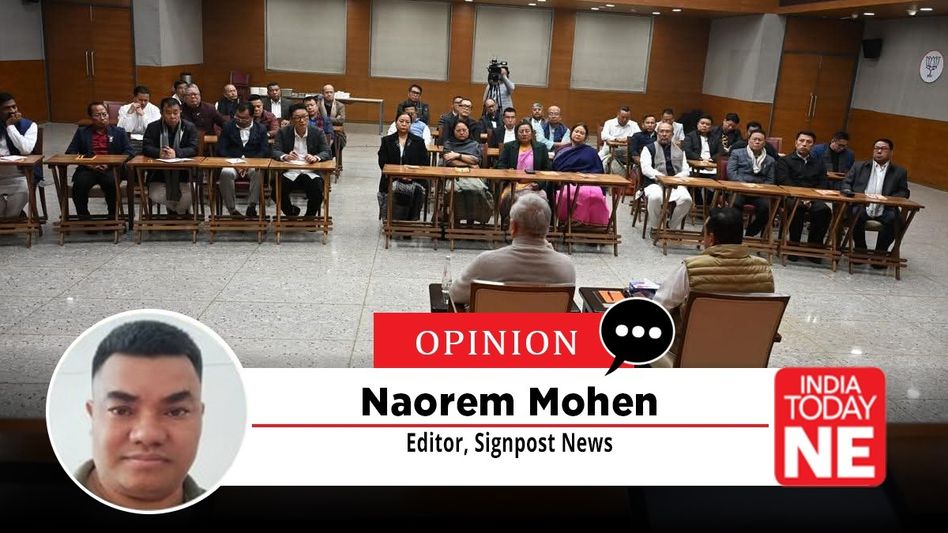
During the crucial December 14, 2025, meeting in Delhi, the high command made it clear that elected representatives must prioritise constitutional responsibilities and the welfare of all communities over yielding to pressures from CSOs intent on derailing free movement and IDP resettlement.
This directive is not merely advisory; it is a clarion call for MLAs to assert their democratic mandate, resist external interference that perpetuates division, and pave the way for an inclusive government—reminding us that true peace in Manipur can only emerge when legislators place the state's unity above factional or organisational compulsions.
This summoning of State legislators to Delhi bears the hallmarks of a contemporary "Delhi Darbar"—a necessary but controversial central intervention in a state long plagued by ethnic divisions, evoking uneasy parallels with the power struggles that led to the fall of the independent Manipur Kingdom in 1891.
During that era, intense rivalries among royal princes over the throne culminated in a violent palace coup in 1890. The deposed ruler fled to British territory and appealed for help, creating an opening that colonial agents eagerly exploited. This internal power struggle—driven by ambition and family feuds—weakened the kingdom, allowing British authorities to interfere under the pretext of restoring order. Aspirants to the throne were manipulated in a darbar-like setting, "schooled" to serve imperial interests, ultimately fracturing Manipur's unity and enabling the brutal Anglo-Manipur War of 1891.
Today's crisis mirrors this historical tragedy in disturbing ways: power-hungry leaders and factional rivalries within communities are once again prolonging division, inviting prolonged central oversight and delaying the restoration of elected governance. Just as princely ambitions in 1890 handed the British a pretext for conquest, current internal discord risks surrendering Manipur's autonomy to extended external administration.
Manipur Pradesh Congress Committee President Keisham Meghachandra Singh captured this sentiment on Facebook, deriding the meeting as turning MLAs into "students attending crash courses in Delhi on how to justify administrative failures back home."
Yet, reliable sources indicate the two-hour session (5:30 PM to 7:30 PM), led by National General Secretary, B L Santosh and Northeast in Charge, Sambit Patra, was substantively focused on reconciliation. The high command explicitly directed all BJP MLAs to collaborate on resettling internally displaced persons (IDPs) and restoring free, safe movement statewide.
They also signalled readiness to install an inclusive government once these preconditions are met, implying an urgent internal target of January 14, 2026, for peace milestones to avoid further extensions of President Rule in the State. Most strikingly, Santosh and Patra cautioned MLAs against aligning with CSOs intent on sabotaging these efforts, especially certain Kuki-side groups.
This exposes a core tension: elected representatives must prioritise constitutional unity over external pressures if a popular government is to emerge. Far from being focused on forming a popular government, the meeting primarily aimed at uniting the Meitei and Kuki communities through direct dialogue among BJP legislators—a vital first step toward reconciliation after over two years of division.
When legislators bridge divides and demonstrate unity, their communities are far more likely to follow suit, fostering broader societal healing.
Notably, the deliberate absence of BJP National President signals no immediate change of guard or selection of new leadership within the state unit. This kept the two-hour discussions firmly focused on broader, non-partisan goals of community reconciliation, trust-building, and restoring peace and stability in Manipur, rather than internal party restructuring.
Supporting this, a Meitei MLA, speaking in confidence, further clarified that while the phrase "popular government" was not explicitly mentioned during the meeting, the intent was unmistakable.
According to him, there is no immediate leadership crisis or debate over who will head the government. The central leadership's unambiguous priority lies in achieving free movement across the state, successful resettlement of IDPs, and genuine unity among all MLAs—both Meitei and Kuki-Zo—before anything else.
These are the non-negotiable criteria that must be fulfilled to enable the formation of an inclusive popular government ahead of the February 2026 deadline for President's Rule expiry. This revelation reinforces that the path forward is conditional and performance-based, placing the onus squarely on the legislators themselves.
Though not explicitly named during the meeting, a key underlying concern—widely understood by all stakeholders as a major barrier to restoring normalcy—is the persistent opposition from certain influential Kuki-Zo civil society organisations to unrestricted free movement and the resettlement of internally displaced persons (IDPs), particularly those from the Meitei community. Groups such as the Kuki Inpi Manipur, Kuki-Zo Council, Indigenous Tribal Leaders' Forum (ITLF), Committee on Tribal Unity (CoTU) in Kangpokpi, and allied bodies have repeatedly resisted such initiatives, often conditioning them on broader demands for a separate administration or Union Territory status, which has deepened mistrust and stalled progress toward reconciliation and the safe return of thousands still languishing in relief camps.
These organisations have resisted central directives for "free movement," viewing it as premature without political concessions, and have condemned attempts at cross-community resettlement as provocations. Assertions of "buffer zones" (denied officially by authorities) and protests against highway reopenings or IDP marches have effectively hindered progress, creating de facto barriers that prolong displacement and mistrust. Central leaders reportedly view this as a major hindrance, fearing it perpetuates division and blocks the inclusive government roadmap.
While these CSOs cite security fears for their communities—a valid concern amid ongoing trauma—their hardline positions risk undermining broader reconciliation, as warned in the Delhi deliberations. All eyes are now on MLAs from key districts like Kangpokpi and Churachandpur, whose constituencies straddle critical highways and buffer areas. Their cooperation in facilitating safe passage through these assembly segments will be pivotal for restoring free movement and enabling IDP returns.
Further discussions on leadership selection for the potential government remain pending, amid questions over whether the Centre will accommodate inputs from Kuki SoO groups or CSOs. Still, internal divisions persist in both Meitei and Kuki-Zo MLA camps, complicating consensus. Amid these hurdles, hope flickered brightly: four of seven Kuki-Zo BJP MLAs—Nemcha Kipgen, Letzamang Haokip, LM Khaute, and Ngursanglur Sanate—attended, achieving the first joint Meitei-Kuki-Zo legislative gathering since May 2023. These attendees emerge as genuine pioneers, signalling willingness to transcend divides.
Conversely, prominent absentees like Paolienlal Haokip (chief advocate for separate administration), Letpao Haokip, Vungzagin Valte confirmed lingering resistance. Among the 10 Kuki-Zo MLAs overall, their non-participation—despite personal reasons—highlights a reluctance that prioritises factionalism over collective healing.
The attendance of four out of seven Kuki-Zo BJP MLAs at Delhi meeting—despite three absences due to personal and health reasons—proves that meaningful cross-community dialogue is feasible even without full participation, serving as a vital breakthrough after over 30 months. The absentees, however, risk being seen as barriers to party unity and state's stability.To promote inclusivity and sustain progress, central leadership should require virtual attendance for unavailable MLAs in future sessions, ensuring broader accountability and commitment to peace.
The Delhi meeting, despite darbar-like perceptions was a success one, which provides critical momentum. By resisting disruptive CSO influences, prioritising IDP resettlement, restoring free movement (especially via Kangpokpi and Churachandpur routes), demonstrating MLA unity, and meeting the preconditions for an inclusive government before the February deadline, legislators can finally guide the state toward lasting normalcy.
While the recent joint meeting represents a positive step toward reconciliation and potential government formation under President's Rule, such dialogues must progressively shift to Imphal to foster genuine, lasting trust. Holding these meetings in the state capital, ideally at the State BJP party office, would symbolize a commitment to unity on shared ground, demonstrating to both communities that normalcy and free movement are achievable.
This approach would not only strengthen bonds among the MLAs themselves but also cascade down to their party workers and supporters, rebuilding grassroots confidence eroded by the ongoing ethnic divide.
Only through sustained, on-the-ground engagement in Manipur can true peace and inclusive progress take root, paving the way for the restoration of an elected government and healing for all affected communities, be it Meitei, Kuki or Naga!