CM Khemchand’s State Committee Announcement: A Perfect Intellectual Convergence on NRC Updation
Manipur Chief Minister Y Khemchand has demonstrated commendable seriousness and foresight in addressing the long-standing demand for updating the National Register of Citizens (NRC) in the state.

- May 05, 2026,
- Updated May 05, 2026, 11:16 AM IST

Manipur Chief Minister Y Khemchand has demonstrated commendable seriousness and foresight in addressing the long-standing demand for updating the National Register of Citizens (NRC) in the state.
By announcing efforts to constitute a dedicated State Committee to examine the issue “in depth and breadth” and avoid future flaws, the CM has sent a clear signal that the government is moving beyond mere rhetoric towards structured, careful implementation.
This marks a mature acknowledgement of the long-standing demands raised by civil society and represents a strong intellectual convergence with the resolutions that emerged from the One-Day Intellectual Exchange Programme organised by the All Manipur Students’ Union (AMSU) Headquarters in collaboration with the Manipur University Students’ Union (MUSU) on 4 May 2026 at Manipur University.
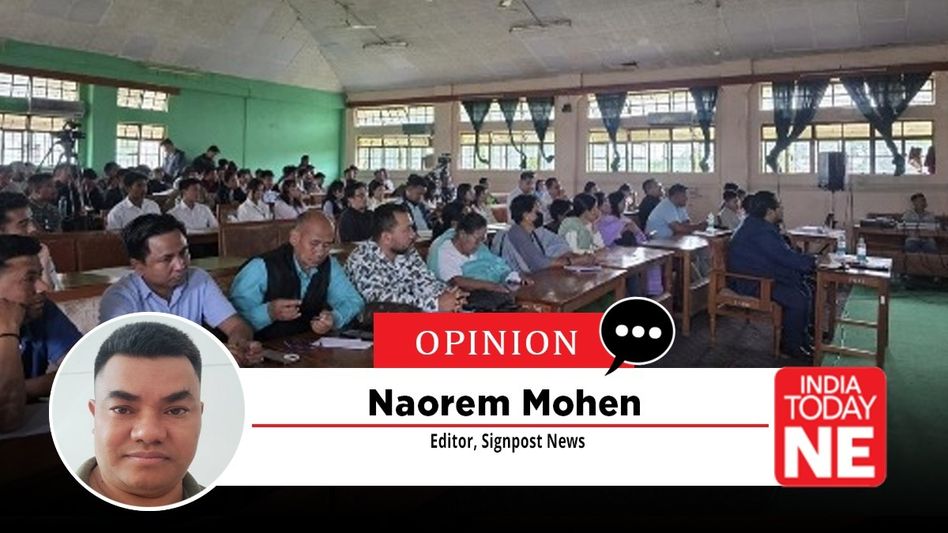
The event, attended by journalists, legal experts, and scholars, and themed “Updating the National Register of Citizens (NRC): Collective Mobilisation and Demographic Governance in Manipur,” was far more than a routine academic exercise.
The CM Khemchand statement carries weight and sincerity. He openly admitted that although the Manipur Legislative Assembly had passed resolutions on NRC earlier, concrete implementation had lagged. He also appreciated the proactive role of Civil Society Organisations (CSOs) in organising seminars and workshops to ensure the process is conducted carefully, avoiding the flaws seen elsewhere.
This measured and responsible approach from the highest office of the state finds near-complete alignment with the collective intellect and aspirations voiced at the Manipur University programme.
It was a serious, focused deliberation that culminated in ten unanimous resolutions. These resolutions provide a comprehensive, practical, and legally sound framework for NRC updation in Manipur.
What makes CM Khemchand’s announcement remarkable is how seamlessly it converges with the core spirit and specific demands of these resolutions. At the heart of this convergence lies the shared emphasis on institutional mechanisms, careful study, and avoidance of hasty implementation.
The most striking alignment appears in Resolution No. 2 of the Intellectual Exchange Programme, which explicitly demands “the establishment of a strong institutional mechanism, including the constitution of an Expert Committee,” for systematic collection, compilation, and verification of all relevant demographic and administrative data.
CM Khemchand’s proposed State Committee is virtually the same institutional body that the students, scholars, and intellectuals have called for.This is not a superficial similarity. Both the government announcement and the AMSU resolutions recognise that NRC updation in Manipur cannot be rushed. It requires rigorous study, expert inputs, and foolproof methodologies.
By committing to examine the matter “in depth and breadth to avoid flaws in the future,” the Chief Minister has echoed the cautious, responsible approach advocated by the intellectual forum. This convergence transforms what could have been a point of tension between the government and civil society into a moment of rare unity and shared vision.
This alignment gains deeper meaning when viewed against Manipur’s historical commitments. The programme’s first resolution calls for strengthening the demand for NRC based on the Memoranda of Agreement signed in 1980 (22nd July and 5th August) between the Government of Manipur and AMSU-AMSCOC, and the subsequent 1994 agreement in the presence of Governor V.K. Nayar. These are not forgotten documents — they are sacred commitments that have shaped public consciousness for decades.
CM Khemchand’s seriousness in addressing CSO demands and his reference to past Assembly resolutions (5th August 2022 and 1st March 2024) demonstrate that the government is finally ready to move from resolution to structured action. The proposed State Committee can serve as the bridge that connects these historical promises with practical implementation.
Beyond the State Committee, several other resolutions of the Intellectual Exchange Programme find strong resonance with the Chief Minister’s broader approach:
Resolution No. 3 demands the effective functioning of the Manipur State Population Commission (constituted in March 2023). The State Committee can work in tandem with this Commission, creating a powerful institutional ecosystem for demographic governance.
Resolution No. 4 calls for a clear, transparent, and legally sound modality with 1951 as the cut-off base year. The Chief Minister’s emphasis on avoiding future flaws naturally supports the need for such a well-defined framework, which the State Committee can help formulate after thorough study.
Resolution No. 5 seeks a detailed White Paper on demographic trends. Such a document would provide the empirical foundation needed for meaningful engagement with the Government of India — an exercise the State Committee is ideally positioned to guide.
Resolution No. 6 on establishing Foreigners Tribunals, Resolution No. 7 on coordinated pressure on the Centre, and Resolution No. 8 on public awareness programmes all fit logically into the preparatory work that a dedicated State Committee would undertake.
Resolution No. 9 (exploring legal options, including PIL) and Resolution No. 10 (demanding time-bound measures) reflect the urgency felt by civil society. The Chief Minister’s announcement offers hope that such escalation may not be necessary if the government delivers on its commitment.
This intellectual convergence is perfect for several profound reasons. First, it bridges the traditional divide between government and civil society in Manipur. Instead of confrontation, we see the beginning of collaboration. Second, it elevates the NRC discourse from political slogan to evidence-based policy making. Third, it ensures that the process remains rooted in Manipur’s unique realities while being informed by intellectual rigour and historical understanding.
For a state that has suffered immensely from unchecked demographic changes — affecting land, employment, resources, and social harmony — such convergence is not merely welcome; it is essential. A well-designed State Committee can help Manipur learn from the Assam experience without repeating its mistakes. It can protect indigenous rights while ensuring justice and transparency.
The true test of this convergence lies in implementation. The State Committee must be notified at the earliest with clear terms of reference, a realistic timeline, adequate funding, and inclusive representation from experts, legal minds, indigenous organisations, and civil society. It should function with complete transparency and submit periodic reports to build public confidence.
CM Khemchand has shown political will and administrative foresight. The intellectuals and students who have attended the event organised by AMSU have provided a thoughtful, actionable roadmap. When the government’s announcement and civil society’s resolutions align so perfectly, the foundation for meaningful progress is already laid.
Manipur stands at a critical crossroads. The proper updation of the NRC, guided by a dedicated State Committee and informed by intellectual consensus, can become a cornerstone for demographic security, sustainable development, and lasting peace.
The Chief Minister’s announcement has opened a promising door. Now is the time for all stakeholders — government, CSOs, students, scholars, and citizens — to walk through it together.
The people of Manipur have waited long enough. Let this timely intellectual convergence between Chief Minister Khemchand’s announcement of the State Committee and the resolutions adopted at the 4 May 2026 Intellectual Exchange Programme now translate into swift, sincere, and time-bound action. The future of our demographic identity and collective dignity depends on it.