Delhi Must Listen This Time as Naga and Meitei Organisations Unite for Justice
The coming together of 25 Naga and Meitei civil society organisations over the killing of six Konsakhul Naga civilians is more than a protest. It is a rare civic convergence that demands serious attention from the Government of India and the State Government.

- Jun 14, 2026,
- Updated Jun 14, 2026, 2:38 PM IST

The coming together of 25 Naga and Meitei civil society organisations over the killing of six Konsakhul Naga civilians is more than a protest. It is a rare civic convergence that demands serious attention from the Government of India and the State Government.
For more than three years, public discourse in Manipur has been dominated by division, distrust, and competing narratives of victimhood. Communities that once shared civic spaces have increasingly found themselves separated by conflict, displacement, suspicion, and competing claims of justice.
Against this painful background, the gathering of 25 Naga and Meitei civil society organisations under one roof at Classic Hotel in Imphal may prove to be one of the most significant public developments in recent months.
This was not an ordinary meeting. It was not another routine statement from civil society. It was a rare moment when organisations from two major communities came together to speak on a common moral ground: justice for the six Naga civilians from Konsakhul who were abducted and later found dead under circumstances that have shocked communities across Manipur.
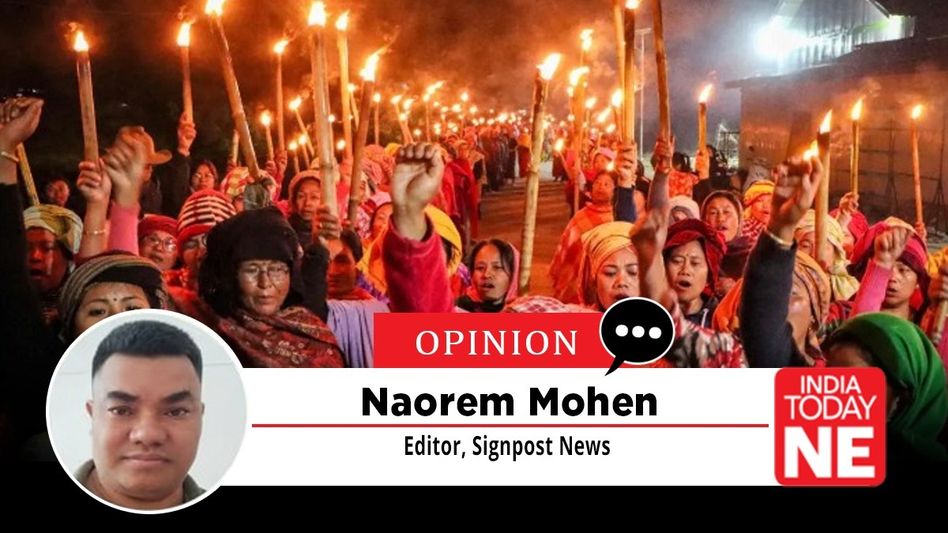
In a state where public platforms are often organised along ethnic lines, the image of Naga and Meitei organisations speaking with one voice carries meaning far beyond the immediate tragedy. It signals that even in a deeply fractured society, justice remains one of the few principles capable of bringing communities together.
The meeting, convened by the Joint Tribes Council Manipur, brought together a broad spectrum of organisations. Representatives from COCOMI, AMUCO, Imagi Meira, Foothills Naga Council, Liangmai Naga Council, Joint Tribe Councils and several others participated in the deliberations. Their collective position was clear. They resolved to pursue justice for the six victims and press the authorities to act with seriousness.
The importance of this unity must not be underestimated. Manipur has suffered not only because of violence but also because of the failure to build credible public confidence after violence. Every unresolved crime becomes a fresh wound. Every delayed investigation becomes a new source of suspicion. Every perception of selective justice deepens the divide between communities and the state.
The killing of the six Konsakhul civilians has therefore become more than a criminal case. It has become a test of whether the rule of law can still command trust in Manipur.
Addressing the media after the deliberations, JTCM Convenor Merachao Inka described the incident as a “gruesome and inhumane act” that had sent shockwaves across the Naga community and beyond. According to him, the bodies of the six victims were returned in a mutilated condition, making identification extremely difficult for their families.
Whoever saw the mutilated bodies of the hostages would have shivered at the brutality inflicted upon them. The cruelty was so extreme that many in Manipur are asking a painful question: even in times of war, has such treatment ever been heard of against Indian jawans by enemy forces across the border? If civilians can be abducted, tortured, dismembered, and returned to their families in such a condition without swift punishment, then the very meaning of law collapses. The perpetrators of this barbaric crime must be punished not for revenge, but to affirm that human life has dignity, that cruelty has consequences, and that no armed group or individual can stand above the law.
Such details are painful, but they explain the intensity of the public reaction. Families do not merely seek sympathy. They seek answers. They seek accountability. They seek the assurance that the lives of their loved ones will not be reduced to another entry in Manipur’s long record of unresolved violence.
The anguish of the families was made clear when Saimon Chawang, brother-in-law of Phenrongwi Thuimai, one of the hostages, expressed deep dissatisfaction with the government. “We don’t trust the government anymore. Those responsible for the murders must be arrested before we take the bodies home,” he said.
When bereaved families say they no longer trust the government, the issue is no longer only about one incident. It becomes a question of institutional credibility
That statement should trouble every institution responsible for justice. When bereaved families reach a point where they publicly say they no longer trust the government, the issue is no longer only about one incident. It becomes a question of institutional credibility.
The organisations alleged that cadres of the Kuki National Front-President were responsible for the abduction and killings. They further alleged that the kidnapping was carried out under the direction of the chief of Leilon Vaiphei village. They also claimed that certain members of the village women’s society and some police personnel were involved in facilitating the abduction.
The responsibility now rests squarely on investigating agencies and the government. They must establish the facts. They must identify the perpetrators. They must act against all those involved, regardless of affiliation, identity, status, or political connection.
This is where Delhi must listen carefully.
The participating organisations demanded that the Government of India and the State Government declare KNF-P a terrorist organisation. They also demanded the immediate abrogation of the Suspension of Operations agreement with Kuki militant groups.
These demands arise from a serious erosion of public confidence in the existing security framework. The SoO arrangement was conceived as a mechanism to reduce violence, contain armed activity, and create conditions for dialogue and peace. If any group operating under such an arrangement is alleged to have taken part in the abduction and murder of civilians, the arrangement itself comes under public scrutiny.
This does not mean that allegations alone should determine policy. It means that the government cannot continue as though nothing has happened. The SoO framework must be reviewed with honesty. Compliance must be verified. Ground conduct must be examined. Accountability mechanisms must be made visible. Agreements that exist on paper but fail to prevent violence on the ground cannot inspire public confidence.
A peace arrangement without accountability becomes a shelter for impunity. That is a danger Manipur cannot afford.
The meeting also entered the political domain by calling upon Deputy Chief Minister Nemcha Kipgen to resign on moral grounds, citing her marital relationship with KNF-P Chairman Thangboi Kipgen. This demand reflects the degree to which the incident has expanded beyond a criminal investigation into a wider question of public morality, political responsibility, and perceived conflict of interest.
In a sensitive state like Manipur, public office carries a burden beyond formal legality. It also requires moral distance from forces that are under serious public scrutiny. Whether the demand is accepted or contested, the political establishment cannot dismiss the sentiment behind it. Public trust is a fragile asset. Once damaged, it cannot be restored through silence.
Equally important is the demand for adequate compensation, rehabilitation support, and government employment for the families of the six victims. Justice cannot end with arrests and prosecution. The families left behind must be supported in a meaningful manner. No amount of compensation can replace a human life, but a responsible government must assist those who bear the consequences of violence.
This is not charity. It is a public obligation.
The state must also recognise that compensation alone cannot heal the wound. The families require clarity, dignity, timely legal support, and protection from further intimidation. They must not be made to run from office to office in search of relief. A government that fails victims twice, first by failing to protect life and then by failing to support families, loses moral authority.
Another issue raised during the meeting concerned Leilon Vaiphei village. The organisations described it as a settlement established by refugees who were allegedly granted land on a 100-year lease after their arrival in 1920. They claimed that the lease period had expired and further alleged that the village had become a recurring source of attacks on neighbouring areas, including Konsakhul.
These claims will require careful examination by competent authorities. Land, settlement history, customary rights, lease records, and security concerns must not be handled through rhetoric. They require documentation, legal scrutiny, and administrative clarity. In Manipur, many conflicts worsen because unresolved historical and administrative questions are allowed to remain vague for decades.
The larger significance of the Classic Hotel meeting lies in the convergence between Naga and Meitei organisations at a time when Manipur’s public life remains deeply wounded. This convergence does not erase all differences between the communities. Nor does it automatically resolve longstanding disputes. But it shows that common civic ground is still possible when the issue is justice.
That is precisely why Delhi must not treat this meeting as another local pressure event. It must be understood as a political signal. When 25 organisations from different social and ethnic backgrounds come together over the killing of civilians, the government must respond with seriousness, not routine assurances.
Manipur has paid an enormous price for delayed action. From the outbreak of violence to displacement, from highway insecurity to village attacks, from public distrust to competing narratives of victimhood, the state has repeatedly suffered because institutions acted late or appeared uncertain. Delay has become one of the most damaging features of governance in the state.
Every delay creates space for rumours. Every silence creates room for propaganda. Every unresolved crime strengthens the belief that justice depends on identity, influence, or armed power. This belief is corrosive. It weakens the idea of the state itself.
The government must therefore act on several fronts. First, the investigation into the abduction and killing of the six Konsakhul civilians must be credible, time bound, and transparent. Second, if evidence points to the involvement of any armed group, action must follow without hesitation. Third, the SoO arrangement must be reviewed in the light of ground conduct, not merely official files. Fourth, the families of the victims must receive immediate and dignified support. Fifth, the government must communicate clearly with the public to prevent speculation and mistrust.
The rule of law cannot remain an abstract phrase in official statements. It must be felt by the family waiting for justice, by the village living under fear, by the citizen travelling through conflict affected areas, and by communities who wonder whether the state will protect them equally.
The six men from Konsakhul deserve justice. Their families deserve answers. The Naga community deserves assurance that the lives of its civilians matter. The Meitei organisations that stood with the Naga organisations have also sent a message that justice cannot be selectively owned by one community.
That message deserves respect. Manipur does not need more symbolic condolences. It needs action that restores confidence. The Government of India and the State Government must understand that the present demand is not merely for punishment. It is for the restoration of faith in law, governance, and public accountability.
Delhi must listen this time because the appeal comes from a rare moment of unity. It comes from grief, but it also comes from civic courage. It comes from communities that have known division but have chosen to stand together for justice.
The government must not squander this opportunity.
If justice is delivered, it can become a small but meaningful step toward rebuilding trust. If it is delayed or diluted, it will deepen the belief that Manipur’s citizens must live under fear, violence, and impunity.
The choice before the government is clear. It can treat the killing of the six Konsakhul civilians as another tragic file. Or it can treat it as a decisive test of the rule of law.
For the sake of the victims, their families, and Manipur’s future, Delhi must choose the second path. It must listen this time because the appeal comes from a rare moment of unity!