
Did Five Congress MLAs Walk Out of Manipur Assembly Denouncing the NRC Resolution?
The Indian National Congress’s stand on the National Register of Citizens (NRC) in Manipur is nothing short of political duplicity. In the state, the party tries hard to project itself as a champion of citizen verification and protector of indigenous rights against illegal immigration.

- Apr 29, 2026,
- Updated Apr 29, 2026, 3:00 PM IST

The Indian National Congress’s stand on the National Register of Citizens (NRC) in Manipur is nothing short of political duplicity. In the state, the party tries hard to project itself as a champion of citizen verification and protector of indigenous rights against illegal immigration.
At the national level, it continues to paint the NRC as a communal weapon designed to divide India. This is not the beauty of federalism at work. It is classic Congress opportunism — saying one thing in Imphal to survive local pressures and singing an entirely different tune in Delhi to please its national ideological gallery.
To answer the question directly and clearly: No, the five Congress MLAs did not walk out denouncing the NRC resolution. Their exit was over procedural grievances, not opposition to the substance of NRC. Yet the timing was disastrous.
In a state already tense with ethnic fears and demographic anxieties, visuals of the main opposition party leaving the chamber during a crucial NRC reaffirmation moment gave critics, particularly the BJP, easy ammunition to question Congress’s real commitment. It created confusion and weakened the message at a critical time.
The Manipur State Assembly has passed a unanimous resolution demanding NRC on August 5, 2022, with Congress support. It was reaffirmed on March 1, 2024.
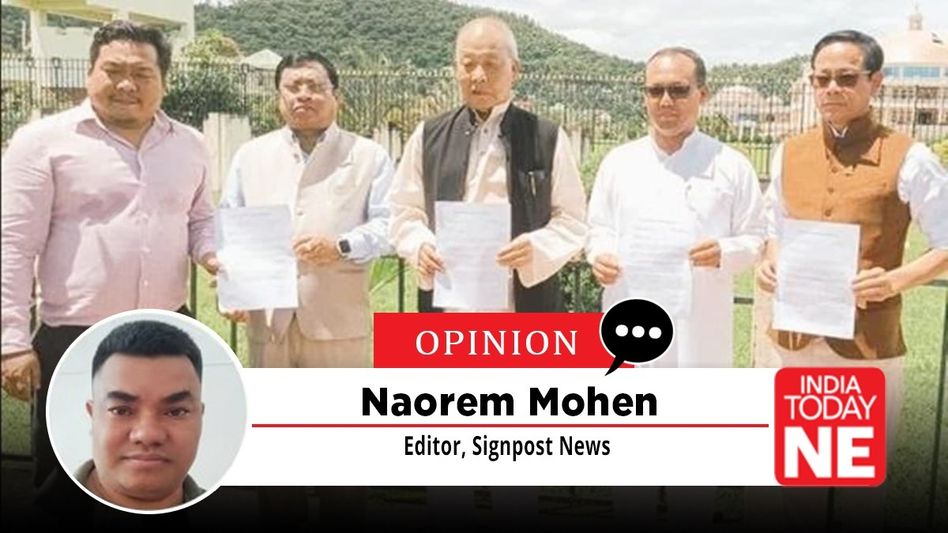
But then came the optics that raise serious doubts. On that very day of reaffirmation — March 1, 2024 — five Congress MLAs walked out of the Assembly House exactly when NPF MLA Leishiyo Keishing’s private member’s resolution on NRC was being taken up and later converted into a government resolution. The resolution passed unanimously among those who remained. The Congress members protested because the Speaker did not admit their own private member resolutions, especially one connected to the Kangla Resolution.
Senior leaders like former CM Okram Ibobi Singh later clarified that the walkout was not against the NRC. The party, they said, supports citizen verification. The issue was procedural — about opposition rights and the Speaker’s alleged bias. In the March 2026 session, Congress Legislature Party leader Keisham Meghachandra Singh moved a cut motion to defer the Census until illegal immigrants are identified — perfectly in line with the popular “No NRC, No Census” demand on the streets.
This incident is symptomatic of a deeper problem in the Manipur Congress. The state unit understands the ground realities and often speaks the right language. But procedural drama, mixed signals, and dependence on central cues prevent it from appearing fully consistent and credible. Strong words are undermined by avoidable optics.
At the national level, the contradiction is even starker. During 2019-2020, Congress under Sonia Gandhi and Rahul Gandhi aggressively opposed the CAA and any form of nationwide NRC. Sonia called the NPR a “disguised NRC” meant to fool the people. Rahul described the entire exercise as a fascist tool for polarisation. The party framed citizen verification as inherently anti-Muslim and divisive.
This national ideological position makes the Manipur unit’s activism look like a regional embarrassment that the high command would rather not own openly. The Congress has tried to bridge this gap by talking about a “decoupled NRC” — one implemented in Manipur without linking it to CAA.
The demand for NRC in Manipur is deep-rooted and legitimate. It did not begin with the 2023 violence. In 1980, the All Manipur Students’ Union (AMSU) and All Manipur Students’ Coordinating Committee (AMSCOC) launched the historic “Go Back Foreigner” movement. This forced the state government to sign an agreement on August 5, 1980, promising to identify and detect foreigners with 1951 as the base year.
A similar understanding was reached in 1994. Both promises remain largely on paper even today. The fresh urgency now comes from the approaching Census and delimitation. Without proper citizen verification first, illegal immigrants risk being absorbed into the system as legitimate residents, voters, and beneficiaries. This would permanently tilt Manipur’s demographic balance and endanger the very survival of its indigenous communities.
Congress MP Dr. Angomcha Bimol Akoijam has taken a refreshingly strong position on this. On March 27, 2026, he submitted a Rule 377 notice in the Lok Sabha, warning that census preparations were triggering protests and potential unrest. He demanded that both the Census and delimitation be deferred until a proper citizen verification exercise is completed.
In a detailed letter to the Union Home Minister the same day, Dr. Akoijam laid out concrete steps: update the National Register of Indian Citizens under the 2003 Citizenship Act amendment, establish a Foreigners Tribunal in Manipur under the new Immigration and Foreigners Act 2025, put in place safeguards to avoid Assam-type mistakes, and take firm law-and-order measures against illegal armed groups.
He backed his demands with hard facts — decades of migration from Myanmar and erstwhile East Pakistan, deliberate vote-bank politics that blur the citizen-non-citizen line, the dangerous linkage between illegal immigration, poppy cultivation, drug trafficking through the Golden Triangle, and Manipur’s porous border. He also highlighted the controversies of the 2001 Census, where abnormal population growth in certain hill districts forced the Gauhati High Court to order a fresh count.
These are not emotional outbursts. They are documented realities that every responsible leader from Manipur must confront.The Manipur Pradesh Congress Committee (MPCC) has also gone on record several times in support.
Dr. Bimol Akoijam himself has articulated this position. It allows the state unit to address Manipur’s unique vulnerabilities — porous borders, historical migration, and security threats — while the central leadership maintains distance from the BJP’s national narrative.
But this is tactical juggling, not honest politics. If illegal immigration and demographic invasion are real threats requiring urgent NRC in Manipur, the same logic should apply wherever similar problems exist. Selective application based on electoral convenience only exposes hypocrisy.
As of now, the central Congress leadership remains hesitant. It prefers to focus on relief, rehabilitation, and attacking the BJP’s handling of the ethnic crisis rather than explicitly backing the Manipur-specific NRC demand.
The Home Ministry’s reply to Dr. Akoijam’s submissions — stressing ongoing detection, deportation, and state empowerment under the 2025 Act — did not go far enough to satisfy local aspirations for a comprehensive exercise and deferral of Census and delimitation.This continued limbo damages Congress more than anyone else.
In Manipur, where the fight for indigenous identity, land, and survival is existential, people expect clarity and courage from their leaders. The state Congress has shown moments of resolve through resolutions and parliamentary interventions. Yet incidents like the 2024 walkout and the national leadership’s ambivalence create persistent doubt.
Congress must end this contradiction. Regional realities in the Northeast cannot be sacrificed at the altar of outdated national dogma. If the party genuinely believes in protecting indigenous communities from illegal immigration, it should own the NRC demand consistently — with necessary safeguards, transparency, and state-specific adaptations. Half-measures, procedural walkouts, and decoupled excuses only breed public cynicism. Voters in Manipur are watching closely. They can distinguish between convenient posturing and genuine commitment.
The evidence on the ground is clear. The Manipur Congress unit is already demanding and shaping the NRC framework, despite occasional slips. The national party lags behind, trapped by its own past rhetoric. Until Delhi aligns with Imphal’s reality, Congress will remain stuck in a self-created paradox — active where it suits, hesitant where it matters most.
MORE NEWS












Copyright©2026 Living Media India Limited. For reprint rights: Syndications Today
