Divine Panthou’s Teaching Is What Manipur Desperately Needs to Hear
What does it mean to preserve a faith without turning it into a reason to look down on someone else? In Manipur, Divine Panthou’s message offers an answer that reaches beyond religion—to how we live with one another and with the world around us.

- Sep 13, 2026,
- Updated Sep 13, 2026, 11:43 AM IST

- He linked devotion with compassion towards neighbours, animals and the natural world
- Cultural events at Masaikol help younger people learn rituals through participation
- Songs, chants and dances were presented as bridges between prayer and place
At a gathering in Imphal on September 12, marking the 32nd anniversary of Ibudhou Langoi Shafonglakhiba Day, Divine Panthou spoke about religion. Follow your own religion, he urged, but do not belittle another. One religion should not try to bring another down. People must respect one another.
Today, many religious leaders speak about the importance of faith. What caught my attention was that Divine Panthou spoke about how we should treat those who do not share ours. He was asking people to practise their beliefs sincerely while remembering that the person before them is a human being, with beliefs and feelings of their own.
That is a teaching anyone can understand. It is also one Manipur needs badly at this moment. We have grown accustomed to hearing people speak in the name of a community, a cause or a faith. We hear less about the care owed to someone outside that circle. Divine Panthou’s words ask us to widen it.
His concern for living beings is part of what makes his outlook meaningful to me. If religion teaches respect for humanity, its compassion should reach beyond humanity too—to the creatures with which we share this land. A person may be devoted in prayer and still need to ask how they treat a neighbour, an animal or the natural world around them. I hear in Divine Panthou’s teaching a call to bring those parts of life together.
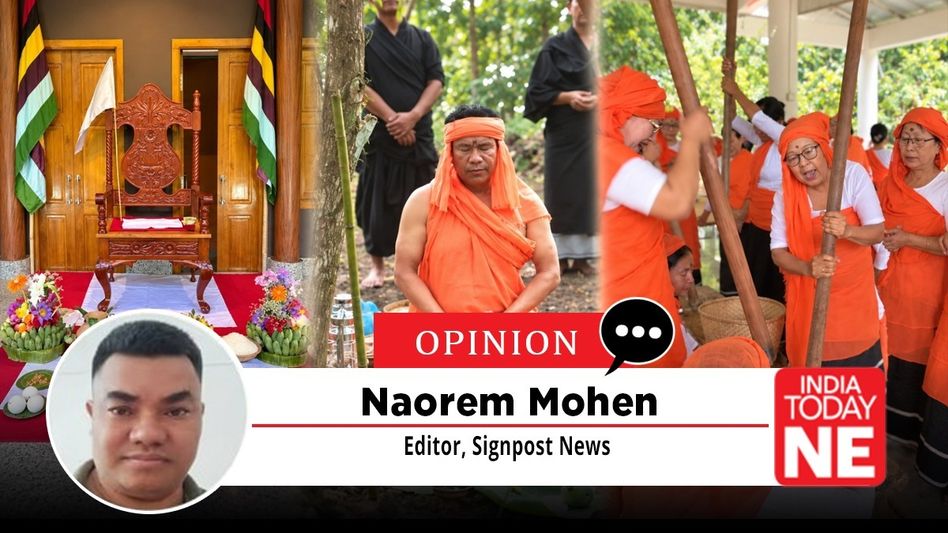
That does not make his commitment to Meitei Sanamahism any less strong. His work has helped bring ancestral practices before a younger generation through prayer, chant, dance and ceremony. Earlier, during the Panthou Laining Hinggatpa Thouram in January 2023, a dance called Mi Lai Ngamtai Chatkoi was performed. Speaking about Meitei Khunung Eshei, he drew attention to sounds familiar to anyone who has listened closely to the world around them: birdsong, the forest and children’s voices.
I find that way of speaking about tradition beautiful. It allows a child to hear a connection between a prayer and a place they know. A song can lead to a question; a question can lead to an elder’s story. That is how knowledge passes on. We cannot expect the next generation to preserve practices we have never taken the time to show them.
Gatherings associated with Divine Panthou’s Masaikol at Thalo Sipi Lok, on the foothills of Nongmaijing (Selloi Langmai Ching) in Imphal East, show people taking part in cultural performances and preparing food together in the traditional way. These acts may appear ordinary, but they give young people something they can see and remember. An elder’s hands at work can teach as much as a speech about heritage. Religion, in this sense, belongs to the daily life of a people as well as to moments of worship.
Yet we should pay close attention to what Divine Panthou said on September 12. A child learning to value Meitei religion must also learn how to treat a person who follows another religion. If that lesson is absent, pride in tradition can become an excuse for contempt. We would have taught the child the words of a prayer while neglecting the person standing next door.
Some Meiteis practise ancestral religion; others are Hindus or Christians. People with different beliefs may live in the same household, speak the same language and care for the same place. Across Manipur, we have neighbours whose faiths and customs are their own. We need not settle every disagreement about belief to recognise their right to live with dignity.
Divine Panthou’s appeal is all the more striking when we recall a dispute over his religious activities at Wangkhei in 2016, after which he left the area. When his followers later observed Anganba Numit, he asked them to forgive those he believed had wronged him. Asking people to forgive when they feel hurt is a demanding act. It gives weight to his present call for respect.
He also appealed to community leaders to tell the Government of India that there are Meiteis who follow their own religion, and to seek ways to protect and preserve it. He spoke of this as a moment to promote Meitei religion—a time when its renewal is possible. I hear urgency in that appeal. Prayers, songs and ceremonies survive when people continue to practise and teach them; leaders, too, have a responsibility to make sure this living tradition is recognised and has room to flourish.
None of this means we must remain silent about coercion or pressure in matters of faith. Such conduct should be challenged wherever it occurs. But defending religious freedom also means defending a person’s right to choose a faith different from ours. The test of respect comes when that choice is one we would not make ourselves.
This is why I find Divine Panthou’s teaching both universal and distinctive in this moment. Respect for other faiths, concern for humanity and care for living creatures are values people everywhere can recognise. In a Manipur where divisions have entered so many conversations, it matters that a leader devoted to preserving Meitei Sanamahism is urging people to practise it without bringing another religion down.
The present generation has a choice about what it passes on. We can teach our children our prayers, songs, dances and sacred places. We can also show them how to speak to a neighbour whose prayer is different and how to care for the living world around them.
If we follow both parts of Divine Panthou’s teaching, future generations will inherit a Meitei tradition they know how to practise and a Manipur in which they know how to live together. That is a future worth working for now.
(The views expressed in this article are those of the author and do not necessarily reflect the views of India Today NE or its affiliates)