Driven From Home, Still Waiting for Help: Internally Displaced Nagas of Manipur
Tangkhul and Liangmai Naga families displaced by violence are seeking government relief. Their appeals highlight gaps in food, schooling, security and rehabilitation support.

- Nov 06, 2026,
- Updated Nov 06, 2026, 3:50 PM IST

- Around 100 Tangkhuls are near Senapati, roughly 60 in Khabam
- Ningchou violence killed two civilians and triggered departures on October 11
- Host households accommodate up to 15 people with scarce essentials
A family that escapes an attack should not have to spend the following weeks wondering whether anyone in authority will help it survive. Yet this is the hardship described by Tangkhul Naga villagers from Ningchou in Kamjong who are now sheltering with relatives in Imphal, sharing rooms, food and clothing while waiting for government assistance.
Their immediate concerns are painfully ordinary: rice for the next meal, blankets for the approaching winter, medicines for elderly people and a classroom for children whose education has been interrupted. Their accounts also bring attention to a wider humanitarian concern, because Liangmai Naga families displaced from Makui, Konsakhul and other affected areas have similarly been struggling away from home, with civil society representatives alleging that their continuing needs have been neglected.
According to the latest ground reports, around 100 displaced Tangkhuls from Kamjong are sheltering towards Senapati, while roughly 60 are staying in Khabam, Imphal. These approximate figures require an updated official count, but they indicate how families have scattered beyond their villages in search of safety. They are internally displaced persons, not refugees from another country. Their dependence on relatives does not make their displacement less serious, nor should the absence of a designated relief camp make them less visible to the administration.
Should the government not recognise these displaced Naga families as internally displaced persons and extend the assistance their circumstances demand? Tangkhul families who fled Kamjong and Liangmai families displaced from Makui, Konsakhul and other affected areas have been forced from their homes by violence and insecurity, leaving them dependent on others for shelter and daily survival.
Staying with relatives rather than inside an officially designated relief camp does not lessen their displacement or the government’s responsibility towards them. Their appeals raise a troubling question: why must people who have already fled for their lives now plead to be recognised and assisted?
The two Tangkhul villagers from Kamjong district describe what happened after violence reached Ningchou on October 10. The man says his group left the village on October 11 and reached Imphal the following day, carrying little money and hardly any belongings. The woman recalls an attack by armed men whom she says came from the Myanmar side, the deaths of two innocent villagers and the fear that forced vulnerable residents to leave. National and local medias recorded two Naga civilian deaths at Ningchou, while the Tangkhul Naga Long alleged the involvement of the Kuki National Army–Burma, or KNA-B, and the Village Volunteers of Eastern Zone, or VVEZ.
Ningchou was not the only village named in accounts of attacks on Tangkhul settlements. In an October 21 statement, the Naga People’s Organisation, Senapati, cited attacks on Z. Choro, Wanglee and Namlee on May 7; Huimin Thana and Kherongram, a hamlet of Nampisha, on July 1; Pilong on September 24; and Ningchou on October 10. The organisation alleged a pattern of aggression involving KNA-B and VVEZ and demanded stronger civilian protection. It also reported that abandoned houses in Skipe and Pilong were set ablaze on October 18, after residents had fled amid threats and insecurity. These are allegations and incident accounts attributed to the organisation, rather than independently established findings about responsibility.
Subsequent reporting described another fire at Pilong on October 22, in which around 15 houses were reportedly burned by suspected militants. The repeated destruction of houses in an already deserted village deepens the meaning of displacement: people may escape with their lives, only to learn that the homes they hoped to return to have also been lost. This is the background to the Tangkhul woman’s appeal for officials to inspect burned houses and assess the damage. She says affected villagers have not seen the survey and assessment they need. The administration should clarify which villages have been inspected, what losses have been recorded and what assistance will follow.
Her account makes the hardship inside host households particularly clear. Some families, she says, are accommodating as many as 15 displaced people, while others are sheltering smaller groups. Those who escaped came without blankets, spare clothes or the resources needed for a prolonged stay. Parents and able-bodied villagers have remained behind to guard their settlements, leaving some children separated from their immediate families. The man similarly describes elderly people, students and people who are unwell among those seeking shelter. Their appeal is for an arrangement that allows them to stay safely, eat regularly and care for those who cannot manage on their own.
The other families from Kamjong sheltering with them have not received government support. These statements should prompt an immediate administrative visit. If assistance has already been delivered, officials should explain when, to whom and in what form; if these households have been missed, they should be included without further delay. Voluntary help can bridge an emergency, but it cannot sustain displaced families indefinitely.
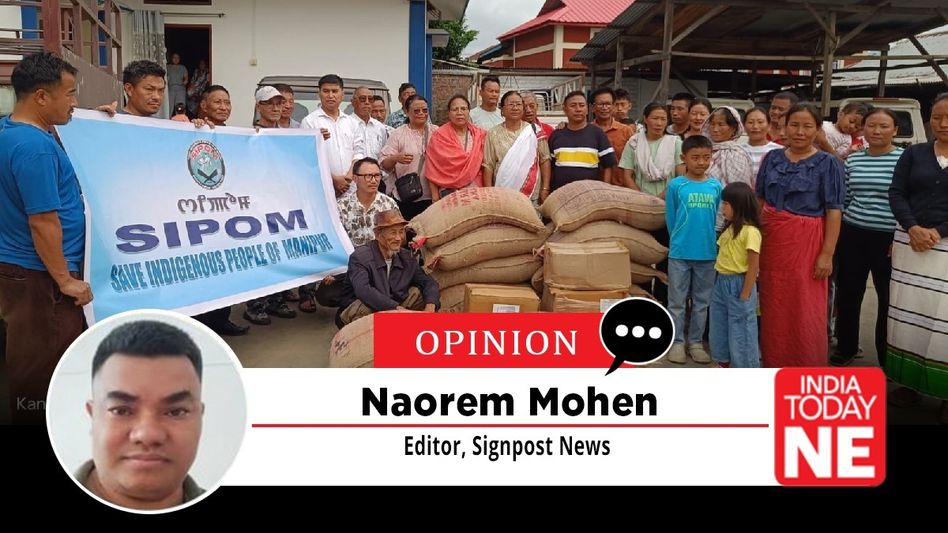
The experience of the Liangmai families must also remain within this discussion. M. Bobby Meitei, convenor of Save Indigenous People of Manipur, or SIPOM, says people displaced from Konsakhul, Makui and other affected Liangmai areas are staying in different locations, including around Konsakhul and in Senapati. He alleges that some families have received only limited supplies and have subsequently been left without adequate continuing assistance. Their circumstances may differ from those of the newly displaced Tangkhul families, but the central concern is shared: reaching temporary safety has not necessarily brought reliable support for daily survival.
There is evidence of official intervention in the Makui evacuations, and that must be acknowledged. Reporting on September 30 recorded that Senapati Police and the CRPF had evacuated 39 people from Makui Thebram and Makui Pipuram, with some staying with relatives and others accommodated at the Emesiiphro Community Hall relief centre. That rescue was important. It also establishes that the displacement was known to the authorities. The question now is whether the families have received sustained food supplies, medical care, educational support and rehabilitation assistance after evacuation. Moving people away from danger begins the government’s responsibility towards them; it does not complete it.
SIPOM’s allegation that displaced Nagas have been left outside comparable relief arrangements deserves a documented answer. Bobby refers to daily assistance of around Rs 80 being extended to other displaced people, although the applicable rules, coverage and disbursement require official confirmation. The government should publish a clear account of assistance reaching displaced families from Kamjong, Makui, Konsakhul and other affected places. An initial delivery of rice or bedsheets cannot reasonably be treated as sufficient when displacement continues for months and families have lost access to their livelihoods.
Accountability must extend to elected representatives and district administrations too. A Tangkhul man (hiding his identity) says his group has received no assistance from its MLA. At the same time, reporting shows that Phungyar MLA Leishiyo Keishing sought additional security deployment in Kamjong after the October violence and referred to an earlier request for reinforcement. That intervention deserves acknowledgment, but security appeals and humanitarian assistance are separate responsibilities. Families sheltering outside the constituency still need their representative’s help in securing accommodation, food, treatment and schooling.
The children’s situation is especially urgent. The man interviewed asks for admission to nearby schools even if only a short period remains in the academic year. There is something deeply troubling about a displaced parent having to plead for even a few remaining weeks of education. Schools and education officials should coordinate temporary admission, learning materials and examination arrangements, helping obtain records where these have been left behind. Children should not lose an academic year because the adults responsible for their protection have not arranged a workable response.
A practical relief effort should begin by visiting the places where families are actually staying, registering their needs and identifying those requiring urgent care. Where displaced people wish to live together, suitable accommodation should be arranged in consultation with them; where they prefer to remain with relatives, support should reach those households.
At the same time, relief cannot replace the work of making return possible. The government must protect vulnerable villages, assess damaged homes and establish conditions in which families can return voluntarily with confidence that they will remain safe. A return programme that leaves people exposed to renewed violence would merely begin another cycle of displacement.
The Tangkhul families from Kamjong and the Liangmai families from Makui, Konsakhul and other affected areas are asking for recognition through action. Their needs should not be ranked by community, political influence or the visibility of their suffering. For those now depending on relatives, the next meaningful response would be an official at the door, food that arrives reliably, medicines for the unwell and children returning to class. They have already left their homes to survive. They should not have to keep pleading for the means to live.
The government cannot regard silence as an adequate response to families who have lost their homes and are struggling to survive. Waiting until suffering turns into agitation places another burden on people already living through fear, bereavement and uncertainty. Displaced families should not have to organise a rally, block a road or repeatedly approach officials before their needs receive attention. The accounts from Kamjong, Makui and Konsakhul are sufficient reason for the administration to reach them, establish what assistance is missing and provide it without further delay.
The displaced Tangkhul villagers’ appeal for the deployment of Manipur Police and other state security personnel also deserves a serious response. Their stated loss of confidence in the existing security arrangements cannot be dismissed without examining the incidents behind it.
The wider public concern was evident at the November 5 rallies in Ukhrul and Kamjong, where participants demanded a resolution to the Manipur crisis, withdrawal of Assam Rifles from Naga areas and abrogation of the Suspension of Operations agreement with Kuki militant groups. Organised by Tangkhul bodies under the aegis of the United Naga Council, these demonstrations brought the community’s security concerns directly before the authorities.
The state government and the Centre must engage with these demands, examine the allegations behind them and explain what action they will take. The villagers’ request for state police deployment requires a concrete assessment of how their settlements can be protected, while the demand for SoO abrogation requires a substantive response from the governments responsible for the agreement.
Another memorandum acknowledged without meaningful follow-up will offer little reassurance to people afraid to return home. For the Tangkhul and Liangmai families now scattered across shelters and relatives’ houses, responsible government must become visible through food, schooling, protection and a credible path home, before further hardship forces them onto the streets to demand what should already have reached them.