Durand Cup at Manipur University: A Legacy Placed Before the Youth
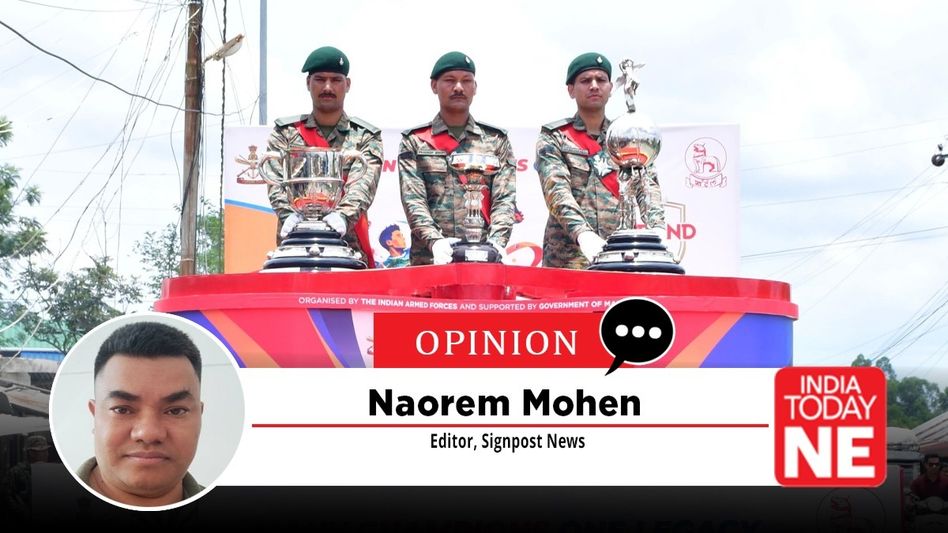
When the Durand Cup Trophy Tour reached Manipur University on July 15, 2026, Vice-Chancellor in-charge Prof. Sumitra Phanjoubam placed the occasion in its proper perspective.

- Jul 15, 2026,
- Updated Jul 15, 2026, 1:54 PM IST

When the Durand Cup Trophy Tour reached Manipur University on July 15, 2026, Vice-Chancellor in-charge Prof. Sumitra Phanjoubam placed the occasion in its proper perspective.
Speaking on behalf of the University community, she welcomed the prestigious trophy tour to the campus and thanked the organisers, the GOC in Command, members of the Armed Forces, University officials, faculty members, staff, officers, students, schoolchildren from neighbouring institutions, and representatives of the print and electronic media.
Her remarks were significant because they did not reduce the event to ceremony. She reminded the gathering that the Durand Cup is one of Asia’s oldest and most prestigious football tournaments, and that its arrival at Manipur University gave students a rare opportunity to connect with a glorious sporting legacy. More importantly, she interpreted the presence of the trophies as a source of motivation, a reminder of the values that sport instils in young people: teamwork, leadership, companionship, perseverance, hard work and dedication.
This was the real meaning of the July 15 event.
The trophies reached the University campus at Canchipur at 12:45 p.m. as part of the Imphal leg of the 135th edition of the Durand Cup and halted for about 30 minutes. In official terms, it was one stop in a larger Trophy Tour. In public meaning, it was a moment when football entered the academic space of Manipur’s most important university.
The occasion was attended by Vice-Chancellor in-charge Prof. Sumitra Phanjoubam, Registrar Prof. Moirangthem Premjit Singh, Lt. Gen. (Dr.) Konsam Himalay Singh (Retd.), GOC 57 Mountain Division Major General Subhankar Basu, SM, VSM, Prof. Maibam Chourjit Singh, HoD, Department of Physical Education and Sports Science, Manipur University, and other organisers. Students from different schools welcomed the Durand Cup trophies as the convoy entered the Manipur University campus, giving the event a youthful and cultural character.
The Vice-Chancellor in-charge was correct in observing that Manipur is regarded as one of the sporting powerhouses of the nation. Despite its small geographical area, the state has produced Olympians, Arjuna Awardees, national champions and international achievers across several disciplines. This record is not accidental. It is built on family sacrifice, community support, individual discipline and a sporting culture that has taken root across generations.
Prof. Sumitra Phanjoubam’s observation that people may find it remarkable to see Olympians walking on the streets of Manipur captured something essential about the state. In many places, an Olympian is a distant figure. In Manipur, sporting excellence often comes from familiar neighbourhoods, local grounds and ordinary families. This closeness between achievement and everyday life has given Manipur a distinct sporting confidence.
Her central message was that the arrival of the Durand Cup trophies at Manipur University was not merely a display of historic sporting objects. It was a source of inspiration for students. It reminded them that hard work, perseverance, dedication and a positive mindset can bring success. This message deserves attention because it speaks directly to the responsibility of a university.
A university is not only a place where degrees are awarded and examinations are conducted. It is a place where young people are formed. It must teach knowledge, but it must also cultivate discipline, confidence, humility, courage and public responsibility. Sport contributes to this formation in a direct and powerful way.
Football teaches preparation. It teaches teamwork. It teaches respect for rules. It teaches acceptance of defeat and restraint in victory. It teaches young people that talent alone is insufficient unless supported by discipline. These are not only sporting lessons. They are civic lessons.
This is why the Durand Cup Trophy Tour at Manipur University was not an interruption of academic life. It was an extension of it.
The Durand Cup, established in 1888, carries one of the longest histories in Indian football. It is closely associated with the Indian Armed Forces and has continued through different periods of Indian public life. Its endurance gives it rare institutional weight. When such a tournament brings its trophies to a university campus in Manipur, the act has symbolic value. It connects history with youth, football with education, and national sporting memory with regional aspiration.
For Manipur University, the moment carried added significance. The University has passed through phases of uncertainty, institutional strain and recovery. In such circumstances, positive public occasions matter. They remind students and faculty members that a campus is not meant to be defined only by pressure, administration and conflict. It must also be a place of gathering, celebration, confidence and aspiration.
The presence of Prof. Sumitra Phanjoubam as Vice-Chancellor in-charge gave the event an institutional seriousness. Her speech rightly placed students at the centre of the occasion. She expressed the hope that among the students gathered on the campus, there may one day be champions who will represent Manipur and India in national and international competitions. This was not an exaggerated claim. In Manipur, such hopes are rooted in lived experience.
Many champions from the state began in modest conditions. They trained on local grounds. They balanced studies, family obligations and sporting dreams. They travelled long distances for competitions. They succeeded because of perseverance and community support. To tell students that they too can rise through dedication is not empty encouragement. It is a lesson drawn from Manipur’s own sporting history.
The participation of school students gave this message greater meaning. Their dance performances as the trophy convoy entered the campus brought cultural warmth to the event. The moment allowed schoolchildren to see a university as a place of welcome and possibility. It also allowed university students to witness the continuity between childhood enthusiasm and higher education.
Such moments have quiet educational value. A child who sees the Durand Cup trophies at Manipur University may remember not only the trophies, but the atmosphere, the welcome, the discipline and the message that achievement is possible. Public symbols can influence young minds when they are placed in meaningful settings.
The role of 19 Garhwal Rifles in bringing the Durand Cup Trophy Tour to Manipur University deserves sincere appreciation. As part of the Local Organising Committee for the 135th edition of the Durand Cup in Imphal, 19 Garhwal Rifles has been playing the lead facilitative role in the conduct of this prestigious tournament. The Commanding Officer of 19 Garhwal Rifles is the Nodal Officer for the event, and the battalion has functioned as the single point of contact for planning, coordination and execution of the Imphal leg.
This role is not merely administrative. The conduct of a tournament of this stature requires disciplined coordination across military formations, civil authorities, state administration agencies, event production teams, security personnel, venue managers and local institutions. From venue preparation and protocol management to crowd control, administrative support and feedback to higher authorities, the work behind the scenes is demanding and often invisible to the public.
The smooth arrival of the Trophy Tour at Manipur University reflected this organised effort. 19 Garhwal Rifles helped provide the backbone for a dignified public engagement. Its facilitative role ensured that the legacy of the Durand Cup reached not only the stadium and official venues, but also an academic campus where young people could encounter its meaning.
This deserves acknowledgement because public events succeed through institutional cooperation. A university alone cannot create such a moment. A military unit alone cannot give it educational meaning. A sports tournament alone cannot create public value unless institutions and people receive it with seriousness. The July 15 event became meaningful because these different actors converged around a common purpose.
The stated purposes of the Trophy Tour included photo opportunity, a brief gathering, legacy of football in Manipur, youth engagement, national integrity, visibility and pride. These phrases found substance at Manipur University because the event brought together students, teachers, organisers, schoolchildren, military representatives and the media.
Youth engagement is not a decorative expression. It is a public requirement. Manipur’s young people need platforms that give them direction, confidence and exposure. They need to see achievement not only in terms of examinations and employment, but also in discipline, teamwork, creativity and sporting excellence. A university should help widen their understanding of success.
National integrity also acquires practical meaning through sport. It is easy to speak of unity from formal platforms. It is harder to create spaces where people from different regions, institutions and backgrounds gather under common rules and shared enthusiasm. Football does this naturally. The Durand Cup does it through competition, participation and continuity.
This matters deeply in Manipur. The state has endured difficult years marked by social tension, disruption and uncertainty. A football tournament cannot resolve deep public problems. It should not be burdened with such expectations. But sport can create constructive spaces. It can bring young people together without asking them to erase their identities. It can create common ground without denying difference. It can remind society that competition need not become conflict.
The arrival of the Durand Cup trophies at Manipur University should therefore be understood as a small but meaningful act of public confidence. It offered students, teachers, staff and schoolchildren a moment to gather around something positive. It reminded the campus that pride can be disciplined, inclusive and constructive. It brought to the University a national sporting tradition while respecting the local football identity of Manipur.
The timing of the event gave it greater relevance. Imphal is one of the host cities for the 135th edition of the Durand Cup, along with Kolkata, Ranchi, Shillong and Guwahati. The Khuman Lampak Stadium is set to host league-stage matches from July 28 to August 17, besides one quarter-final. The Manipur leg will feature TRAU FC and NEROCA FC, two clubs that carry the football aspirations of the state, along with the Indian Navy Football Team and FC Raengdai.
For students at Manipur University, this made the Trophy Tour immediate and relatable. The trophies were not distant symbols belonging to another city. They belonged to a tournament that Imphal itself will host. They belonged to a competition in which local clubs will participate. They belonged to a football culture many students have grown up watching, playing and supporting.
This is where the academic and sporting meaning of the occasion came together. A university has the capacity to interpret events. It can turn ceremony into reflection. It can help students understand why the Durand Cup matters, why Imphal’s role as a host city matters, and why Manipur’s football legacy must be supported through institutions, not only emotion.
Manipur University should build upon this moment. The Trophy Tour should not end with photographs and memories alone. It should encourage the University to think seriously about sports education, campus tournaments, physical fitness, sports research, student volunteering and collaboration with local clubs and sporting bodies. A university located in a state with such sporting talent cannot treat sport as a marginal activity.
The Durand Cup trophies provided such a moment. Prof. Sumitra Phanjoubam’s words gave the event its larger educational meaning. She thanked the organisers for including Manipur University in the Trophy Tour and expressed confidence that the students would be motivated to adopt a healthy lifestyle, remain positive, work hard and persevere in whatever they seek to achieve. This was the most important message of the day.
For Manipur, football carries a special emotional weight. It is one of the state’s most democratic cultural spaces. One does not need privilege to love the game. One needs a field, a ball, discipline and a community willing to support the player. From such modest beginnings, Manipur has produced talent of national importance. That story must be honoured not by nostalgia alone, but by institutional support.
The July 15 Trophy Tour was brief. But brevity does not reduce significance. Some public moments matter because they condense history, pride and possibility into a short encounter. The Durand Cup trophies, standing for a few minutes inside Manipur University, carried the weight of Indian football history and the promise of Manipur’s youth.
For the University, the lesson is clear. Academic institutions must not remain spectators to the energies of society. They must receive them, interpret them and guide them. Football has entered the campus. The task now is to ensure that the values it represents, discipline, teamwork, fairness, courage and collective pride, remain part of Manipur University’s educational life.
The Durand Cup Trophy Tour at Manipur University was therefore not merely a ceremonial stop. It was a reminder that education and sport belong together. It was a reminder that Manipur’s football legacy must find support within its institutions.
Above all, it was a reminder that a university becomes truly meaningful when it participates in the aspirations of its people.