
Enough of Blame Games: Time for Practical Action on Manipur’s NRC
Manipur’s NRC debate is moving towards a records-based update using voter, census and land documents. That shift sharpens the focus on digitising archives and securing Central approval for rollout.
Advertisement

Naorem Mohen
- May 08, 2026,
- Updated May 08, 2026, 2:07 PM IST
Story highlights
- Manipur has legal and administrative groundwork ready for an NRC exercise
- The 2022 ILP guidelines recognise multiple historical records as residence proof
- RTI replies fuelled questions over records cited in the 2015 bill
It is no longer the time for passing the ball, engaging in endless political blame games, or diverting public energy into sterile debates. Whether the 1951 NRC copy for Manipur will eventually surface or not, whether the exercise was conducted at all, or whether it was implemented successfully — these questions have been debated enough. Equally unproductive are arguments over the base year — 1951 versus 1961 — and accusations about why the BJP government favoured one cut-off over the other, or why civil society organisations have not aggressively questioned the authorities on these points. All such discussions, while emotionally charged, only waste precious time and fragment our focus at a critical juncture.
The core agenda remains crystal clear: Manipur urgently needs a National Register of Citizens to safeguard its indigenous identity, demographic balance, and resources. Instead of prolonged controversy, the state and its people must now concentrate on the practical path forward — preparing an NRC updation using the readily available archival records that already exist.
At the same time, the Central Government must be persuaded to fully support and commit to this exercise, recognising the unique and pressing demographic vulnerabilities that make NRC implementation in Manipur not just desirable but essential for long-term stability and survival of the native population.
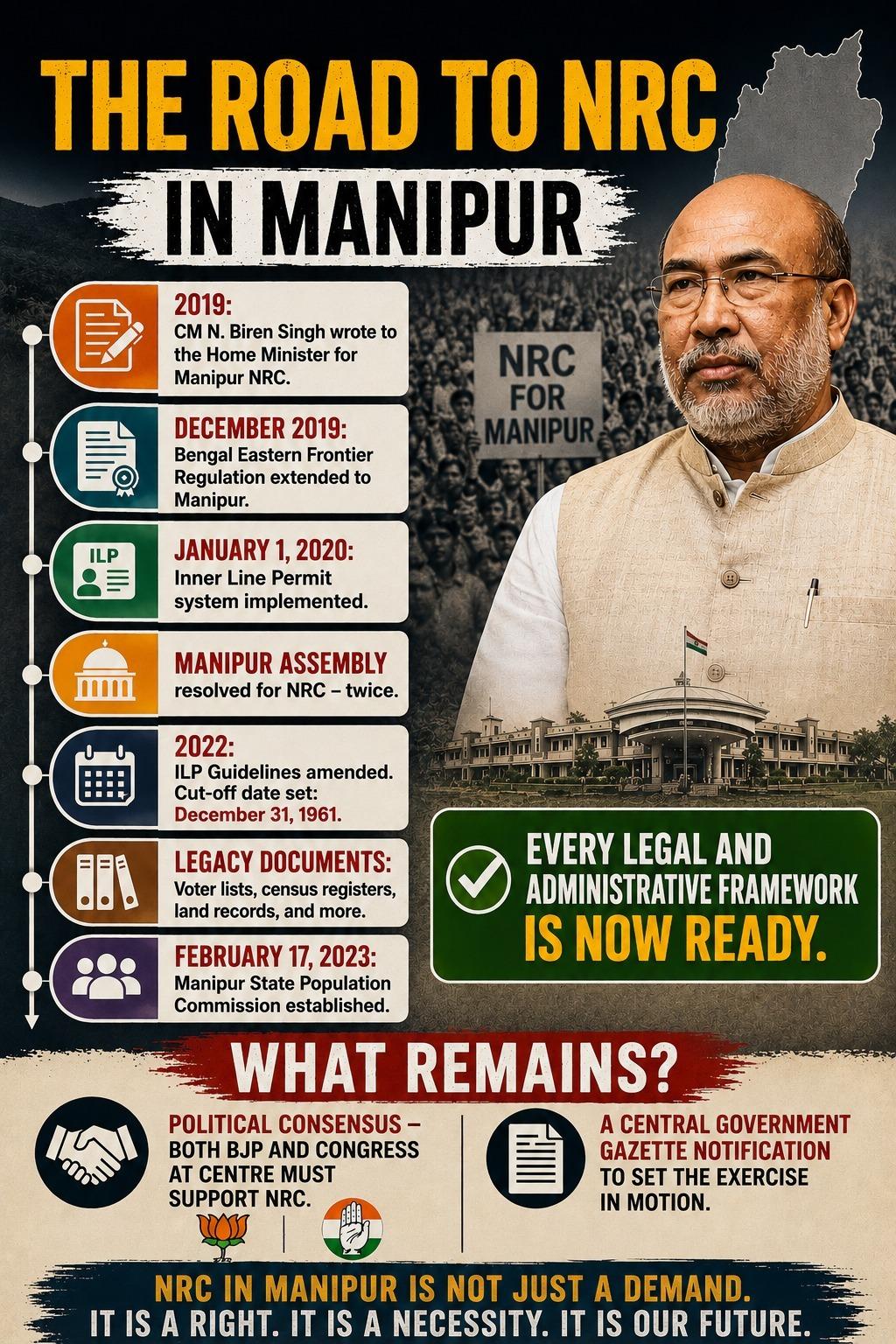
The journey towards implementing the National Register of Citizens (NRC) in Manipur has seen steady progress over the years. In 2019, Chief Minister N. Biren Singh formally wrote to the Union Home Minister demanding an NRC for the state. In December 2019, the Bengal Eastern Frontier Regulation was extended to Manipur, followed by the implementation of the Inner Line Permit (ILP) system on January 1, 2020.
The Manipur Assembly passed resolutions supporting the NRC twice. In 2022, the ILP guidelines were amended and a cut-off date of December 31, 1961 was established. The state has also identified legacy documents such as voter lists, census registers, and land records to support the process. On February 17, 2023, the Manipur State Population Commission was established. With these steps, every legal and administrative framework required for the NRC is now ready. What remains is political consensus, with both the BJP and Congress at the Centre needing to support the initiative, along with a formal Gazette Notification from the Central Government to officially begin the exercise.
In this context, Chief Minister Yumnam Khemchand has shown welcome proactivity by initiating concrete steps toward NRC updation. The formation of a state-level committee and the organisation of seminars involving experts, civil society groups, and all relevant stakeholders mark a positive and constructive shift. These efforts deserve full support from every section of society — political parties, civil society organisations, student bodies, and the general public — so that the process can move forward with unity, transparency, and collective ownership rather than division.
The way forward is clearly outlined in an official notification issued by the state government. On 23 September 2022, the Manipur Home Department released the Inner Line Permit (Amendment) Guidelines, which introduced an important new definition: the “Record of residence in the State of Manipur.”
According to the guidelines, this record includes “Government records such as voter lists, Census Village registers, head of the households for house listing operations data, head count individual data for population enumeration data of Census of India, land records, or any other document of the year or period as the case may be, as the Government may, by order, specify from time to time” (Government of Manipur, Home Department 2022, para 2A(iii)).
This approach demonstrates thoughtful governance. Rather than depending on one specific paper, it acknowledges that official documentation is spread across different departments and accepts a variety of sources as valid proof. Voter lists are maintained by the Election Commission, census village registers by the Census Directorate, and land documents by the Revenue Department. All of these now qualify as legitimate evidence under the guidelines.
This flexibility is crucial. Anyone seeking to prove ancestral connection to Manipur can use a range of pre-1961 documents — a 1952 voter list, a 1951 census village register, a 1959 land record, or several of them together. Each carries the same legal weight for establishing Permanent Resident status. The missing 1951 NRC, therefore, creates only a limited gap that can be filled effectively using these other reliable sources. The legal structure has already anticipated and addressed this exact challenge.
Historical Reality: The 1951 NRC Was Prepared, But Its Records Are Missing
The current inability to locate the 1951 NRC does not mean the register was never created. Historical and administrative evidence confirms that it was compiled in Manipur during the national census process of 1951. The real issue lies in the physical documents, which have not surfaced despite multiple attempts to trace them.
Public awareness of this gap emerged clearly in 2015 following a Right to Information request submitted by political analyst Laihaothabam Saratchandra to the Manipur Home Department. The department stated it did not hold the records and referred the matter to the Directorate of Census Operations. That office responded that it was “not aware of the authority which prepared the 1951 NRC,” making the requested information unavailable. It later reiterated that it had no knowledge about the preparation of the National Register of Citizens, 1951.
These replies were particularly significant because they came soon after the state assembly had passed the Protection of Manipur People Bill, 2015, which defined “Manipur people” based in part on the 1951 NRC, the 1951 census report, and the 1951 village directory, along with their descendants. Saratchandra pointed out the risk that the government could be accused of misleading the legislature by relying on a document whose location was unknown.
Besides, the Office of the Registrar General, India (Ministry of Home Affairs) has also replied to Shri Khoirom Gourashyam Singh’s RTI application dated 25.04.2025. In its letter dated 30.05.2025, the department clearly stated that the National Register of Citizens (NRC) was not conducted in Manipur in 1951 (Point 1(a) – “No”). It further informed that the specific information sought under Point 1(c) is not available with the Central Public Information Officer (CPIO), as public authorities can only provide records that already exist in their possession. The reply also mentions the option to file an appeal within 30 days if the applicant is not satisfied.
Additional expert input reinforced the situation. In February 2024, retired professor R.K. Narendra, former head of Biostatistics at the Regional Institute of Medical Sciences, highlighted during a public discussion that the 1951 NRC records for Manipur were unavailable due to unclear reasons. He encouraged citizens to file further RTIs to help locate them. While initial questions about whether the register was ever prepared have been settled by documentary proof of its existence, the location of the actual papers remains unknown. They may have been misplaced, damaged, or lost amid administrative changes over the decades. With each passing year since the 2015 RTI, the chances of recovery grow slimmer.
Building a Reliable Baseline Using Multiple Records
Since the 1951 NRC remains out of reach, the state can construct a strong foundation for the NRC by combining the various surviving official records. Far from being second-best, these documents together create a detailed and interconnected picture of pre-1961 residents.
Voter lists from the 1952, 1957, and 1961 elections provide valuable village-level information on adult citizens, frequently including family connections such as father’s or husband’s names. Census village registers from 1951 and 1961 offer even broader coverage by listing every household member, including children. Land revenue records add another layer by documenting property owners and tenants, capturing individuals who might have been overlooked in electoral or census exercises due to remoteness, illiteracy, or social circumstances.
The verification process remains thorough and consistent with established methods. A claimant would identify a pre-1961 ancestor — for example, a grandparent. Officers would search the digitised collection of available records for a matching entry in any accepted document. Once a link is confirmed, they would cross-check against other verified claims to rule out inconsistencies or duplication. This mirrors the matching techniques used successfully elsewhere, differing only in the variety of source materials.
Individual record sets have natural limitations — voter lists may miss some adults, census data may be incomplete in remote areas, and land records may exclude those without property. The strength of the Manipur approach lies in allowing multiple document types. If one source does not show the ancestor, another often will. For communities practising shifting cultivation, census registers or officially notified headmen’s reports can provide the necessary evidence. This inclusive design ensures broader and fairer coverage, especially for historically marginalised groups.
Accepting the current unavailability of the 1951 NRC opens the door to a better system. A single-document model inevitably carries forward any gaps or biases present in that one source — such as under-counting of women, nomadic tribal populations, or landless families.
Manipur’s guidelines, by recognising several categories of records and allowing the government to add more as needed, create built-in redundancy. This redundancy promotes greater accuracy and fairness. A woman absent from old voter rolls might still appear clearly in her father’s census household entry. A landless individual could be recorded in village registers. Groups missed during one enumeration may surface in subsequent revisions. The outcome is a legacy database that more accurately reflects the true composition of pre-1961 Manipur than any isolated document could achieve. The missing register, rather than weakening the process, invites the creation of a more robust and representative foundation.
Launching an Urgent Archival Mission
The most immediate threat is not the absent 1951 NRC but the ongoing deterioration of the records that still exist. Many of these ageing documents remain stored without proper protection or digitisation, making them vulnerable to damage from environmental factors, pests, or simple neglect. Manipur should therefore initiate a dedicated, time-bound archival project without delay. The mission would involve:
1. A thorough survey of all relevant government repositories, including Election Commission archives, the Census Directorate, Revenue Department record rooms, the Secretariat Library, and district court land files.
2. Professional high-resolution digitisation that captures every detail, including handwritten notes and seals, with secure, duplicated digital storage.
3. Comprehensive indexing of names, villages, and family links to make the database user-friendly and searchable.
4. Official notification in the gazette to formally recognise the digitised records as valid “Records of residence” under the 2022 guidelines.
With Manipur’s current population of about 3.2 million, the volume of pre-1961 records is significantly more manageable than in larger states. Properly resourced and supported by political commitment, the entire exercise can realistically be completed within two to three years. The required investment is reasonable when weighed against the much higher long-term costs of continued demographic uncertainty and potential social instability.
Moving from Records to a Verified Register
Once the pre-1961 records are digitised into a searchable database, the NRC process can proceed in an organised and transparent manner. Citizens would submit applications linking themselves to an ancestor appearing in the legacy data. Verification officers would confirm the connection and ensure no conflicting claims exist. Approved cases would be added to the register, while unresolved ones would receive a fair hearing before a Foreigners Tribunal, with opportunities to present further evidence and access legal support.
Importantly, the ILP system allows this work to move forward step by step rather than in one dramatic nationwide drive. Permanent Resident certificates can begin being issued immediately using whatever records are currently accessible. Each new certificate adds certainty and gradually builds the complete register. Linking this system with the existing electronic ILP portal, which already collects biometric and personal details of outsiders, would create a comprehensive, up-to-date view of residency in the state.
Lessons from other states highlight the difficulties of relying on one document source and rushing through a single massive operation. Manipur has the opportunity to follow a smarter route — one that draws on diverse records, proceeds gradually, and includes flexibility for genuine cases. The 2022 guidelines supply the legal basis for exactly this kind of measured, effective implementation.
The fact that the 1951 NRC records have not yet been found is a matter of historical circumstance rather than any shortcoming in current policy. Multiple official responses, expert observations, and legislative documents confirm that the register was prepared, even if its physical copies have not been traced despite sincere efforts. This reality must be accepted, but it can also be effectively addressed.
Through the Manipur Inner Line Permit (Amendment) Guidelines of 2022, the state has established a practical, multi-source definition of residence records. By promptly safeguarding and digitising the available voter lists, census registers, land records, and other official documents from before 1961, Manipur can create a foundation for its NRC that is more complete, more inclusive, and more reliable than reliance on any single historical register would have allowed.
The real task is not to remain trapped in blame games or academic debates over cut-off years. It is to act decisively on the rich materials that are still within reach, back the Chief Minister’s initiatives wholeheartedly, and secure firm commitment from the Centre for this vital exercise. The necessary legal authority is already in place, modern technology makes the work feasible, and pressing demographic concerns provide strong motivation.
All that remains is to begin the archival mission with clear purpose, unity, and sustained commitment. Doing so will help secure clarity on citizenship and protect the interests of genuine residents in a fair and forward-looking manner.
NRC in Manipur is not just a demand. It is a right. It is a necessity. It is our future.
POST A COMMENT