Gunfire in the Hills, Festival Plans in the Valley: Manipur’s Dangerous Split-Screen
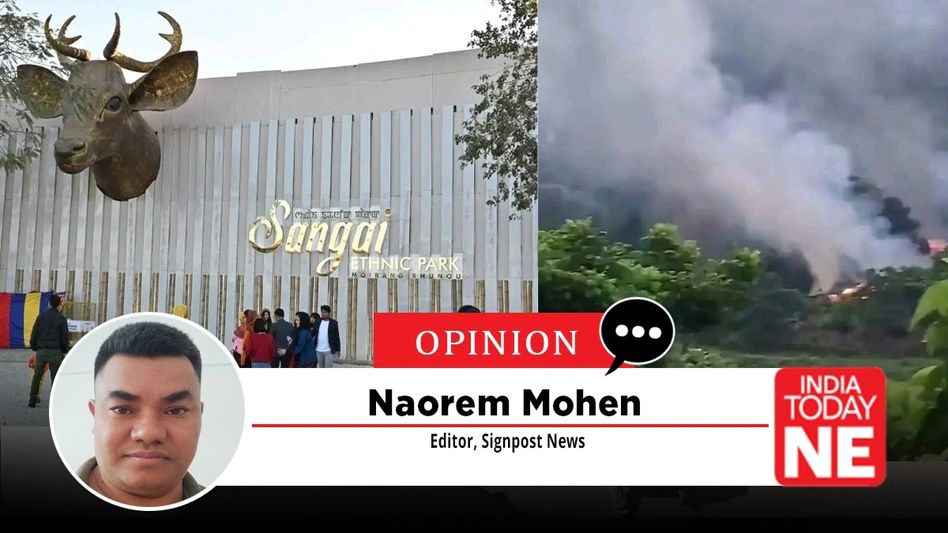
Two days after a 17-year-old Naga boy was killed, fresh attacks have been reported from the hill districts. Yet the government is preparing to spend another Rs. 15 crore on the Sangai Festival, despite the boycott and disastrous turnout that marred its 2025 edition.

- Sep 23, 2026,
- Updated Sep 23, 2026, 1:09 PM IST

Two days after a 17-year-old Naga boy was killed, fresh attacks have been reported from the hill districts. Yet the government is preparing to spend another Rs. 15 crore on the Sangai Festival, despite the boycott and disastrous turnout that marred its 2025 edition.
Two days after a 17-year-old Naga boy was shot dead in Tamenglong district, reports of fresh firing, attacks and burning emerged from Manipur’s hills on Wednesday morning.
Initial accounts said Makui Chamriupiu, a Naga village, was attacked and houses were set on fire. Firing was also reported around Lasan, a Kuki village, while Tazaikaiphun under Nungba Sub-Division reportedly came under attack.
What is already clear is that the violence did not end with the killing of Nk Wiphenbou. Wiphenbou, a 17-year-old Liangmai Naga boy from Nkou Naga village, was reportedly walking alone from Upper Nkou towards Malek village near Tamei when he was ambushed at around 10.05 am on September 21. Police recovered his body and took it to the Tamenglong mortuary.
He was not travelling with an armed group or involved in a confrontation. He was a teenager reportedly going to buy essential items when the conflict found him.
His killing should have forced the Manipur government to reassess the security situation across Tamenglong, Noney, Kangpokpi and the adjoining hill areas. Instead, within two days, villages were again reporting gunfire and attacks.
These can no longer be treated as isolated incidents to be answered with routine statements of condemnation. They show that armed actors retain the capacity to move through vulnerable areas, attack civilians and deepen distrust between communities while the state struggles—or fails—to establish effective control.
At the same time, the Manipur government is preparing for another edition of the Sangai Festival, the state’s principal tourism and cultural showcase.
There is nothing inherently wrong with organising a festival. Sangai provides a market for artisans, performers, traders, farmers, transport operators and small businesses whose livelihoods have suffered through years of conflict. A state cannot suspend its cultural and economic life indefinitely. Restoring ordinary public activity can be part of recovery.
But normalcy cannot simply be staged in the Imphal valley while gunfire continues in the hills.
More than 100 days after the bodies of six abducted Naga men were recovered, their mortal remains are still lying in the JNIMS mortuary as the families and the government have yet to reach a resolution that allows their final rites to be performed. The men were reportedly abducted on May 13, and their bodies were recovered on June 10.
Their prolonged wait for burial is not merely a dispute over custody of remains; it is an indictment of a state that has failed to deliver justice, accountability or even closure to the bereaved families. When six citizens remain unburied for more than three months and fresh bodies continue to arrive at mortuaries, what normalcy is the Sangai Festival expected to celebrate?
A festival intended to present Manipur’s culture to India and the world cannot be offered as evidence of peace if villagers elsewhere in the same state are fleeing attacks, guarding their settlements or waiting to learn whether their relatives are safe. Decorative lights, cultural performances and tourism campaigns cannot conceal a security landscape marked by ambushes, burnt houses and roads that civilians are afraid to travel.
The question is not whether Manipur should celebrate its culture. It is whether the government can justify devoting political attention and public resources to projecting normalcy before ensuring that citizens across the state can live and travel without being attacked.
The contrast is becoming increasingly difficult to ignore: celebration in the valley, gunfire in the hills.
The government does not have to imagine how the public might respond. It has the experience of the 2025 Sangai Festival before it.
That edition went ahead despite boycott calls from the Coordinating Committee on Manipur Integrity (COCOMI) and internally displaced people. The IDPs argued that a state still unable to resettle its displaced citizens should not organise a grand celebration of normalcy. Sit-in protests were held at relief camps, while several civil society organisations supported the call for non-participation.
The opposition was not merely symbolic. Against the 2.19 lakh visitors recorded during the 2022 festival, officials said only around 8,000 to 9,000 people visited the event during its first nine days in 2025, a fall of roughly 96 per cent.
Empty seats, deserted stalls and negligible public participation marked the principal venues. A company engaged to operate a children’s amusement show at Khuman Lampak reportedly began dismantling its infrastructure before the festival ended because of the extremely low footfall. What the government intended as a showcase of recovery instead exposed the depth of public alienation.
Now, COCOMI has again announced a boycott of the proposed festival. The organisation does not speak for every citizen in the valley, and its position cannot by itself determine whether a government event should proceed. Yet a call from one of Manipur’s most visible civil society platforms cannot simply be brushed aside as routine opposition. It shows that even within the valley, where most government preparations and festival activities are expected to be concentrated, the official narrative of returning normalcy is being openly contested.
The government can disagree with the boycott. It can argue that the festival supports livelihoods and helps restore Manipur’s damaged tourism economy. But it cannot pretend that last year’s experience did not happen.
Proceeding again without addressing the reasons behind the previous boycott risks reproducing the same empty venues, public resentment and political embarrassment.
The financial question makes the decision harder to defend without greater transparency. Available budget summaries indicate that approximately Rs. 15 crore has been allocated for the Sangai Festival in 2026–27. A similar amount was reportedly sanctioned for the 2025 edition.
The figure is a budgetary allocation, not necessarily the final amount spent. That distinction matters. But Rs. 15 crore is substantial enough to require a full public explanation, particularly when the previous festival recorded such a steep fall in attendance.
There is no easily accessible, itemised public account showing the final expenditure for the 2025 festival, the revenue collected, the number of tourists who came from outside Manipur, the benefits received by participating artisans and businesses, or the economic return generated by the event.
The absence of such information does not by itself establish financial wrongdoing. It does, however, leave an accountability gap.
Before committing another Rs.15 crore, the government should publish the previous edition’s audited expenditure and measurable outcomes. It should disclose how much was spent on venues, publicity, cultural programmes, security, temporary infrastructure, hospitality and outside agencies. It should also show how much income was generated and how many local artisans, farmers, performers and entrepreneurs received tangible economic benefits.
The government must answer a basic question: What did Manipur receive in return for the money spent on a festival attended by only a fraction of its previous audience?
This is not an argument that every rupee allocated to Sangai could automatically be transferred to policing or rehabilitation.
Public budgets do not work through such simple substitutions. Tourism and culture deserve government support. But a government facing an unresolved security and humanitarian crisis must demonstrate that its spending priorities are defensible and that public money is producing a public benefit.
Repeating the festival without accounting for the previous allocation would mean repeating not only the event but also its failure of transparency.
For much of the national audience, the Manipur conflict continues to be understood primarily as a confrontation between the Meitei and Kuki communities that began in May 2023. That frame is now inadequate.
Recent killings and confrontations involving Naga villages show that insecurity has widened. Armed violence is altering relationships among communities, affecting routes through the hill districts and generating new fears in areas already carrying the burden of instability.
This widening insecurity has consequences beyond the immediate areas of violence. Tamenglong, Noney and the adjoining districts are not remote spaces whose security can be separated from the rest of India. Roads through these areas connect communities, markets and administrative centres. Violence along them affects civilian movement, trade, public confidence and the authority of the state itself.
When armed groups can allegedly stop, abduct or kill civilians on public roads, the issue can no longer be reduced to an “ethnic clash”. It becomes a question of internal security, policing and equal protection under the law.
The Union government cannot treat this only as a matter for local reconciliation. Central forces have been deployed in Manipur, and national security agencies operate across the affected districts. Delhi therefore faces the same questions as Imphal: What intelligence existed before these attacks? Which armed organisations remain active in the area? Are vulnerable roads and village approaches being secured? How many weapons looted or otherwise obtained during the conflict remain outside state control?
And why do civilians continue to die after repeated assurances that peace is returning?
The government, civil society and the media must also resist language that turns allegations against armed individuals into accusations against entire communities.
If evidence points to members of a particular armed organisation, the organisation and the suspected individuals should be identified through investigation. Saying that “Kukis attacked” or “Nagas retaliated” collapses thousands of civilians into the actions of gunmen. Such shorthand does more than distort the facts; it can expose innocent settlements to retaliatory violence.
The reported firing around Lasan, a Kuki village, is itself a warning that civilians from more than one community may be at risk. Every attack must be investigated under the same law, irrespective of the identity of the victims or the alleged perpetrators. Civilian protection cannot change with geography or ethnicity.
The Sangai Festival is meant to represent the best of Manipur—its art, landscape, music, food and cultural inheritance. But the credibility of that representation depends on the condition of the people whose traditions are being displayed.
The government need not abandon cultural or economic activity. But it must demonstrate that public safety receives greater urgency than public spectacle. That means protecting threatened villages, securing civilian routes, investigating Wiphenbou’s killing, acting against armed perpetrators and publishing credible information before rumours provoke another round of violence.
If the festival proceeds, it cannot become a carefully arranged picture of a peaceful valley presented to visitors while the hills remain outside the frame. Manipur cannot be divided into a zone of celebration and a zone of mourning.
The immediate test before the government is not how well it can organise another Sangai Festival. It is whether it can prevent the next village from being attacked and the next child from becoming another name in Manipur’s growing record of unresolved killings.
Until that answer is visible on the ground, claims of normalcy will remain a performance, and the sound carrying across the hills will not be festival music, but gunfire.