Homes for 15 displaced families in Kshetrigao. When can the rest go home?
MLA Sheikh Noorul Hassan’s offer raises a wider question for Manipur. What is the government’s plan for families who want to return to their own homes in Moreh, Churachandpur and Kangpokpi?

- Nov 19, 2026,
- Updated Nov 19, 2026, 8:21 PM IST

Kshetrigao MLA Sheikh Noorul Hassan has offered to provide land and build permanent houses for 15 displaced families. For those families from Moreh and Churachandpur, now staying at a working women’s hostel in his constituency, the offer could mean privacy, security and a place to rebuild their lives.
It also puts a question before the Manipur government. If 15 families are permanently settled in one constituency and 20 in another, who will help those who want to return to their own homes? And will the families who accept a house today still be able to return to their ancestral land and reclaim the property they left behind?
To understand why that question matters, listen to people in the relief camps when they talk, sometimes through tears, about the homes they fled. They wonder whether their houses are still standing, whether they will ever be able to work their land again, and whether their children will grow up knowing the places their families came from. Those thoughts return while they are trying to earn a living, send their children to school or care for an elderly parent in a shelter they once thought would be temporary. After more than three years, the uncertainty itself is part of what they endure.
Manipur has already seen reports of displaced people dying by suicide. The state’s Commission for Protection of Child Rights has raised concerns about the mental health of people living in relief camps. In March, a Class 12 student who had spent nearly three years in a Bishnupur relief camp was found dead in a suspected suicide. She had recently told her family that she wanted to go home. A death by suicide cannot be explained by one circumstance. Her words still deserve to be heard, as do the accounts of families living with grief and prolonged uncertainty. Regular visits by mental health professionals, confidential counselling and access to treatment should be part of relief while families wait for a decision about their future.
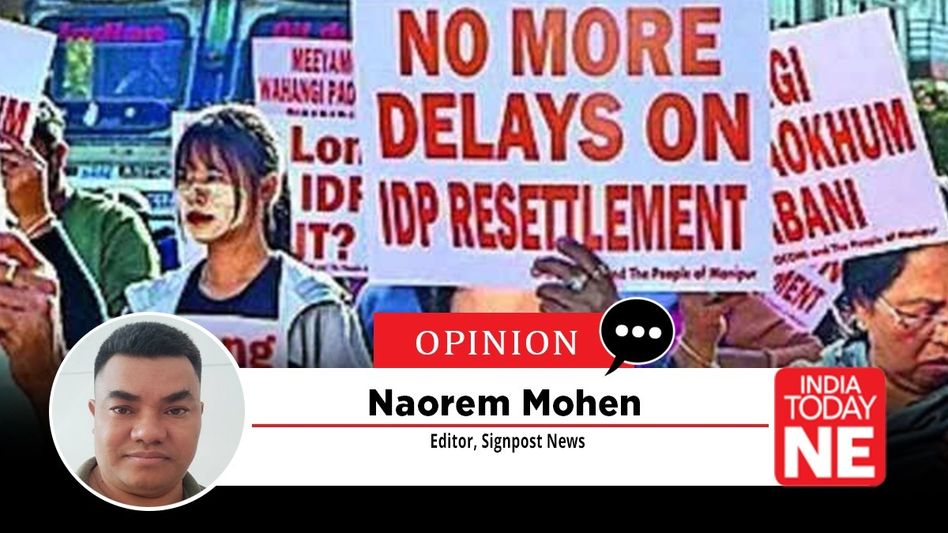
At a press briefing, Imagi Meira president Thokchom Sujata called on MLA Noorul Hassan and the state government to explain the proposal within 10 days. She asked why elected leaders were offering permanent houses elsewhere while families were still waiting for help to rebuild in Moreh, Churachandpur and Kangpokpi. On November 22, the Apex Committee of Meitei Internally Displaced Persons plans to take that demand to the streets of Imphal. Its question is the one the government needs to answer directly: “When will we be allowed to return to our homes?”
Sujata also asked whether some legislators in the ruling alliance were, through decisions like this, making it easier for separate administration to become a reality on the ground. Her question deserves an answer. When families driven from their neighbourhoods are permanently housed elsewhere and the government takes no practical steps to reopen those neighbourhoods to them, the division created by violence hardens.
That outcome can serve the aims of those demanding separate administration regardless of Hassan’s reasons for offering help. The government can address the concern by guaranteeing in writing that accepting a house elsewhere will leave a family free to pursue its property claims and return if it chooses and conditions allow.
Displaced families should never have to depend on party affiliation or an MLA’s personal favour to secure a roof, claim compensation or regain access to their property. If legislators and political parties genuinely want to help, they should put a funded return and rehabilitation plan before the Assembly and press the government to carry it out. The state announced rehabilitation committees in December 2025. Families should be able to find out what those committees have done for their villages and neighbourhoods, who is responsible for the next step and when a decision is due.
The 15 families offered houses in Kshetrigao deserve a clear answer about what happens to the homes they left behind. So does every family marching on November 22. They should be able to ask a district official when they can visit their home, who will help them reclaim or rebuild it, and what the government will do to make sure they can live there safely. Those are questions the state can begin answering now.
Since 3 May 2023, families driven from Moreh, Churachandpur and Kangpokpi have spent more than three and a half years wondering whether they will ever live in their own homes again. There is a particular pain in being displaced within your own state and having to ask, year after year, when you can set foot on the land your parents left you. The longer the government leaves that question unanswered, the harder it becomes for people to hold on to the hope of returning. Eventually, a family may feel worn down enough to give up the home it still wants to return to.
The offer of houses for few selected families in Kshetrigao can ease real hardship. But the government and political parties must ask themselves what kind of choice they are leaving families who have spent years in relief camps. If a family accepts a house elsewhere because it can no longer bear another year in a camp, can anyone honestly say it has chosen to leave its ancestral home behind? No family should be made to feel that a roof today comes at the cost of the land, the home or the life it hopes to recover tomorrow.
For those who want to go home, the government’s action plan must begin at the places from which they were displaced. It must restore safe access, help families reclaim their property and fund the rebuilding of their homes. Our leaders should press for a budget, a timetable and an official answerable to each affected locality.
After more than three and a half years, people displaced in their own state should be able to ask, “When can we go home?” and hear from their government what it is doing to get them there.