
How Kuki Diaspora Links Led to New 'Trump Land' Assault on India's Northeast
Who could have imagined, back in August 2023, that a plea for help delivered in a Surrey gurdwara would plant the seeds for something as audacious as “Trump Land”? Yet that is precisely what happened.

- Dec 28, 2025,
- Updated Dec 28, 2025, 3:18 PM IST

Who could have imagined, back in August 2023, that a plea for help delivered in a Surrey gurdwara would plant the seeds for something as audacious as “Trump Land”? Yet that is precisely what happened. The provocative map unveiled by the banned Sikhs for Justice (SFJ) on December 27, 2025—proposing a separate Christian-majority state across India’s Northeast—has its roots in those early diaspora overtures.
A defining moment came when Lien Gangte, Canada chapter chief of the North American Manipur Tribal Association (NAMTA), a Kuki advocacy group, addressed the Guru Nanak Sikh Gurdwara in Surrey. That same gurdwara had been led by Khalistani separatist Hardeep Singh Nijjar until his assassination just two months earlier.
In his speech, Lien Gangte decried alleged “attacks on minorities in India,” openly called for “all possible help” from Canada, and spotlighted the unfolding ethnic violence in Manipur. NAMTA proudly shared videos of the event on social media on August 7, 2023—only to quietly delete them months later as diplomatic fallout over Nijjar’s killing strained India-Canada ties.
What seemed then like an opportunistic appeal for sympathy has since evolved into a full-blown separatist blueprint, with SFJ exploiting the very grievances Gangte highlighted to push for a Christian “safe haven” under the provocative banner of “Trump Land.” The connection is unmistakable—and deeply alarming.
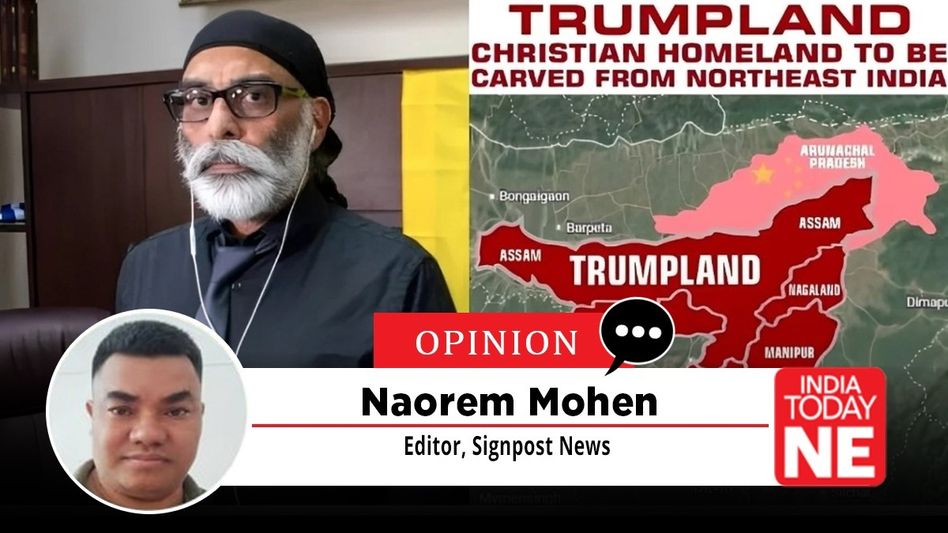
As 2025 draws to a close, India faces a brazen separatist provocation that demands unflinching national attention. On December 27, Gurpatwant Singh Pannun—designated terrorist and head of the banned Sikhs for Justice (SFJ)—unveiled a map proposing “Trump Land,” an autonomous Christian-majority enclave to be carved from Nagaland, Mizoram, Meghalaya, Manipur, Tripura, and Assam.
Timed deliberately with Christmas, the announcement alleges systematic persecution of Christians under the Modi government: burned churches, criminalised Bible preaching, violent assaults, and mass displacement. Pannun’s direct appeal to US President Donald Trump and invocation of UN self-determination rights are not mere rhetoric—they are a calculated bid to internationalise India’s internal challenges.
This is no spontaneous outburst. It is the predictable outcome of a dangerous nexus that took shape in the diaspora more than two years ago. The trail begins in August 2023, when Lien Gangte, Canada chapter chief of the North American Manipur Tribal Association (NAMTA), addressed the Guru Nanak Sikh Gurdwara in Surrey.
Subsequent reports revealed NAMTA members engaging with Nijjar’s supporters, while the organisation’s US chapter publicly thanked the “Sikh family” for solidarity with the Kuki cause. Separate intelligence inputs point to early 2023 meetings between US-based Kuki leaders and Pannun himself, coinciding with the outbreak of Manipur violence. Indian security agencies rightly flagged these interactions as potential Khalistani infiltration of Northeast grievances.
These early contacts were no fleeting coincidence. By January 2025, when the Union Home Ministry extended the ban on SFJ for another five years, intelligence inputs explicitly stated that Pannun’s outfit had been “inciting the Christian community in Manipur to raise their voices for a separate country,” alongside provocative calls for “Dravidstan” in Tamil Nadu and “Urduistan” for Muslims.
The 'Trump Land' map is the most audacious manifestation yet of this strategy: repackaging Manipur’s ethnic tragedy as religious persecution to justify carving up the Northeast.
Compounding the unease are statements from within the region itself. In September 2024, Mizoram Chief Minister Lalduhoma, during visits to the United States, addressed Zo (Chin-Kuki-Mizo) diaspora gatherings in Maryland and Indianapolis. He spoke passionately of a shared “nationhood” for communities divided by colonial borders across India, Myanmar, and Bangladesh, lamenting that they had been “unjustly divided” and invoking a common destiny that transcended current boundaries.
Though he clarified in one forum that such unity could be realised within India, the religious framing and talk of divine sanction triggered sharp criticism back home, with many seeing it as dangerously ambiguous at a time when external forces were already fishing in troubled waters.
The propaganda machinery amplifying 'Trump Land' is equally telling. Stories pushing the proposal have appeared prominently on websites with Pakistani-registered (.pk) domains—a classic indicator of hostile hybrid warfare aiming to exploit India’s internal fault lines.
For every Indian living comfortably in the mainland, this should be a moment of reckoning. The Northeast is not a distant frontier; it is the sentinel of our eastern borders with China, Myanmar, Bangladesh, and Bhutan. It holds immense strategic and economic value—oil and gas in Assam, hydropower potential across the hills, and vital connectivity under the Act East Policy.
Allowing it to be portrayed as an oppressed Christian enclave ripe for “liberation” risks not just territorial loss but a cascading security nightmare.
Our own prolonged neglect has created the vacuum these forces are filling. The bitter truth is that external actors like Pannun and his proxies are merely exploiting a vacuum we ourselves have created through decades of neglect.
In Manipur, the state’s prolonged failure to decisively tackle illegal immigration from Myanmar and Bangladesh, curb the menace of narco-terrorism fuelled by cross-border drug and arms networks, and suppression of the Manipur Hill Areas (Acquisition of Chiefs’ Rights) Act, 1967, has allowed grievances to fester. What began as a containable dispute over land and identity has been permitted to spiral into a protracted ethnic crisis, claiming over 300 lives and displacing more than 70,000 people. This self-inflicted wound is precisely the opening that separatist forces—both domestic militants and foreign-backed propagandists—have eagerly widened.
History is unforgiving on such indifference. Unaddressed grievances fuelled the Khalistan insurgency of the 1980s. Neglect of East Pakistan’s aspirations led to Bangladesh’s birth in 1971.
We cannot repeat those mistakes. As citizens, we must reject the mainland-periphery mindset. Learn the Northeast’s history—from the Battle of Kohima that halted Japanese advances in World War II to the contributions of artists like Bhupen Hazarika and boxers like Mary Kom. Buy Assam tea, Manipur black rice, or Mizo handicrafts. Demand that national media cover the region beyond conflict headlines.
The “Trump Land” map and Khalistani-Kuki links reflect our shortcomings, it is more than a provocation. It is an indictment of our indifference. It began with NAMTA’s outreach in a Khalistani-linked gurdwara, gained momentum through Pannun’s systematic incitement, and now threatens India’s territorial integrity.
We cannot ignore this first tinder. We still have time to douse this fire—but only if we finally treat the Northeast not as distant periphery, but as the vital limb it has always been.
MORE NEWS












Copyright©2025 Living Media India Limited. For reprint rights: Syndications Today
