How Long Will SoO Remain a License for Kuki Militants to Take Innocent Lives?
The recovery of six Naga civilians from Kangpokpi district has sent shockwaves across the Northeast states. These men had reportedly gone missing after being abducted from Leilon Vaiphei on May 13, 2026.

- Jun 15, 2026,
- Updated Jun 15, 2026, 10:05 AM IST

The recovery of six Naga civilians from Kangpokpi district has sent shockwaves across the Northeast states. These men had reportedly gone missing after being abducted from Leilon Vaiphei on May 13, 2026.
Their bodies were recovered weeks later, mutilated and in dismembered condition, forcing families, communities and the state government to confront another episode of civilian vulnerability in Manipur’s continuing conflict that has long outgrown every moral boundary.
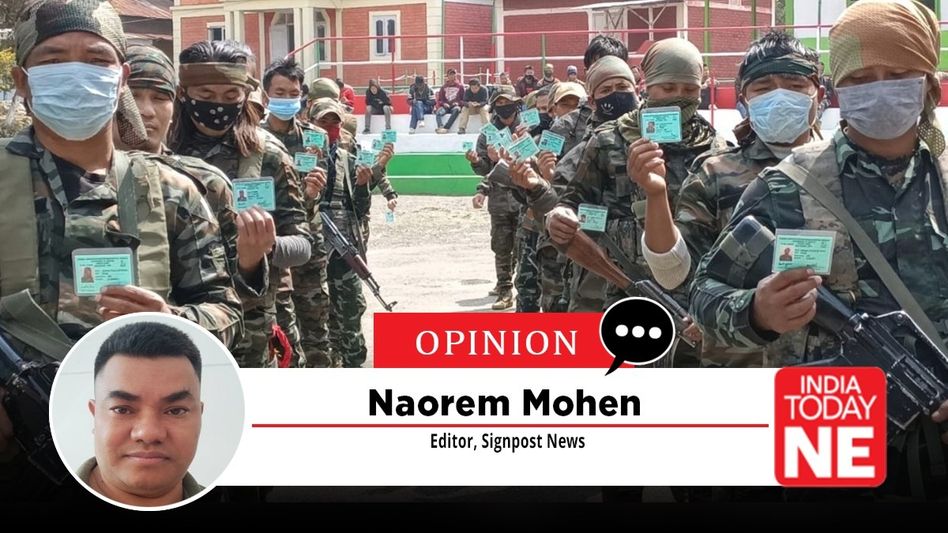
On June 14, Manipur Deputy Chief Minister Losii Dikho alleged that those involved belonged to a group covered under the Suspension of Operations (SoO), arrangement. He also appealed to Prime Minister Narendra Modi for strict action. Chief Minister Yumnam Khemchand Singh said the case had been handed over to the National Investigation Agency (NIA) and that anyone found involved, irrespective of position or office, would face legal action.
These are not routine statements. They reflect the growing pressure on both the state government and the Centre to answer a question that has been avoided for far too long: how can an agreement meant to reduce violence and bring armed groups to the negotiating table continue without serious review when allegations of grave violence are repeatedly linked to groups operating under its protection?
The killing of six Naga civilians in Kangpokpi has reopened a painful question that Manipur can no longer postpone: whether the Suspension of Operations framework has become a peace instrument without accountability.
The SoO agreement was conceived as a mechanism for peace. Its purpose was to bring armed groups into a monitored framework, reduce hostilities and create conditions for political dialogue. In principle, such arrangements are not unusual in conflict zones. States often negotiate with armed groups when endless confrontation produces only civilian suffering. But any ceasefire arrangement survives only on discipline, verifiable compliance and public trust.
In Manipur, that trust has eroded badly. The September 2025 renegotiated SoO agreement, involving the Union Home Ministry, the Government of Manipur, Kuki National Organisation (KNO) and United People’s Front (UPF), was presented as a step toward restoring movement, easing tension and enforcing revised ground rules. The Union government stated that the agreement was to remain effective for one year from the date of signing. But an agreement cannot be judged by signatures alone. It must be judged by what happens on the ground.
If armed cadres under SoO remain in designated camps, obey ground rules and assist peace, the arrangement has meaning. If they are accused of abduction, intimidation, extortion, arming local formations or participating in ethnic violence, the arrangement becomes morally indefensible. The state cannot offer stipend, protection and political engagement on one side, while ordinary civilians count their dead on the other.
However, the hills of Manipur are weeping again, once more due to the barbaric acts of Kuki militants under the shadow of SoO. On June 10, 2026, the mutilated bodies of six Naga civilians — ordinary men, including two respected pastors — were finally recovered from Kangpokpi district after weeks of desperate searches.
Abducted on May 13 from Leilon Vaiphei, a Kuki village, they were reportedly handed over by local women and the village chief to Kuki militants. Fourteen other Naga hostages, mostly women and children, were eventually released. These six never returned home.
Their families, standing at the JNIMS mortuary, could barely recognise the mutilated and disfigured remains. This is not an isolated tragedy. It is the latest chapter in a story of impunity that has stained our land for far too long.
No grievance, no retaliation for the killing of Thadou church leaders days earlier, can justify the abduction, torture, and execution of unarmed civilians. The Naga community responded with maturity, releasing their 14 Kuki hostages unharmed. That contrast only sharpens the horror.
Eyewitness accounts, hostage messages, and forensic evidence point directly to the perpetrators, the Kuki militants who are under SoO with Indian government. The NIA must now act decisively.
But the deeper question haunts every conscience in Manipur: How long will the Suspension of Operations (SoO) agreements continue to provide a shield for such barbaric killings?
This horror echoes an earlier massacre that should have served as a warning. In November 2024 in Jiribam district, Kuki militants abducted six members of a Meitei family from their home, three women and three children, among them an 8-10-month-old infant named Laishram Lamnganba Singh.
The bodies were recovered from the Barak River days later. Autopsy reports revealed gunshot wounds, blunt trauma, chopping injuries, missing eyeballs in the infant, and advanced decomposition. A helpless baby shot in the knee, stabbed in the chest, struck on the jaw—his tiny body desecrated. The family was executed and discarded like garbage.
Had those responsible forthe heinous and barbaric crime faced swift and severe punishment, the mindset behind the May 13 Naga abductions might have been deterred. Instead, hesitation and half-measures have allowed the cycle to claim more innocent lives.
The wild, barbaric nature of these acts reveals a pattern that goes far beyond sporadic violence. Time and again, Kuki militants have targeted innocent civilians who fall into their custody, subjecting them to unimaginable cruelty.
The list of victims is heartbreakingly long. More than 50 remain missing — boys and girls whose bones may never be found, lost to jungles and rivers. Their families endure a living hell of uncertainty.
Consider the case of Phijam Hemjit and Hijam Linthoingambi, two young Meitei students who went missing in July 2023. Their bodies were later confirmed murdered, with disturbing images showing the brutality they endured.
Similarly, Atom Samarendra Singh and Yumkhaibam Kirankumar, who disappeared in May 2023 from the Sangaithel area, remain missing even years later, their families living in perpetual agony without closure.
These are not mere statistics. Mayanglambam Rishikanta Singh’s execution in early 2026 was captured on video: the young Meitei man, visiting his Kuki fiancee in Churachandpur, was forced to kneel, hands folded, begging for his life before being shot point-blank.
Laishram Kamalbabu and others like him have also fallen prey to similar fates. The pattern is consistent — abduction of civilians, often from different communities, followed by torture, mutilation, and disposal of bodies in rivers or jungles.
Adding to this endless list of pain is the case of 20-year-old Luwangthem Mukesh from Keishampat Leimajam Leikai, Imphal West. He went missing on March 16, 2025, after leaving home in his red Maruti Alto. CCTV footage showed his vehicle heading towards Kuki-dominated areas in Bishnupur district.
Despite repeated appeals by his family, JAC, MLAs, and even the Governor’s assurances, Mukesh remains untraceable. His parents continue to live in daily torment, not knowing whether their son is alive or has met the same gruesome fate as so many others. His unresolved case stands as yet another symbol of how SoO with Kuki militants enables fear and impunity.
Many victims are never recovered, their remains left to disappear in forests and ravines, beyond the reach of grieving families. This is not a conventional clash between armed groups. It is the deliberate targeting of the defenceless, carried out along ethnic fault lines, while the Suspension of Operations framework is increasingly seen as offering a protective cover to those accused of grave violence.
Even after the revised pact in September 2025, voices from Meitei, Naga, Thadou, and other communities are rising in unison, demanding abrogation. Naga Women’s Union, Native People’s Committee, and others have written to the Prime Minister, Union Home Minister stating plainly that SoO has become a licence for militants to terrorise neighbouring communities and sometimes their own people.
Manipur’s wounds run deep — land, identity, political power, historical rivalries from the 1990s Naga-Kuki clashes, narco-terrorist and the scars of broader insurgency. The 2023 Meitei-Kuki violence reopened every fault line. Armed groups exploit these genuine grievances while ordinary villagers pay with their blood.
Justice cannot mean revenge that breeds fresh retaliation. It demands resolute action from the state and Centre: relentless operations to dismantle the networks, revocation of SoO protections for those proven involved in atrocities, prosecution of both militant commanders and village-level collaborators, and fast-track trials with exemplary punishment.
The NIA’s involvement is welcome, but it must deliver results that restore public faith. The Naga bodies’ restraint in releasing hostages deserves respect. Such gestures must be met with iron-clad governance that upholds the rule of law over the rule of the gun.
The world now sees what we in Manipur have endured for years. Armed ethnic militancy, wherever it festers, produces the same tragedy — innocent blood spilled in the name of identity. Our Constitution promises equality and justice.
Manipur tests that promise daily. Decades of political expediency, porous borders, and failed counter-insurgency approaches have created zones where the state’s writ weakens.
Changing this requires courage: rigorous enforcement or complete scrapping of SoO where violations persist, stronger local policing, honest development that addresses root causes, and sustained dialogue across communities.
Our people are not monolithic. Many Thadou, Nagas, and Meiteis condemn these acts and long for normalcy. Civil society voices from all sides have raised their hands in horror. Those voices must be amplified. Yet denial or shielding of perpetrators deepens mistrust and invites more cycles of revenge.
Selective outrage that excuses crimes by “our side” has brought us to this precipice. The families of the six Naga men, standing broken before the remains of their loved ones, spoke of lost faith and delayed justice. Their despair echoes in every grieving home across our state.
We cannot allow it to harden into permanent division. The government owes every victim — Naga, Meitei, Kuki, or otherwise — transparent investigations, accountability, and a genuine path to reconciliation.
Unity is no longer a slogan; it is our only survival. The native peoples of this land must rise above narrow ethnic silos, demand an end to the culture of impunity, and reclaim the soul of Manipur from those who profit from its pain.
Political courage has been scarce for too long. The time for cosmetic renewals of flawed agreements is over. How long must we count our dead before SoO is held accountable or set aside?
The six Naga men, the Jiribam infant and his family, the young students Hemjit and Linthoingambi, Atom Samarendra, Laishram Kamalbabu, Mayanglambam Rishikanta, Luwangthem Mukesh and all those unnamed missing do not deserve mere condolences. Their blood cries out for us to finally choose life over the gun.
The SoO agreement must now face a simple test. If it can enforce discipline, disarm illegal networks and support peace, it may still have a limited purpose. If it cannot prevent armed groups under its umbrella from being linked to abduction and civilian killings, it must be suspended, rewritten or scrapped.
Manipur cannot continue to bury its citizens while agreements survive untouched. Peace is not the absence of operations. Peace is the presence of justice. Until that principle is restored, SoO will remain, in the eyes of many grieving families, not a peace mechanism but a licence for armed impunity.
(The views expressed in this article are those of the author and do not necessarily reflect the views of India Today NE or its affiliates.)