If You Love Manipur, Keep It Clean, These Young People Are Showing Us How
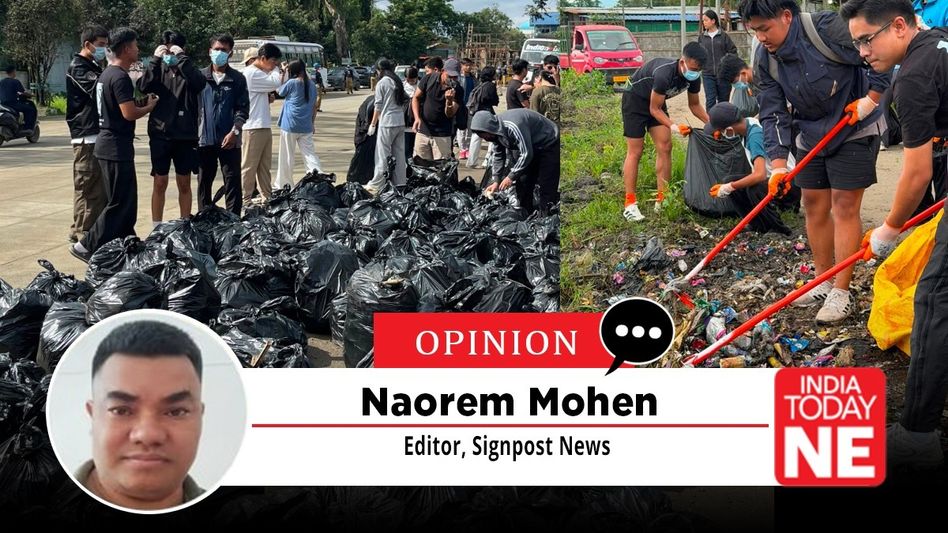
In just over a year, For Better Kangleipak has mobilised hundreds of young volunteers across wetlands, hills and public spaces, collecting an estimated seven tonnes of waste. But what gives me greater hope is what happens when young people from different communities begin caring for the same land.

- Sep 25, 2026,
- Updated Sep 25, 2026, 3:21 PM IST

- The initiative marked its first anniversary on July 6, 2026
- Most participants are aged 17 to 25, with elders joining too
- A single drive at Punshi Lok drew their biggest 400-strong turnout
There are many ways of saying that we love Manipur. We say it from public platforms, write it on social media, observe important days, remember the sacrifices of our forefathers and make pledges about building a better Manipur. Then someone finishes a packet of chips and throws the wrapper beside the road. Perhaps that small act tells us more about our relationship with Manipur than many of our speeches do.
For a little over a year, a group of mostly young volunteers has been quietly asking Manipur to look at this contradiction. They call themselves For Better Kangleipak. Founded by management graduates Wangkheimayum Mangal and Chongtham Cheenglai Lakpa, the initiative completed its first anniversary on July 6, 2026. It is sustained largely through volunteers, donations and people willing to support its activities.
There is nothing particularly glamorous about much of their work. They go where people have left their waste, carrying gloves and garbage bags, and bend down to pick up what others have thrown away. Yet the numbers tell a story. According to the founders, volunteers have so far collected around 3,000 garbage bags of waste, estimated at roughly 7,000 kg.
A normal cleanliness drive draws about 150 to 200 volunteers, depending on the location. At Punshi Lok in Langol, around 400 people reportedly joined, their largest turnout so far. Most volunteers are between 17 and 25 years old, though older people also come forward to participate and support them. People from different communities join the drives. In today's Manipur, that last detail matters as much as the seven tonnes of garbage.
The volunteers have worked across wetlands, hills, roadsides and public spaces. At Lamphelpat Wetland, they cleaned part of an ecosystem that had been subjected to dumping and appealed to people not to throw plastic and other waste into the wetland. At Ningthem Pukhri Mapal, they cleaned while asking the public for something that should hardly require a campaign: please do not litter the same place again.
They have undertaken drives at Ramrei, Sandang Semba Maring and Lamphel Supermarket. At Cheirao Ching, volunteers extended their cleaning effort across the hill range. At Sangai Ethnic Park, Moirangkhunou, For Better Kangleipak collaborated with the Department of Tourism, Government of Manipur, to clean the surrounding area and appeal to tourists and members of the public to use dustbins.
These efforts expose an uncomfortable absurdity. A group of volunteers can spend hours under the sun or in the rain collecting bottles, food packets and plastic, while one person can undo part of that work in seconds by casually throwing another wrapper on the ground. The volunteers can return and clean again, but why should they have to? If we genuinely love Ema Leibak, why should the land have to bear evidence of our carelessness?
One incident brought this message dramatically into public view. At the Fashion Tourism Show 2026 in Manipur, designer Robert Naorem noticed waste scattered around the venue. Instead of simply leaving the cleaning to somebody else, the ramp paused and Robert, along with around 40 models from different parts of India, put on gloves, took garbage bags and began picking up the waste.
For those few minutes, the most striking thing on a fashion ramp was not what the models were wearing, but what they were carrying: garbage bags. The moment was powerful precisely because ignoring the waste would have been so easy. The programme could have continued and somebody could have been asked to clean it afterwards. Instead, the litter became impossible to ignore.
There should be no embarrassment in bending down to pick up a discarded bottle. The embarrassment should belong to the person who threw it there. That is the cultural change initiatives like For Better Kangleipak are trying to encourage. Cleaning should not be viewed as somebody else's occupation. Keeping a public place clean begins much earlier — with the decision not to litter it.
For Better Kangleipak has also stepped beyond cleanliness drives. On May 3, 2026, three years after the conflict in Manipur began, its members went to Mandop Yumpham Relief Camp at Khurkhul and distributed notebooks and edibles to internally displaced children. Tens of thousands of people have been displaced during the conflict, and many families continue to live with its consequences.
A notebook cannot restore a lost home, and something to eat cannot return the years a child has spent growing up in displacement. But there is meaning in choosing to go there. On anniversaries associated with tragedy, statements are issued, memories are shared and appeals are made. These young people chose to spend part of that day with children who continue to live with the consequences. That too is service.
Every August 13, Manipur remembers its patriots through ceremonies, floral tributes, speeches and pledges to honour those who sacrificed their lives for the land. On Patriots' Day 2026, For Better Kangleipak collaborated with YumTech and went to Yaralpat to clean it.
I find something deeply meaningful in that choice. Political leaders and institutions will continue to deliver speeches and pay ceremonial tribute, and such observances have their place. But these young people added another language of remembrance — work done with their own hands for the land whose patriots they were honouring. If we say our forefathers sacrificed themselves for this land, what are we doing with the land they left us? That question cannot be answered by a pledge alone.
Another cleanliness drive took the volunteers to Ramrei in Kamjong district. For a Manipur wounded by conflict and community divisions, people coming together to care for a common space carries a meaning beyond cleanliness. This is also central to what Mangal and Cheenglai Lakpa want their initiative to represent.
Their message is that protecting Manipur's environment cannot have a community barrier or a hill-valley divide. People from every community must participate. Manipur is too delicate, and its environment too precious, to be divided in the way politics and conflict can divide people.
A polluted wetland does not ask which community threw the plastic. A hill covered with bottles does not recognise ethnicity. A forest does not know hill and valley. The land suffers all the same, and the land is what every community ultimately claims to love.
That is why the age of these volunteers matters. Many are between 17 and 25. They are a generation coming of age in a Manipur that has seen some of its deepest divisions laid bare. Yet when they stand together with garbage bags in their hands, there is no reason for the person beside them to be identified by community. There is simply work to be done.
There is, however, an important distinction to make. Volunteerism must never become an excuse for government agencies to neglect their responsibilities. Keeping Manipur clean requires functioning waste collection, segregation and disposal systems. Wetlands need protection, tourist destinations require adequate facilities, municipal bodies and local authorities need resources and accountability, and environmental laws need enforcement. Young volunteers carrying garbage bags cannot substitute for the State, nor should they.
But government shortcomings cannot become an excuse for personal irresponsibility either. No government can station an official beside every person opening a plastic bottle. No tourism department can follow every visitor carrying a packet of food. No municipality can place a worker beside every hill, wetland and roadside to stop someone from throwing garbage.
Eventually, there is a decision only the individual can make: do I throw this wrapper here, or do I keep it in my bag until I find a dustbin? It sounds too small to matter, but multiply that decision by thousands of people every day and it becomes the difference between the Manipur we complain about and the Manipur we say we want.
For Better Kangleipak describes itself modestly. It is a young initiative, sustained mostly by volunteers, donations and supporters. Yet in a little over a year, it has moved across wetlands, hills, roadsides, tourist spaces and neighbourhoods. Its volunteers have collected an estimated seven tonnes of waste, reached out to children living in a relief camp and drawn hundreds of people to individual drives.
But those numbers are not what give me the greatest hope. The young people do.
I have a simple belief: young people who learn to love the land will find it harder to destroy it. Those who care enough to bend down and remove plastic from a wetland, protect a hill or spend hours cleaning a public space are learning something deeper than cleanliness. They are learning that Manipur is something to be cared for, not merely claimed. Perhaps healing can begin there.
Mangal and Cheenglai Lakpa speak of environmental responsibility beyond community boundaries and beyond the hill-valley divide. Their generation has inherited divisions it did not create. It should not be condemned to carry those divisions forever.
For me, young people like these represent one of Manipur's strongest reasons for hope. Not because collecting garbage can resolve a political conflict — it cannot — and not because volunteerism can replace governance, justice or the difficult work required for reconciliation. But they are nurturing something without which lasting healing will remain difficult: the understanding that the land is shared, and so is the responsibility for caring for it.
My hope is that For Better Kangleipak grows into something larger than a cleanliness campaign. Let it become part of a generation that refuses to inherit hatred as its destiny; a generation that loves Manipur enough to care for its wetlands and forests, its hills and valley, its roads and public spaces — and ultimately, its people.
To the parents, elders, donors and ordinary citizens who have stood behind these young volunteers, continue supporting them. And to every young person who has gone out in the rain or under the scorching sun with gloves and a garbage bag: keep going.
Manipur has spent enough time seeing what division can destroy. Perhaps it is time we allowed our young people to show us what caring for the same land can rebuild.
If you love Manipur, keep it clean. And if we want to heal Manipur, perhaps learning to care for the land we share is a good place to begin.