Imagi Meira Thokchom Sujata Questions: Why Didn’t CRPF Shoot Unarmed Meitei Civilians Below the Knees?
Thokchom Sujata, President of Imagi Meira, has strongly condemned the CRPF firing in Tronglaobi Maning (Gelmol area), Bishnupur district, as excessive, disproportionate, and potentially biased.

- Apr 11, 2026,
- Updated Apr 11, 2026, 12:46 PM IST

Thokchom Sujata, President of Imagi Meira, has strongly condemned the CRPF firing in Tronglaobi Maning (Gelmol area), Bishnupur district, as excessive, disproportionate, and potentially biased.
She described it as a shameful violation of every established tenet of minimum force, low-aim directives, and fundamental constitutional safeguards under Articles 14 and 21 of the Indian Constitution.
Sujata has demanded an impartial, thorough, and time-bound investigation, including strict scrutiny of command responsibility at the CRPF camp. The CRPF firing on grieving Meitei civilians on April 7, 2026, has laid bare a deeply disturbing double standard in how security forces handle protests and aggressive mobs across Manipur.
While the Meitei community was still shattered by the barbaric Kuki militant attack that killed two innocent sleeping children of a BSF jawan, the response to their grief-driven protest was live bullets.
In stark contrast, heavily armed Kuki aggressive groups in areas like Moreh, Churachandpur, and Kangpokpi have repeatedly engaged in violence with apparent leniency from central and state forces.
In the early hours of April 7, 2026, around 1 am, suspected Kuki militants launched a projectile bomb attack on the home of BSF jawan Oinam Mangalngamba in Tronglaobi Awang Leikai, under Moirang Police Station in Bishnupur district. The explosion killed his five-year-old son and his five-month-old infant daughter, while critically injuring their mother, Oinam Binita.
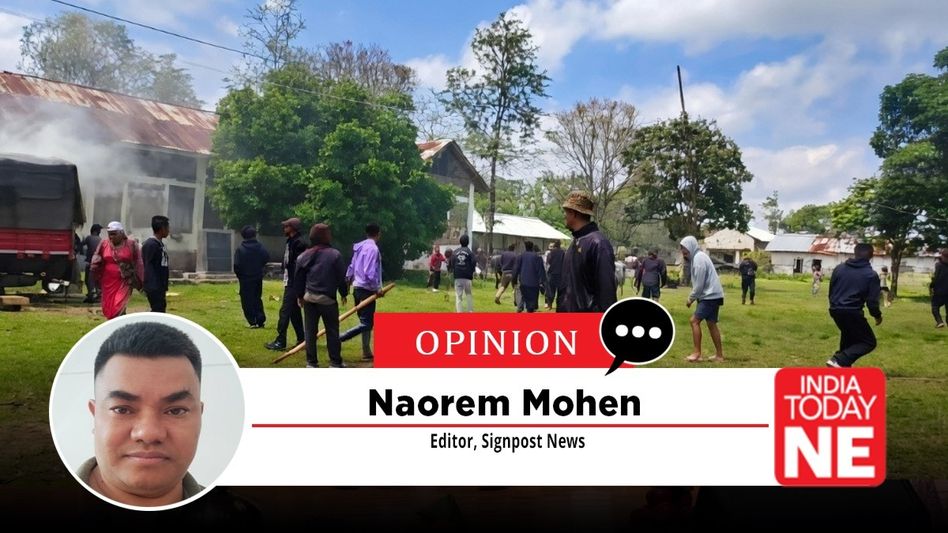
This targeted assault on a civilian family in a vulnerable valley area near the hills triggered raw grief and justified outrage across the Meitei community. Hundreds of protesters, including youths and women carrying only traditional bamboo sticks (wakhok), gathered near a nearby CRPF camp in the Gelmol area to demand accountability and better protection.
Official accounts claim the crowd turned violent — setting vehicles on fire and attempting to breach the camp. In response, CRPF personnel opened live fire, killing at least three Meitei civilians and injuring over 20 others. Circulating videos suggest direct aiming at protesters, many of whom were unarmed.
What has particularly outraged Thokchom Sujata is the apparent complete disregard for established low-aim directives. Supreme Court precedents, High Court guidelines, and standard operating procedures for paramilitary forces are unambiguous: lethal force is the absolute last resort.
When unavoidable, shots must be aimed below the knees to incapacitate without causing death. Firing at the torso, chest, or upper body is strictly prohibited except in cases of imminent threat to life.
Non-lethal options must be exhausted first, warnings issued, and firing authorized by the senior-most officer (ideally with a magistrate present), stopping the moment the crowd begins to disperse.
Thokchom Sujata has directly questioned: Why were unarmed or lightly armed grieving civilians not shot below the knees? Were tear gas, rubber bullets, water cannons, or lathi charges genuinely exhausted? Who issued the explicit order for direct live firing? Did these protesters, driven by the unimaginable pain of losing two toddlers, pose a threat that justified bypassing all protocols?
This selective harshness stands in outrageous contrast to the restraint shown toward heavily armed Kuki aggressive groups. In Churachandpur, Kangpokpi, and Moreh, there have been multiple instances of mobs burning government offices, police vehicles, and public properties, along with direct assaults on security personnel — yet central forces largely responded with tear gas, minimal intervention, or no live firing at all.
A glaring example is the January 3, 2025, incident in Kangpokpi, where a violent mob — reportedly involving heavily armed Kuki groups — attacked the office of Superintendent of Police Manoj Prabhakar. The SP sustained injuries, several police vehicles and properties were damaged or destroyed, and the assault involved stones, petrol bombs, and significant aggression.
Despite the direct threat to a senior police officer and destruction of government assets, not a single live bullet was fired on the crowd. The response remained restrained, without the kind of lethal force unleashed on grieving Meitei civilians just days ago.Similar patterns of relative leniency have been observed in Moreh and Churachandpur during Kuki-led agitations involving arson, clashes, and armed mobilizations.
This blatant hypocrisy — bullets for Meitei pain, restraint for Kuki aggression — has deepened perceptions of partisan bias and selective enforcement, severely undermining the impartial role that central forces like the CRPF are expected to uphold in an ethnically fractured state.
Indian law and judicial rulings leave no ambiguity. The Supreme Court in PUCL v. State of Maharashtra (2014) mandated rigorous scrutiny and accountability for every death caused by state action.
In Anita Thakur v. State of J&K (2016), it stressed that force must be proportionate and must cease once the threat subsides. High Court directives explicitly prohibit high-aim firing and require targeting lower limbs only when absolutely necessary.
Under the Bharatiya Nyaya Sanhita (BNS), 2023, dispersal of unlawful assemblies demands minimal injury. Reports of torso injuries in Tronglaobi directly violate the low-aim protocol and raise serious questions of excessive force.Article 21 guarantees the right to life — any deprivation must be just, fair, and reasonable, not dictated by ethnic identity.
Article 14 demands equality before the law and equal protection. When grieving civilians protesting the cold-blooded murder of two innocent children face bullets, while heavily armed mobs assaulting officials and destroying property receive measured responses, these constitutional pillars appear compromised.
The Tronglaobi tragedy demands accountability on all fronts. The militant attack on the BSF jawan’s family requires a swift, professional NIA probe to bring the perpetrators to justice. At the same time, the handling of the protest must undergo an independent, time-bound investigation — ideally Supreme Court-monitored or NHRC-led with forensic experts.
This inquiry must examine bullet trajectories, entry wounds (especially torso injuries), whether non-lethal measures were exhausted, who ordered the firing, and patterns of differential treatment compared to incidents like the Kangpokpi SP attack.Command responsibility cannot be evaded.
Thokchom Sujata’s strong condemnation highlights a critical truth. Central forces must protect all citizens of Manipur — Meitei, Naga, Kuki, and others — without fear or favor. Perceived bias, deviation from minimum-force and low-aim principles, or selective application of lethal force only deepens ethnic distrust, risks escalating the cycle of violence, and undermines the peace efforts that the Indian Army and other forces have been pursuing in vulnerable areas for years.
In a state yearning for healing after years of strife that has claimed hundreds of lives and displaced tens of thousands, such incidents erode public trust in institutions meant to safeguard life. Swift, transparent justice — including immediate suspension and subsequent prosecution of those found responsible for protocol violations — is non-negotiable.
The people of Manipur deserve security forces that apply the rule of law equally. No community should face disproportionate bullets for mourning atrocities while another appears to enjoy relative impunity for aggression and armed violence.Investigate the firing now.
Sujata have voiced the aspirations of many innocent Manipuri which are suffering due to partiality and biasness of some Security forces in the state. Those responsible must be held accountable, the constitutional right to life must apply equally without ethnic discrimination, and grieving civilians seeking protection and justice should not face excessive force.
The Tronglaobi tragedy is not just another statistic in Manipur's long saga of violence; it is a flashpoint exposing systemic failure.We must demand equal application of the rule of law. No community should face bullets for protesting atrocities while another enjoys impunity for aggression. Failure to investigate thoroughly and punish the guilty will only deepen divisions and invite more bloodshed.
Condemnation alone is insufficient — swift, transparent justice is the only path to even a fragile peace. The state cannot afford another layer of injustice piled upon existing ethnic wounds. Investigate now.
Hold accountable those responsible. Ensure that in Manipur, the right to life applies equally — or admit that the forces meant to safeguard it have become part of the problem.