In Manipur, Some Children Are Rescued by Hashtags, Others Recruited by Hate
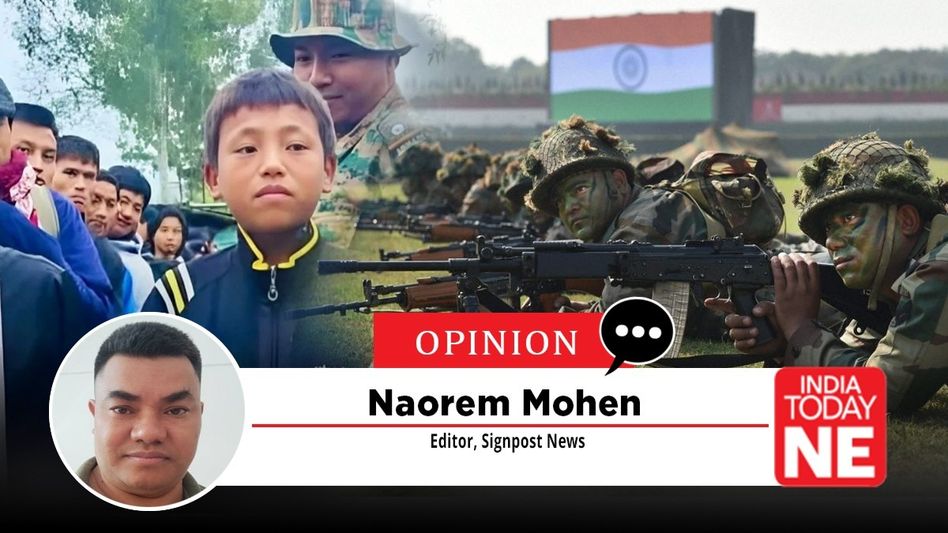
While boys his age chase footballs across dusty courtyards or pore over textbooks beneath mango trees, thirteen-year-old Abraham Pausiankap, uprooted by Manipur’s unrelenting ethnic conflict, recently stood in line at an Army recruitment rally.

- Dec 03, 2025,
- Updated Dec 03, 2025, 4:28 PM IST

- Abraham's viral image led to his school admission by Assam Rifles.
- Abraham's family fled ethnic violence in Manipur in May 2023.
- Military intervention helped Abraham, but many children remain vulnerable.
While boys his age chase footballs across dusty courtyards or pore over textbooks beneath mango trees, thirteen-year-old Abraham Pausiankap, uprooted by Manipur’s unrelenting ethnic conflict, recently stood in line at an Army recruitment rally.
His dream was straightforward yet profound: to don the uniform and support his family, now sheltering in a relief camp in Churachandpur. In a state where childhood has become a rare privilege, Abraham’s quiet determination shines as both inspiration and indictment.
The grandson of an Indian Army veteran and son of former sepoy Linus Mungvanglian—who took voluntary retirement from the Assam Regiment on medical grounds after five years of service—Abraham carries a proud military legacy.
Like tens of thousands of others, his family fled their home in Sugnu Lokhijang village, Chandel district, when violence erupted on 3 May 2023. Since then they have lived in the Zoveng relief camp run by the Zou Youth Organisation.
Abraham, the eldest of three siblings, is the son of Linus Mungvanglian and Mary Manzanuam. A passionate footballer who once represented Kakching district in the under-10 category, he was a Class 7 student at Bijang Loubuk Government Junior High School, Zoveng, when he appeared at the recruitment rally organised by 165 Infantry Battalion (Territorial Army) Assam at 37 Assam Rifles headquarters on 24 November 2025.
Too young and too short, dressed in faded clothes, he stood dwarfed by adult aspirants—yet towering in spirit.A single photograph of that slight figure in the queue went viral. The response was swift and compassionate. He was granted an audience with the Brigadier of 27 Assam Rifles at Tuibong.
The Assam Rifles secured his admission to Assam Rifles Public School, Mantripukhri, Imphal. On 27 November 2025, Lt Gen Abhijit S Pendharkar, GOC Spear Corps, personally felicitated him, praising his extraordinary courage and resolve. “Abraham’s journey reflects the indomitable strength of the human spirit,” the General said. “It is our privilege to stand by him as he chases his aspirations and carries forward his family’s proud legacy with honour.”
An official admission letter dated 29 November 2025, signed by Principal Dr Alka Jain of Assam Rifles Public School, Mantripukhri in Imphal, confirms that Master Abraham Pausiankap, admission no. 6609, has been enrolled in Class VII with full sponsorship—tuition fees, books, stationery, and hostel facilities all borne by the school.
One child rescued. A heart-warming story we readily embrace: resilience rewarded, military benevolence bridging despair. It fits neatly into our feeds, a brief reprieve from images of burning churches, paraded women, and orphaned children.Yet Abraham’s story shines as a rare triumph, a quiet reminder that the system can still lift those who deserve it.
Beyond the frame of that single viral photograph lie countless other displaced children—scattered across relief camps in Churachandpur, Kangpokpi, and Imphal—who will never trend on social media.While daylight belongs to hope and hashtags, night brings a different kind of recruitment. Shadows move silently through the camps, offering not fame but something far more immediate: meals, shelter, and the burning promise of settling scores.
For these children, the lure is not a camera flash, but the weight of a uniform and the whisper of retribution.A fourteen-year-old Kuki boy who never made it onto anyone’s timeline is handed an AK, two magazines, and a packet of yaba tablets. A fifteen-year-old Meitei boy in a valley camp is shown drone footage of his burned village.
Within weeks both are on the front lines—some in Manipur’s hills, others smuggled across the border to fight the Myanmar junta for a mythical Kukiland or Zalengam.Most of these children will never return home. The chasm separating Abraham from the boys now vanishing into the hills is not bravery, nor the strength of their families, nor even the depth of their wounds.
It is simply this: one fleeting moment when a smartphone camera turned toward him, and the world briefly looked back.That single photograph—Abraham standing defiantly in a recruitment queue—became his passport to a classroom and a future. For thousands of others, no lens will ever find them.
In the deepening shadows of the relief camps, recruitment is no longer a choice; it is the only door left ajar by hunger, fear, and unbroken silence. One boy was saved by a hashtag. The rest are being claimed by our indifference.
For Kuki boys in Abraham’s orbit, the recruitment pipeline to Myanmar’s civil war is as insidious as it is transnational. The porous, unfenced Indo-Myanmar border serves as both escape hatch and conveyor belt. Groups like the Kuki National Army (Burma) and the United Tribal Volunteers (UTV) under the Kuki National Front (Military Council) have intensified operations since the 2021 Myanmar coup.
Displaced, desperate youth from Manipur camps are prime targets—lured by kinship, monthly stipends, and promises of defending a greater Zalengam.A boy from Churachandpur crosses at night, joins a PDF unit allied with KNA-B, and soon learns to ambush convoys in the Kabaw Valley. No hashtags mark his departure. Once across, the glamour evaporates: jungle skirmishes, junta airstrikes, malaria, and anonymous graves.
Indian officials often dismiss casualty reports, but mothers in Manipur receive gamcha-wrapped bodies—or no word at all.In 2024 alone the UN recorded over 2,100 grave violations against children in Myanmar, including recruitment; Kuki-Zo youths from Manipur figure prominently among the uncounted.
The UTV alone is estimated to have moved 500–800 recruits, many juveniles, into Sagaing and Tamu regions. Funerals in Churachandpur and Kangpokpi have become grim processions: January 2025 claimed 21-year-old Seikhotinsat Khongsai; February saw over twenty fighters, including teenagers, killed in airstrikes near Border Pillar 81; October witnessed two juvenile cadres arrested en route to Tamu for “advanced training.”
Had their faces gone viral at a rally like Abraham’s, they might today be clutching school bags in an Army school. Instead, stalled peace talks and mutual hatred delivered them coffins.While Abraham unpacks his dormitory bag and dreams aloud of football and the Indian Army, his peers bleed out in the Chin hills for a borderless fantasy.
One boy’s determination earned applause and a classroom; the others’ became ammunition on forgotten frontlines.Let us not pretend the rescue is meaningless.
The Assam Rifles and Spear Corps acted with genuine nobility—bending rules, moving a child to safety, letting him honour his veteran grandfather’s legacy instead of dying across the border. Every officer involved deserves respect.But individual nobility is not national policy. It is what remains when policy fails. A serious state does not wait for a child to go viral before it acts. It dismantles the machinery that turns children into soldiers.
True healing in Manipur demands more than a viral photograph. It requires a transparent, time-bound mechanism—supported by satellite monitoring and neutral security forces—to enable displaced families to safely reclaim their land and rebuild their homes, so that one day Abraham’s parents can again walk their fields without the shadow of arson.
Because tonight, in a camp no hashtag will ever reach, another thirteen-year-old is being handed a rifle instead of a school report card. He will not meet a general. He will not trend. He will simply vanish into the darkness of Tedim Road, and someday his mother will be told he died “defending the community,” while his dreams of football rot quietly in the undergrowth.
Abraham was saved by a camera phone. Thousands more are being lost to our silence. If we accept a world where one child is rescued for every thousand recruited, we have already handed Manipur’s future to the very forces we pretend to resist.
Abraham Pausiankap will now sleeps under a school roof because a stranger’s camera phone caught the light in his eyes. Thousands of others will fall asleep tonight clutching rifles because no light ever reached them.
One boy’s defiance went viral and became a classroom; the same defiance in countless others is being forged into bullets across an unfenced border.
Until we replace the lottery of hashtags with the certainty of policy—safe return corridors, monitored land reclamation, and the resettlement of these children in their homes that moves faster than recruiters in the dark—Manipur will keep trading its children for silence.