In Manipur’s Wounded Sekmai Assembly Constituency, Bringing Government Closer Is a Beginning
For a family still living in a relief camp, the distance from government is not measured only in kilometres. It is also measured in uncertainty: which office to approach, which documents to carry, whom to ask, and whether another journey will end with instructions to return another day. When conflict has already taken away a home or disrupted a livelihood, these ordinary administrative difficulties carry a much heavier cost.

- Oct 06, 2026,
- Updated Oct 06, 2026, 11:39 AM IST

For a family still living in a relief camp, the distance from government is not measured only in kilometres. It is also measured in uncertainty: which office to approach, which documents to carry, whom to ask, and whether another journey will end with instructions to return another day. When conflict has already taken away a home or disrupted a livelihood, these ordinary administrative difficulties carry a much heavier cost.
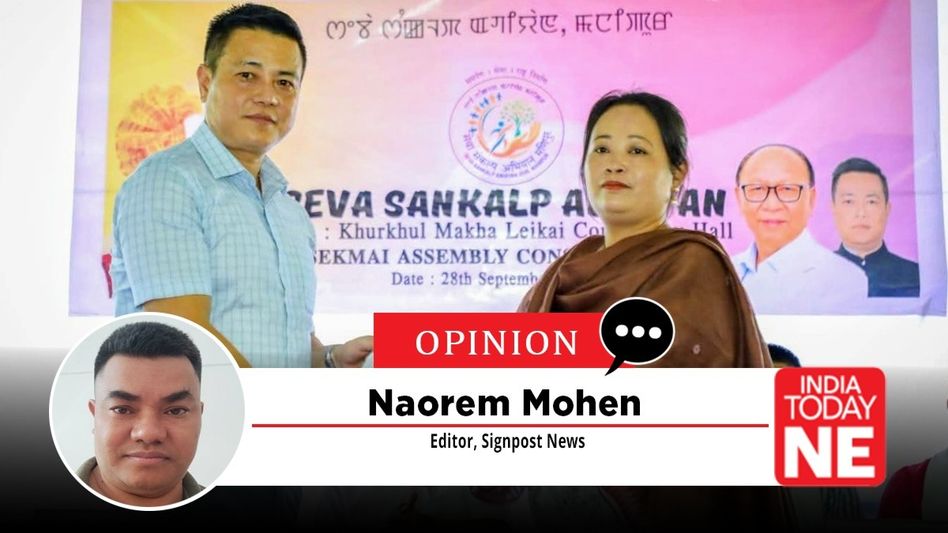
That is why a recent public outreach programme at Khurkhul Makha Leikai Community Hall in Manipur’s Sekmai Assembly constituency deserves attention beyond the usual account of a government function. Taking government departments to a village affected by prolonged insecurity offers an opportunity to restore something that announcements alone cannot provide: confidence that public institutions remain within reach when people need them.
The programme was part of the Seva Sankalp Abhiyan, the nationwide campaign running from September 17 to October 17, 2026, beginning on Prime Minister Narendra Modi’s birthday and marking his 25 years in office as chief minister and prime minister. The national campaign gives the programme political visibility. In Khurkhul, however, its importance must ultimately be judged by what that visibility means for families whose lives have been unsettled by violence and displacement.
Sekmai lies along Manipur’s deeply troubled valley–hill interface adjoining Kangpokpi district, where the conflict that began on May 3, 2023, has repeatedly intruded into civilian life. Reports from the early weeks of the violence recorded clashes in Sekmai and Phayeng, and firing in Khurkhul. For readers outside Manipur, these are not merely names on the itinerary of a welfare programme. They are places that have lived with the consequences of conflict. Bringing public services closer to such communities matters because it can make everyday life a little less uncertain in places that have already endured too much uncertainty.
Explaining the purpose of the Khurkhul programme, Sekmai MLA Heikham Dingo Singh spoke about the difficulties residents face in visiting government departments for health cards, pensions and other benefits for which they may be eligible. He acknowledged that families continued to live in relief camps and that livelihoods remained disrupted even as the intensity of the unrest had eased.
The accompanying speech notes referred to assistance with income and birth certificates, health coverage, old-age and widow pensions, and other welfare schemes. These may sound like routine administrative matters, but they are often the points at which people encounter the state most directly. For those without the money, mobility or guidance to move between several offices, even a relatively simple application can become an obstacle.
There is merit, therefore, in bringing officials together in one place. A person seeking assistance should be able to understand the eligibility requirements, submit the necessary documents and know what happens next without being sent endlessly from one desk to another. For a displaced household, even assembling those documents may require help. Officials at such programmes should be able to explain how missing records can be replaced, discrepancies resolved and applications taken forward.
The test is simple: the administrative burden should become lighter because the government has come closer. Otherwise, the same difficulties have merely been transferred from government offices to a community hall.
MLA Dingo’s suggestion that similar programmes be held at two or three other locations in the constituency is therefore worth pursuing. One gathering cannot be expected to reach every elderly resident, every person with a disability or every family struggling to travel from a relief camp. Repeated visits, announced clearly and organised around local needs, would give the initiative greater purpose.
They would also allow officials to return to unresolved applications, explain delays and determine whether people who sought help at the first camp actually received it. That continuity matters. It would give residents a reason to trust the process beyond the day when officials, representatives and beneficiaries gather under one roof.
The standard of success should also be clear. How many applications were received? How many were completed? How many remain pending because further verification or documentation is required? Were eligible pension applicants enrolled? Did assistance with health coverage result in usable access to the relevant scheme?
Asking these questions does not diminish the work of the officials who participated. It helps establish whether the programme achieved what it set out to do. The material available on the Khurkhul programme explains its intention and the services discussed, but does not establish how many benefits were ultimately delivered. A public follow-up, protecting applicants’ personal information while reporting overall outcomes, would give residents a clearer measure of what the initiative accomplished.
The discussion of roads and livelihoods deserves the same scrutiny because access to welfare cannot be separated from the conditions in which people live. In his speech notes, Dingo described road works at different stages and referred to plans for market sheds at Koutruk, Phayeng and Tairenpokpi, along with a proposal for a nationalised bank branch near the spinning mill area.
Each should be described according to its actual status, with proposals, tenders, ongoing construction and completed facilities clearly distinguished. Their importance is not difficult to see. A usable road can help a patient reach treatment. A functioning market can support local earnings. Accessible banking can reduce the effort required to withdraw money or receive payments.
For residents, however, such potential matters only when the facilities exist, function and can be used safely. Improved connectivity must eventually be judged by completed roads and reliable movement. A proposed market must become a place where people can actually trade with confidence.
Dingo also acknowledged financial difficulties affecting development work. That makes clear priorities and realistic timelines all the more necessary. Public representatives deserve recognition when they secure improvements that make a difference to people’s lives. Residents, in turn, deserve enough information to know what has been completed, what is under way and what remains only a proposal.
The references to educational assistance for children of internally displaced persons require particular follow-up. Dingo’s notes mentioned efforts involving the Labour Department and an intention to raise further educational support with the chief minister. These commitments should not disappear once the programme is over.
A child’s schooling cannot remain indefinitely tied to the uncertainty surrounding a family’s return home. Any assistance should be explained in terms parents can act upon: who is eligible, where to apply, what documents are required and when a decision can be expected. Families already coping with displacement should not have to spend months simply finding out how to seek help.
There is a wider responsibility attached to any campaign delivered through public institutions. Assistance must remain accessible according to need and eligibility, regardless of political affiliation or community identity. In a state where relationships between communities have been gravely damaged, fair and consistent administration can help rebuild confidence through repeated, ordinary encounters.
That rebuilding does not always happen through grand declarations. Sometimes it begins at a desk in a community hall, when an official listens carefully, explains what is required and follows through on what was promised. People recognise such experiences for themselves.
My hope for Khurkhul is that this programme becomes a practice rather than an event that ends with the campaign on October 17. Bringing departments into a conflict-affected village is a constructive beginning, and the MLA’s recognition of the difficulties facing displaced families gives the effort a necessary local focus.
Its lasting worth will become clearer in the months ahead: when residents know whether their applications were resolved, whether their children received assistance and whether the promised works moved forward.
For Sekmai AC, trust in government will not be rebuilt in a single programme. It will return through such experiences accumulating over time, until people can approach a public institution with a reasonable expectation that they will be heard, and that help will follow.