Khelo India 3.0 Can Make Manipur University a Sporting Pathway for India
Manipur has never lacked sporting talent. What it has often lacked is a complete institutional pathway that can identify talent early, support it consistently, expose it to serious competition and carry it from the local field to the national and international stage.

- Aug 28, 2026,
- Updated Aug 28, 2026, 12:25 PM IST

Manipur has never lacked sporting talent. What it has often lacked is a complete institutional pathway that can identify talent early, support it consistently, expose it to serious competition and carry it from the local field to the national and international stage.
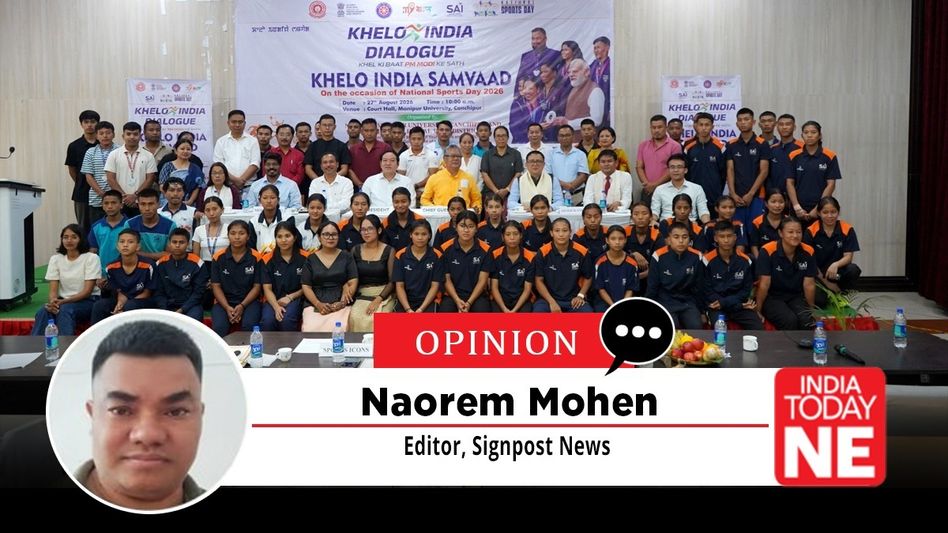
This is why the Khelo India Samvaad held at Manipur University deserves to be read beyond the ordinary formality of a sports programme.
The programme also carried national significance as Prime Minister Narendra Modi addressed the participants virtually and placed the discussion within India’s larger sporting vision. He said the Government is fully committed to building a modern sports ecosystem for 21st-century India, from sports universities to advanced training centres, so that sporting talent can receive support at every stage.
His message was especially relevant for Manipur, as he stressed that sports are not limited to winning medals but are also a mission to unite India’s youth power in the making of a developed nation. The Prime Minister’s emphasis on identifying children between five and 15 years of age, not merely according to the sport they like but according to the discipline for which they are best suited, gives Manipur a clear direction.
In a State where talent often emerges from small schools, local clubs and remote villages, this approach can help discover young athletes before poverty, distance or lack of facilities pushes them out of the sporting system.
The symbolic value of the programme was strengthened by the felicitation of distinguished sports icons who have carried Manipur’s name to national and international platforms.
The dignitaries felicitated Oinam Bembem Devi, Padma Shri and Arjuna Award recipient and former captain of the Indian women’s national football team; Chinglensana Singh Kangujam, Arjuna Awardee and international hockey player; Thingbaijam Sonia Chanu, international weightlifter and silver medallist at the 2010 Commonwealth Games; Likmabam Sushila Devi, international judoka and Olympian; and Okram Boby Singh, gold medallist at the 2011 World Thang-Ta Championship.
Promising youth sports icons were also felicitated and encouraged during the programme. They included Sorokhaibam Melody Devi, national-level archer; M. Sanjana Chanu, national-level footballer; L. Lamnganba, national-level boxer; L. Wilson Singh, national-level weightlifter; and Victoria Huirem, a promising cyclist. Their presence gave the Samvaad a powerful generational meaning: Manipur’s sporting past, present and future stood together on one platform.
The discussions involving officials of the Sports Authority of India, the Department of Youth Affairs and Sports, Manipur University and other stakeholders pointed to one central message: Manipur can no longer depend only on natural talent, community discipline and individual hardship. It must now build a structured sporting system.
This is where Khelo India 3.0 can become important. The proposed framework seeks to bring schools, colleges and universities into a common sporting route. This is crucial because Indian sports has long suffered from a broken ladder. A promising child may shine in school but disappear in college. A talented university athlete may win medals but fail to receive proper coaching, nutrition, competition exposure or career guidance. A local champion may never reach the national stage because there is no systematic bridge between talent and opportunity.
Hence, Khelo India 3.0, AIU registration and inclusive grassroots planning can open a larger future for Manipur’s athletes.
The speeches delivered by Langthabal AC MLA, Karam Shyam Singh; Vice-Chancellor in-charge Prof. R.K. Hemakumar Singh; Secretary Naorem Praveen Singh, IAS; Dr. Mayengbam Veto Singh, Director, Department of Youth Affairs and Sports, Government of Manipur; Shri Dhandapani C., Regional Director In-charge, Sports Authority of India, Takyel, Imphal; and Dr. Ch. Pradeep Singh, Assistant Director of Sports, Manipur University, together reflected the same urgency. Manipur’s sporting culture must now be linked with schools, colleges, universities, Khelo India Centres, sports associations, State institutions and national-level pathways.
The timing is important. India is preparing for a substantially expanded phase of Khelo India for the period from 2026 to 2031. According to Dhandapani C., the proposed Khelo India 3.0 framework envisages a major increase in funding, a far wider athlete-support base, stronger infrastructure, more competitions, better coach development, sports science support, digital monitoring and direct assistance to athletes. The proposed increase from around 3,000 Khelo India athletes receiving monthly support to nearly 30,000 athletes is not a small administrative change. It represents a serious attempt to expand India’s sporting base.
For Manipur, this is not merely another Central scheme. It is an opportunity that must not be missed. The State has already produced Olympians, world champions, national medal winners and generations of disciplined athletes from modest homes and difficult circumstances. Manipur’s sporting culture was not created by government files alone. It grew from traditional games, local clubs, community competitions, village playgrounds, families, neighbourhood organisations and a social respect for physical courage and discipline.
Dr. Mayengbam Veto Singh was right in reminding the gathering that many of Manipur’s sporting achievements came first from this indigenous community-support system. Government assistance came later and strengthened an already existing foundation. Many of the Olympians celebrated today endured considerable hardship before gaining access to modern training, professional coaching and international exposure.
That truth must be remembered. But it must not become an excuse for leaving future athletes to survive the same hardship. The next Mary Kom, Mirabai Chanu or international champion should not have to depend only on personal struggle, borrowed equipment, local goodwill and accidental discovery. A mature sporting State must identify such children early, support them scientifically and place them in a continuous development pathway.
If Khelo India 3.0 is implemented properly, that bridge can be built. The proposed Khelo India Feeder Schools and Khelo India Utkrisht Vidyalayas are especially significant for Manipur. If one of the proposed centres for the Northeast zone comes to Manipur, it can strengthen the State’s position as a serious sporting hub. Such a centre should not be seen merely as infrastructure. It can become a training, education and talent-development institution where young athletes receive coaching, accommodation, nutrition, sports science support and academic continuity.
This matters deeply because many athletes from Manipur come from families that cannot bear the cost of modern sports training. Talent alone does not buy shoes, nutrition, equipment, travel tickets or recovery support. The proposed monthly allowance under the expanded Khelo India framework can ease this burden for thousands of athletes across India. If Manipur wants its rightful share, it must prepare its athletes, institutions and paperwork in advance.
The issue of inclusiveness is equally important. The participant’s question to the Director of Youth Affairs and Sports touched a sensitive but necessary area. Over the years, certain sporting disciplines and geographical areas have received greater attention. Many schools in hill areas still have very few organised sporting activities. School-level competitions are limited. Young children from remote villages often cannot afford to travel to Imphal. Mobilisation, coordination and communication difficulties further reduce their chances of being noticed.
A child’s place of birth should not determine the limits of his or her sporting future. If a talented girl in Ukhrul, Senapati, Churachandpur, Tamenglong, Kamjong, Tengnoupal or any remote part of the State cannot access training, equipment or competition, Manipur loses not only one athlete but a possible medal, a possible career and a possible inspiration for an entire community.
Dr. Mayengbam Veto Singh’s response placed the challenge in practical terms. The Government cannot develop every discipline and every geographical area at the same time because resources are limited. Therefore, the State must identify disciplines where Manipur has a clear advantage and invest strategically. It cannot become a “jack of all trades and master of none.”
This is a realistic point. But strategic prioritisation must not become geographic exclusion. If priority disciplines are identified, access to those disciplines must be expanded across districts. If boxing, weightlifting, archery, football, martial arts, hockey, judo, wrestling or other sports are chosen for focused investment, children from both hills and valley must be given fair entry into the system.
The YAS Director also clarified that it would be incorrect to say all sports facilities are confined to Imphal. Many facilities in and around the capital were created during the Fifth National Games, which naturally led to a concentration of infrastructure in the Imphal area. At the same time, facilities have also been created in hill districts through the Education Department, Tribal Affairs Department and other government schemes, including programmes such as the Pradhan Mantri Jan Vikas Karyakram.
This distinction is important. Sporting infrastructure should not be assessed only through facilities directly controlled by the Department of Youth Affairs and Sports. But the larger question remains: are these facilities functional, accessible, staffed, equipped and linked to competitions?
A building alone cannot create a champion. Naorem Praveen Singh, IAS, made this point clearly while speaking about archery.
Manipur has considerable potential in archery, but it has not yet reached the level required to consistently produce Olympic-standard archers. One of the major obstacles is the cost of modern equipment. Many young archers cannot afford bows, arrows and other accessories. Some beginners have to borrow or share equipment. This places children from poor families at a disadvantage from the very beginning.
This is true not only of archery. It applies to many sports. Equipment cost, nutrition, travel, coaching fees and competition expenses quietly push talented children out of the system before they are properly tested.
Archery provides a useful example of how Manipur should think. The State has a long and proud tradition of archery. Traditional archery is part of Manipur’s cultural memory. But traditional skill must now be connected to modern competitive categories such as Indian round, recurve and compound. Indian-round archery can provide an accessible starting point for beginners. Promising athletes can then move to recurve and compound categories with institutional assistance, modern equipment, qualified coaching and recognised competition exposure.
This is exactly the kind of pathway that Manipur needs in every priority discipline. The Department of Youth Affairs and Sports, recognised sports associations and educational institutions must coordinate so that athletes are not trained in isolation. Young players should know what level they are entering, what standards they must meet and how they can progress. Training must no longer depend only on enthusiasm. It must depend on coaching quality, scientific assessment, equipment access and competition structure.
This brings us back to Manipur University. Ch. Pradeep Singh’s speech brought necessary attention to the new AIU registration system for university-level players. Earlier, players could participate in inter-college tournaments and selection trials by producing identity cards issued by their respective colleges. From the 2026-27 academic session, every player will have to register individually on the Association of Indian Universities portal. After online registration, the details will be verified by the Department of Sports, Manipur University. Only after approval will the AIU identity card be issued.
This may appear like a procedural matter. It is not. For a sportsperson, a missed registration can become a missed career opportunity. If a deserving player fails to obtain the AIU identity card, he or she may not be able to participate in inter-university competitions. In a State like Manipur, where many athletes depend on certificates, medals and recognised participation for academic and professional advancement, such negligence can carry serious consequences.
Manipur University has made the position clear. The AIU identity card will enable eligible players to participate in tournaments conducted under the Association of Indian Universities anywhere in India. Certificates earned at the All-India Inter-University level are recognised as equivalent to national-level sports certificates. This gives university sports a value far beyond campus pride.
It gives it career value. This is precisely why affiliated colleges cannot remain passive. Principals, sports teachers and college administrations must treat AIU registration as an urgent institutional responsibility. It is not enough to wait for students to discover the process on their own. Many promising athletes come from rural, economically weaker and first-generation college backgrounds. Some may not understand online registration procedures. Others may miss deadlines because information does not reach them in time.
No deserving player should lose an opportunity because a college failed to inform, guide or assist. Manipur University is expected to begin inter-college tournaments and selection trials from September 10. The detailed schedule will be announced separately. This gives colleges and players very little room for delay. Once the official notification is issued and sent to affiliated colleges, every institution must move quickly.
The larger issue is not only registration. It is institutional seriousness. For too long, sports in educational institutions has often depended on individual enthusiasm rather than a strong system. Some colleges take sports seriously. Some remember athletes only when medals arrive. Some universities celebrate sporting achievements after the event but invest too little before the event. That approach must end.
Dr. M. Veto Singh’s emphasis on reaching approximately 25,000 young athletes at the grassroots level deserves serious attention. If Manipur wants to produce one champion like Mirabai Chanu, it may need to nurture at least ten equally promising athletes in the same category. If it wants ten athletes to reach Olympic level, it may need to identify and train thousands of young people at the grassroots.
This is the correct sporting logic. A champion is rarely produced by selecting one child and hoping for a miracle. A champion usually emerges from a broad base, repeated competition, scientific filtering, long-term training and sustained support. Talent identification must therefore be large, fair and data-driven. Physical capacity, sporting aptitude, performance, discipline and long-term potential must all be assessed carefully.
Scientific assessment is no longer optional. Talent should not be selected only on the basis of personal opinion, local influence or one-day performance. Manipur needs transparent testing, measurable criteria and regular monitoring. A child identified at the school or district level must be tracked, trained and moved gradually through higher levels of coaching.
The State Government’s plan to make around 30 out of 32 sanctioned Khelo India Centres functional is a welcome step. The proposed additional training centres in strategic locations, including a dedicated water-sports facility at Takmu and facilities in Kakching, Churachandpur, Senapati and Ukhrul, should be pursued with urgency. Their purpose is important: to decentralise access so that talented children do not always have to travel to Imphal.
This is exactly what Manipur needs.
Residential support at selected locations can also make a major difference. If athletes from remote areas receive accommodation, food, coaching and training at suitable centres, their progress can be monitored more consistently. For children from distant hill districts and economically weaker families, residential support may be the difference between continuing sports and dropping out.
There is another important dimension. Prof. R.K. Hemakumar Singh rightly connected physical fitness, discipline and a drug-free life with national development. In Manipur’s present social condition, this message carries serious weight. The State is passing through a difficult period marked by conflict, insecurity, unemployment, drugs and social fragmentation. Young people need direction, purpose and disciplined spaces where their energy can be shaped constructively.
The programme also gained wider meaning through the presence and remarks of MLA Karam Shyam, former Indian women’s football captain Oinam Bembem Devi, Prof. L. Santosh Singh and MY Bharat State Director Paulina Monsang. Their participation reminded the gathering that sports development is not the responsibility of one department or one institution alone.
Political support, the experience of accomplished sportspersons, the mobilisation of students through platforms such as NSS and the active involvement of MY Bharat are all necessary if Manipur is to convert its natural sporting talent into a disciplined and sustainable system.
Sports can provide that space. A playground is not merely a field. It is where discipline becomes habit, teamwork becomes character and ambition becomes measurable. A university or school that invests in sports is not only producing athletes. It is producing healthier citizens, stronger students and more confident young people.
Khelo India 3.0, if implemented with sincerity, can help restore this social function of sports. But schemes do not succeed by announcements alone. They succeed when institutions at the ground level understand them, claim them and implement them. The Centre may provide funding, policy design and athlete support. The State Government, University, colleges, schools, academies, coaches and associations must convert those provisions into real opportunity.
Manipur should not approach this scheme as a beneficiary waiting for grants. It should approach it as a leading sporting State ready to compete.
The country is preparing for major international competitions in the coming years, and India’s ambitions relating to events such as the 2030 Commonwealth Games and the 2036 Olympic Games place a special responsibility on sporting states like Manipur. The posting of experienced sports officials and regional authorities in Manipur should therefore be used properly. Their role must not remain ceremonial. They must help the State identify athletes, improve systems and prepare talent for higher competition.
A building or playground alone cannot create champions. Athletes require systematic coaching, scientific training, good nutrition, quality equipment and regular competitive exposure.
The comparison with Haryana is also relevant. Haryana has built a reputation through a strong sporting culture, reward systems, coaching networks and serious investment in athletes. Manipur has talent of equal intensity and, in several disciplines, even greater historical depth. What Manipur now needs is coordination, infrastructure, documentation, professional coaching, sports science support and timely access to national schemes.
The proposed digital platform under Khelo India 3.0 can also be useful. If athletes, coaches, federations and governments are brought onto a common system, performance can be tracked more accurately. This can reduce arbitrariness and improve accountability. Manipur must ensure that its athletes are properly mapped on such platforms, with verified records, competition history and development needs.
Another area requiring attention is coach development. The SAI Director’s speech mentioned recognised coach-certification programmes and continuous professional development. This is vital. Talent can be wasted by poor coaching as much as by lack of funds. Modern sports demands knowledge of training cycles, recovery, psychology, nutrition, injury prevention and competition planning. Manipur’s local coaches have dedication and field experience. They must now be supported with upgraded knowledge and certification.
Manipur University should explore recognised programmes for coaches, sports science personnel and support staff. It can also create academic linkages between physical education, life sciences, psychology, nutrition, physiotherapy and data analysis. Modern sports is no longer separated from science. If Manipur wants medals at the highest level, it must bring science into the training ground.
The larger lesson from the Khelo India Samvaad is clear. Manipur University stands at an important turning point. It can either remain a participant in national university sports, or it can become a structured pathway that sends athletes from colleges to All-India Inter-University competitions, Khelo India University Games and beyond.
The second path requires seriousness. It requires every affiliated college to identify players early and help them complete AIU registration. It requires schools in both hills and valley to organise regular competitions. It requires the State to activate district centres and make them functional. It requires sports associations to conduct fair and regular tournaments. It requires the University to conduct trials with transparency and discipline. It requires the Government to provide equipment support where poverty blocks talent. It requires coaches to be trained, athletes to be monitored and promising children to be given a pathway from grassroots to elite centres.
The young players of Manipur University and its affiliated colleges must be told clearly: the road to national recognition can begin from the inter-college tournament, move through the All-India Inter-University competition, enter Khelo India University Games and proceed further into India’s larger sporting system. That road is now becoming more organised. But no one can walk it without registration, eligibility, preparation and discipline.
The same message must reach schools and villages. There may be another Mary Kom, another Mirabai Chanu or another Olympic hopeful training in a small school, hill village or local ground today. Manipur’s responsibility is to find that child before poverty, lack of equipment, absence of competition or distance from Imphal kills the dream.
The message from the Samvaad should therefore travel to every college, every school, every sports teacher, every coach, every association and every family that has a young athlete.
Do not wait until the last moment. Register. Train. Compete. Identify. Support.
Manipur has talent. India is expanding its sporting architecture. Manipur University, the State Government and every sporting institution must now connect the two with seriousness, speed and vision.
If they do so, the medals won by university students and young athletes at national and global sporting events will no longer be isolated moments of pride. They can become the visible outcome of a strong, inclusive, disciplined and future-ready sporting system.