Kick, Punch or Both? CM Khemchand’s Taekwondo Politics in Jiribam
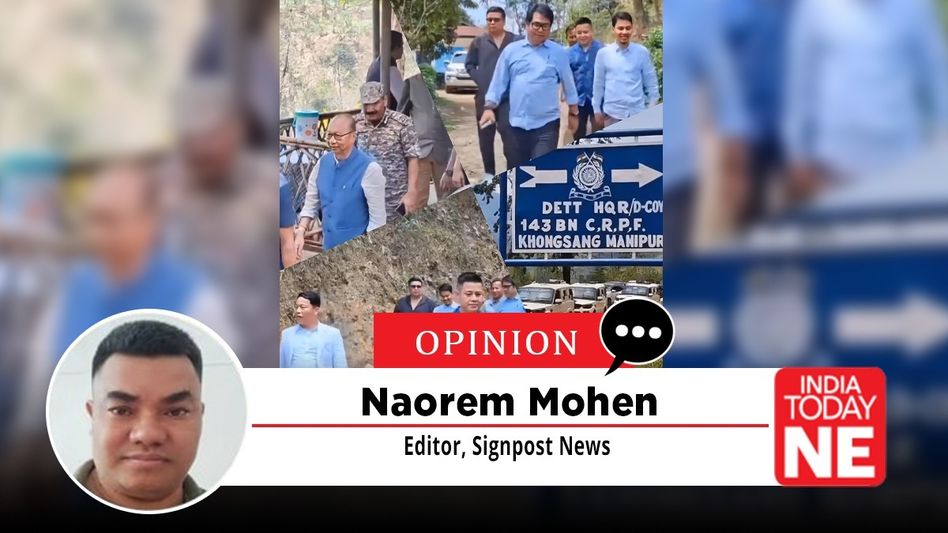
Manipur Chief Minister Yumnam Khemchand Singh’s recent three-day road journey to Jiribam district, undertaken alongside a group of young MLAs widely regarded as his close allies and potential favourites for an expanded cabinet, marks more than a routine administrative visit.

- Apr 04, 2026,
- Updated Apr 04, 2026, 2:37 PM IST

Manipur Chief Minister Yumnam Khemchand Singh’s recent three-day road journey to Jiribam district, undertaken alongside a group of young MLAs widely regarded as his close allies and potential favourites for an expanded cabinet, marks more than a routine administrative visit.
It represents a calculated political and administrative manoeuvre at a critical juncture for the violence-scarred state. If the green signal for cabinet expansion indeed receives a nod from the high commands in Delhi — as unconfirmed reports and the timing of his recent Delhi engagements suggest — this tour could be the opening gambit in consolidating his leadership while projecting stability and outreach to the Centre.
The delegation, which included MLAs such as T. Robindro (Thanga), Sheikh Noorul Hassan (Kshetrigao), Heikham Dingko (Sekmai), Dr. S. Ranjan (Konthoujam), S. Premchandra (Kumbi), Sapam Kunjeshore (Patsoi), Khongkham Robindro (Mayang Imphal), L. Rameshor (Keirao), local Jiribam MLA Muhammad Achab Uddin and BJP Manipur President A. Sharda Devi travelled by road — the first such journey by a Chief Minister to the district since the ethnic violence erupted on May 3, 2023.
This bold move carries deep symbolic weight in a state where physical movement between communities has often been restricted by security concerns, blockades, and deep-seated mistrust.
This journey leaves behind three points worth remembering, each underscoring Khemchand’s emerging style of governance. First, the Chief Minister’s background as a taekwondo practitioner adds an intriguing and highly relevant layer to the narrative.
A fifth-dan black belt, Khemchand brings the mindset of a seasoned martial artist into politics. In taekwondo, one never fully anticipates the opponent’s next move — whether it will be a swift kick, a precise punch, or a combination of both executed with perfect timing and strategy.
Similarly, no one can predict Khemchand’s political manoeuvres with certainty. His decision to personally lead this road trip, accompanied by a youthful team of MLAs, reflects a fighter’s instinct: proactive, disciplined, and willing to venture into contested territory rather than waiting passively for events to unfold. This unpredictability could prove to be his greatest advantage in navigating Manipur’s complex ethnic and political landscape, where previous approaches have often stalled amid entrenched positions and mutual suspicion.
Second, the visit delivered a practical blow to the narrative of permanent division. For months, Kuki militants and certain civil society organisations (CSOs) had effectively manned and monitored highways and entry points, creating a de facto separation between Meitei and Kuki.
Today’s successful road traversal by the Chief Minister and his Meitei MLAs across security-sensitive zones signals that such barriers are not impenetrable. It challenges the notion that physical and psychological walls cannot be crossed.
By reaching Jiribam around 1 pm, interacting with community leaders, civil society groups, local residents, and internally displaced persons (IDPs), and inspecting key installations like the Leingangpokpi police outpost and Jiribam District Hospital, the delegation demonstrated that administrative outreach can pierce through the fog of conflict. This was not merely symbolism; it was a tangible assertion of governmental presence in a border district long affected by spillover violence from the broader ethnic clashes.
Third, and perhaps most strategically significant, CM Yumnam Khemchand has sent a clear signal to the Centre in Delhi: he possesses both the willingness and the capacity to engage directly with sections of the Kuki community that have been reluctant to dialogue with the previous dispensation under N. Biren Singh.
The ongoing ethnic conflict between the Meitei and Kuki communities, which has claimed hundreds of lives and displaced tens of thousands since 2023, has left deep scars, including serious incidents of violence in Jiribam itself in late 2024 and early 2025.
By emphasising dialogue between Meitei and Kuki-Hmar leaders and focusing on reconciliation, IDP welfare, and peaceful coexistence, the new Chief Minister positions himself as a potential bridge-builder.
This is particularly relevant following directives from Union Home Minister Amit Shah urging intensified peace-building efforts and addressing the prevailing trust deficit.
If Delhi has been seeking a fresh face capable of resetting stalled talks, this visit subtly conveys that Khemchand can handle the “unruly” elements unwilling to engage previously, without appearing weak or overly conciliatory to any single side.
The overall message emerging from the tour is cautiously positive. The Jiribam side appears somewhat clearer now, at least in terms of demonstrated governmental intent and reduced immediate barriers to movement. The visit served as an effective public relations exercise, showcasing the state’s commitment to restoring normalcy, reviewing security arrangements, and promoting essential public services.
Interactions with affected communities, particularly IDPs, could help rebuild frayed trust if followed by concrete actions — such as improved relief measures, enhanced policing, or community-level confidence-building initiatives.
However, one must temper optimism with realism. Manipur’s ethnic fault lines run deep, rooted in issues of land, identity, political representation, and historical grievances.
A single road trip, however symbolic, cannot erase years of suspicion or undo the humanitarian crisis involving displaced families living in makeshift camps. The presence of young MLAs — many seen as favourites — also hints at internal BJP dynamics. Their inclusion may be intended to groom a new generation of leaders loyal to Khemchand while signalling to Delhi that his team is cohesive and ready for expansion.
With the current cabinet remaining lean, any nod for expansion from the high command would strengthen his hand in implementing ground-level decisions.
However, a strong note of caution is necessary. If the entire Jiribam episode turns out to be nothing more than a carefully staged drama — a well-choreographed public relations exercise designed primarily for optics, media coverage, and political signalling to Delhi rather than genuine reconciliation — then all the effort, symbolism, and hope generated will ultimately be wasted.
Manipur has witnessed too many such high-profile visits and announcements in the past that created temporary buzz but delivered little on the ground. Empty gestures only deepen cynicism among the people who have suffered the most — the displaced families, the bereaved, and the youth whose futures remain uncertain.
For any real healing to begin in earnest, what the state desperately needs is honesty and transparency. Leaders must move beyond performative politics and demonstrate sincerity through verifiable actions: clear timelines for IDP rehabilitation, impartial security arrangements that protect all communities equally, inclusive dialogues where no side feels sidelined or manipulated, and concrete development initiatives that address long-standing grievances of both hill and valley residents.
Without this foundation of truthfulness, even the most promising outreach risks becoming another chapter in the long book of broken promises that has eroded public faith in governance.The people of Manipur are exhausted by conflict. They can distinguish between a sincere attempt at peace and a tactical manoeuvre meant only to buy time or score political points.
If Yumnam Khemchand’s team is serious about turning the page, every step — from this Jiribam visit to future engagements — must be backed by accountability. Secret deals, selective outreach, or hidden agendas will only fuel fresh suspicions and push the state back into the cycle of violence and mistrust.
The road ahead remains challenging but mapped with intention. Next on the horizon could be similar outreach to Kangpokpi and Churachandpur — districts that have witnessed intense violence and remain sensitive hubs of Kuki and Zo influence. Moreh, the strategically vital border town with Myanmar, also cannot be overlooked, given its role in trade, security, and cross-border influences that have sometimes exacerbated local tensions.
Expanding such visits systematically would demonstrate sustained commitment rather than one-off gestures. The involvement of both Meitei MLAs and the state BJP president in the delegation is a double-edged sword: it broadens representation but could be perceived by some Kuki groups as tilted toward valley interests.
True reconciliation demands inclusive processes where all stakeholders feel genuinely heard, not merely managed.
From a larger perspective, CM Y Khemchand’s taekwondo-honed discipline — emphasising focus, resilience, and strategic timing — may serve him well in this political arena.
Manipur has endured prolonged instability, with the conflict disrupting lives, economy, and social fabric. The Centre’s repeated nudges for peace-building reflect national stakes: a stable Northeast is crucial for regional connectivity, border security, and India’s Act East policy.
If this Jiribam initiative marks the beginning of a pragmatic, hands-on approach that combines outreach with firmness against violence, it could shift the narrative from perpetual crisis to gradual recovery.
The young MLAs accompanying the CM represent fresh energy; their role in follow-up actions will be telling. Will they champion inclusive development or fall back into partisan lines?
In short, Chief Minister Yumnam Khemchand Singh’s Jiribam tour, executed with martial precision and political foresight, offers a glimmer of proactive leadership in a state long beset by division. It challenges the status quo of separation, signals readiness to the Centre, and opens avenues for dialogue where none existed comfortably before.
If cabinet expansion follows with Delhi’s approval, it could empower a more robust team to translate this momentum into lasting change.
However, the ultimate success or failure of this effort hinges on one critical factor like whether it is driven by genuine intent or mere political theatre. Only honest and transparent governance can truly heal Manipur’s wounds.
The coming months — in Kangpokpi, Churachandpur, Moreh, and beyond — will test whether this is the start of genuine healing or another chapter in the state’s cycle of hope and setback.
For now, the road to Jiribam has been traversed. The real test lies in sustaining the journey toward peace, one careful, strategic, yet sincere step at a time.
Only time, verifiable actions, and tangible results on the ground will reveal if Khemchand’s moves — kick, punch, or both — deliver real progress or merely another fleeting performance in Manipur’s long struggle for peace.
The views expressed in this article are those of the author and do not necessarily reflect the views of India Today NE or its affiliates.