Lai Keithel Kaba: When Divine Panthou’s Prayers for Peace Reach the Ima Keithel
An indigenous religious observance at Manipur’s historic Mothers’ Market offers a glimpse into Divine Panthou’s teachings on compassion, the sanctity of human life and the spiritual aspirations of the Meitei people.

- Oct 25, 2026,
- Updated Oct 25, 2026, 2:21 PM IST

A marketplace is where people bargain over vegetables, sell fish, buy clothes and earn enough to feed their families. It is hardly the first place an outsider would associate with religious devotion. But Manipur's traditional marketplaces have another life, one that is not immediately visible to those who see them only as centres of commerce.
They have their presiding deities. They have shrines where people offer prayers. And they have customs that connect the livelihood of ordinary people with the religious beliefs inherited from their ancestors.
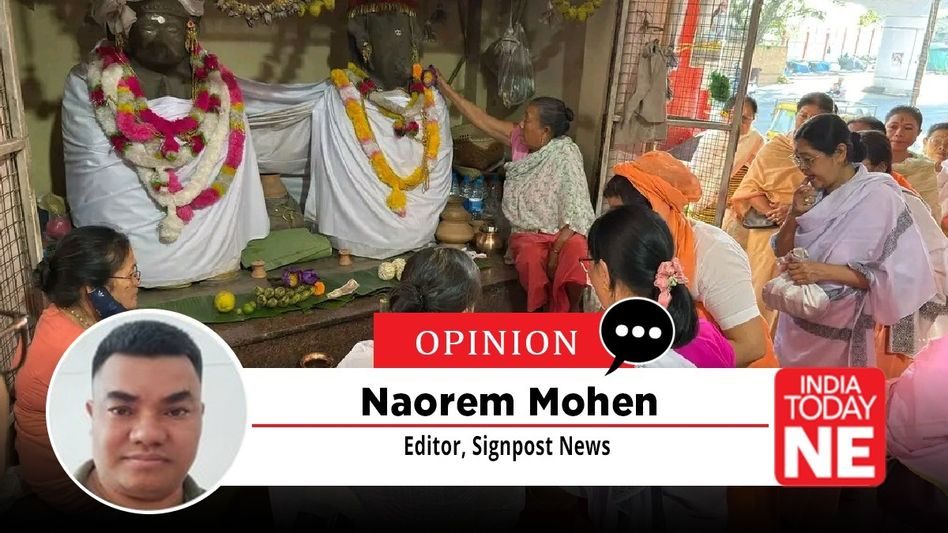
On October 21, seven devotees of Divine Panthou arrived at Khwairamband Ima Keithel in Imphal carrying fruits, flowers and customary offerings. Their destination was not the market stalls but the shrines of its presiding deities. They had come to perform Lai Keithel Kaba, an indigenous religious observance forming part of the 32nd Panthou Sanglen Laipung Halao Thouni Ilaat 2026.
They prayed for peace in the land, protection from death and suffering, and freedom from illness and affliction. They also distributed Senkok Senyai, or blessed coins, among the women vendors, accompanied by prayers for their health and well-being.
The ceremony may appear simple. Yet behind it lies a religious understanding of human life, community welfare and the responsibility of people towards one another. To appreciate its significance, one must look beyond the offerings and understand what the observance represents within Divine Panthou's spiritual tradition.
In Manipur's indigenous Sanamahi religious tradition, marketplaces are not merely places where people exchange goods. Traditional markets have their presiding deities, including Lairembi, the female deity revered as a divine guardian.
Khwairamband Ima Keithel, known widely as the Mothers' Market, is part of this living heritage. Its shrines are associated with Lairembi and Lairamba, the female and male deities to whom devotees offer prayers and customary offerings.
This relationship between religion and the marketplace reflects an understanding of life in which the sacred is not separated from the ordinary. The place where a mother earns her livelihood is also a place where divine protection is sought.
For generations, people have carried their religious beliefs into the spaces where they work and live. The presence of the market deities reminds devotees that prosperity is not simply about earning money. Health, safety, peace and the well-being of the community are equally important. Lai Keithel Kaba draws upon this indigenous religious understanding.
During the October 21 observance, Divine Panthou's devotees approached the market shrines with seasonal produce, flowers and other customary offerings. They sought blessings not only for themselves but for the people of the land.
The prayers were particularly meaningful in the circumstances confronting Manipur. What does prosperity mean to a family that has lost a loved one? What comfort does economic growth offer to someone who cannot return home because of violence These questions give the ceremony a relevance that extends beyond its religious setting.
The 32nd Panthou Sanglen Laipung Halao Thouni Ilaat began on October 11 at Divine Panthou's sacred abode at Meitei Laikol, Selloi Langmaiching. The festival included religious observances alongside songs, dances and other cultural programmes.
But the tragic incident at Nongshum on October 19 changed the course of the celebrations.
Following the incident, the organisers decided to discontinue all songs, dances and entertainment programmes. Only the essential religious rituals were continued.
The decision was taken in accordance with Divine Panthou's teachings, which emphasise concern for human life and sensitivity towards the suffering of others.
This is perhaps one of the most important aspects of the festival that deserves wider attention.
A religious celebration may have been planned months in advance. Performers may have prepared their programmes, and devotees may have travelled to participate. Yet the organisers recognised that continuing with festivities while families were grieving would be inconsistent with the compassion emphasised in Panthou's teachings.
They did not abandon the religious observances. They distinguished between the rituals that had to be performed and the celebrations that could be set aside. The distinction matters.
Religious devotion is often judged by the grandeur of ceremonies, the number of participants or the elaborate arrangements made for a festival. But there is another measure that deserves equal attention: how a religious community responds when people around it are suffering.
Divine Panthou's teachings, as reflected in the organisers' decision, place human suffering within the responsibilities of religious life. The pain of others cannot be dismissed simply because one is engaged in a sacred celebration.
In Manipur, where repeated tragedies have left families mourning and communities struggling with uncertainty, this sensitivity carries particular meaning.
A society does not become compassionate merely by speaking about peace. Compassion becomes visible in the decisions people make, especially when those decisions require them to set aside something they had looked forward to. The suspension of the cultural programmes was one such decision.
The October 21 observance at Ima Keithel was also connected with another important religious ceremony scheduled for October 26, Mera Thanil.
According to the organisers, the fruits, flowers and customary items offered during Lai Keithel Kaba would subsequently be presented during the Meitei Fambal Tongba and Piba Makok Hapa observance.
Within Divine Panthou's religious tradition, these ceremonies carry aspirations for the elevation, dignity and advancement of the Meitei people.
The expression Meitei Fambal Tongba is associated with the aspiration for the community to attain a higher standing, while Piba Makok Hapa attaches religious significance to the elevation of men and their position within the community.
These meanings belong to the traditional religious understanding of the devotees. They express hopes for the continuity, dignity and collective progress of the Meitei people.
For readers outside Manipur, it is important to understand that such rituals cannot be fully appreciated by observing their outward performance alone. Indigenous religious traditions often preserve collective aspirations through ceremonies, offerings and symbols whose meanings have been passed down through generations.
The offerings made at the market shrines are therefore not isolated acts of worship. They form part of a larger sequence of religious observances through which devotees seek blessings for their community.
At the same time, the advancement of any community finds its most meaningful expression in the dignity, education, security and well-being of its people.
A community becomes stronger when its members are able to live without fear, preserve their traditions and provide a better future for their children.
Seen in this light, the religious aspirations expressed through Meitei Fambal Tongba and Piba Makok Hapa invite reflection on the responsibilities that accompany the desire for collective advancement.
The Lai Keithel Kaba observance did not end with prayers at the shrines. Divine Panthou's devotees also distributed Senkok Senyai, or blessed coins, among the women vendors of Khwairamband Ima Keithel. Devotee Thokchom Maniton presented the coins with prayers for the recipients' health and well-being.
The significance of Senkok Senyai does not lie in its monetary value. Within the religious observance, it represents blessings and goodwill extended to the recipient. The gesture was particularly meaningful because of the place where it occurred.
Ima Keithel is not an ordinary marketplace. Generations of women have sustained their families through trade here. They have educated children, supported households and contributed to Manipur's economy through years of hard work.
The market has also occupied an important place in the state's social and political history. Its women have often spoken out on issues affecting the wider community.
Yet behind this collective strength are individual lives filled with familiar worries.
A mother sitting at her stall may be thinking about her child's education, an elderly parent's medicine or whether the day's earnings will be enough to meet household expenses. She may have spent decades working in the same marketplace, watching governments change and generations grow up.
For her, peace is not an abstract subject debated in political meetings. It means being able to work safely, return home without fear and know that her family is secure.
When Divine Panthou's devotees shared Senkok Senyai with the women vendors, the religious observance reached these ordinary lives.
Members of the Khwairamband Ima Keithel Joint Coordinating Committee welcomed the devotees and accompanied them during the ceremony.
Committee convenor Laishram Mema appreciated Divine Panthou's initiative and expressed support for programmes concerned with collective welfare, particularly during the difficult circumstances facing Manipur.
The interaction between the devotees and the market women brought together two important dimensions of Manipur's social life: its indigenous religious traditions and the enduring strength of its women.
There is a reason why the prayers offered during Lai Keithel Kaba deserve attention beyond the community of devotees. Since May 2023, Manipur has endured violence, displacement, loss of life and deep mistrust between communities. Thousands of families have experienced disruptions to their livelihoods, education and everyday security.
In such circumstances, prayers for protection from death and suffering are not distant religious expressions. They speak directly to the anxieties of people living through uncertain times.
Yet prayer alone cannot resolve the problems confronting the state. The government has a responsibility to protect lives, enforce the law, ensure justice and create conditions in which displaced families can return safely. Political leaders must find ways to address grievances without allowing further divisions to take root.
Religious observances cannot substitute for these responsibilities. But neither should their contribution to the moral life of society be overlooked.
A community wounded by violence needs more than administrative measures. It also needs compassion, mutual respect and the willingness to recognise the suffering of people beyond one's immediate circle.
This is where Divine Panthou's emphasis on concern for human suffering becomes relevant.
The decision to suspend celebrations after the Nongshum tragedy and the subsequent prayers for collective welfare at Ima Keithel were different expressions of the same principle: the pain of the people deserves attention. It is a principle that can be understood regardless of one's religious beliefs.
One need not be a follower of Divine Panthou to appreciate the importance of setting aside celebration in a time of grief. Nor does one need to practise the indigenous Sanamahi religion to recognise the value of praying for the health and well-being of women who work to support their families. These are human concerns that extend beyond religious boundaries.
Manipur's indigenous religious practices form an important part of its cultural inheritance. Yet many of these traditions remain little understood outside the state.
Even among younger generations, the names of ceremonies may be familiar while their deeper religious meanings receive less attention.
Lai Keithel Kaba offers an opportunity to understand how traditional beliefs remain connected with everyday life.
The observance brings devotees to the shrines of the market deities, acknowledges the sacred dimension of places where people earn their livelihoods and connects customary offerings with prayers for collective well-being.
Its association with Meitei Fambal Tongba and Piba Makok Hapa also reflects the aspirations for community advancement preserved within Divine Panthou's religious tradition.
Documenting and explaining these practices is important, not merely as an exercise in preserving the past but as a way of understanding how communities continue to find meaning in their inherited beliefs.
A tradition remains alive when people understand why they practise it. It becomes socially meaningful when the values associated with it influence how people treat one another.
The Lai Keithel Kaba ceremony at Khwairamband Ima Keithel was modest in its outward appearance.
Seven devotees of Divine Panthou carried customary offerings to the market shrines. Prayers were made for peace and protection. Blessed coins were distributed among the women vendors. The offerings were also connected with a further religious observance seeking the advancement of the Meitei people.
But the significance of the occasion cannot be measured by the number of participants or the scale of the arrangements. Its meaning lies in the relationship it established between religious devotion and concern for human life.
The organisers' earlier decision to discontinue celebrations after the Nongshum tragedy gives this relationship added importance. It demonstrated how Divine Panthou's teachings on compassion could influence a practical decision during a time of grief.
A society cannot hope for peace while remaining indifferent to the suffering of its people. Nor can the advancement of a community be separated from the safety, dignity and welfare of the families who constitute it.
Religious traditions have their rituals, symbols and sacred obligations. But their influence on society is also revealed through the conduct of those who follow them.
When prayers for peace reach the women of Ima Keithel, they remind us that the welfare of the land begins with the welfare of its people.
And when a celebration is set aside because others are mourning, it reminds us of something equally important: the pain of the people must never become less important than the occasion we have gathered to celebrate.