Leading by Example: Thongam Biswajit Singh’s Electric Ride and the Power of Personal Action in Nation-Building
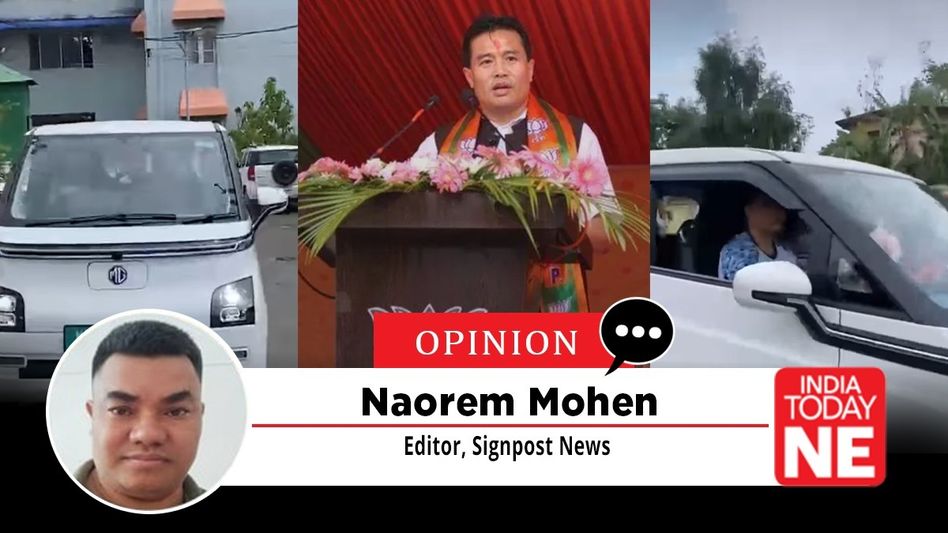
In a time where political rhetoric often outpaces real action, former Manipur Forest and Environment Minister Thongam Biswajit Singh has done something refreshingly simple yet profoundly significant. He stepped into an electric vehicle with his young son, forwent the usual security escorts and convoy, and drove himself—quietly turning words into wheels.

- May 17, 2026,
- Updated May 23, 2026, 4:57 PM IST

In a time where political rhetoric often outpaces real action, former Manipur Forest and Environment Minister Thongam Biswajit Singh has done something refreshingly simple yet profoundly significant. He stepped into an electric vehicle with his young son, forwent the usual security escorts and convoy, and drove himself—quietly turning words into wheels.
His short video on X, captioned “A small personal step towards Nation ,” captures more than just a commute; it embodies a genuine response to Prime Minister Narendra Modi’s recent call for fuel conservation amid global uncertainties.This is not grandstanding. It is leadership at the most relatable level.
As the seniormost BJP leader of Manipur, Thongam Biswajit Singh has shown what real leadership looks like, action over announcement, humility over hierarchy. He has become the first legislator from his state to visibly adopt an EV for personal travel in direct alignment with the Prime Minister’s vision.
His post reads: “Inspired by Adarniya PM Shri @narendramodi Ji’s appeal for fuel conservation, I have shifted to an EV vehicle for my travel. I urge everyone to adopt sustainable lifestyle changes in every possible way.”
No fanfare, no photo-ops with fleets of officials—just a father and son in a clean, silent car. In a country where VIP culture often means flashing lights and multiple vehicles burning fuel for status, this humility stands out as a powerful statement.
Prime Minister Modi’s seven appeals, delivered recently against the backdrop of West Asia tensions and potential energy disruptions, urge citizens to prioritize “Nation First, Duty Above Comfort.” They include reducing petrol and diesel consumption through public transport, carpooling, and EVs; working from home when feasible; postponing non-essential gold purchases and foreign travel; supporting Swadeshi products; and embracing natural farming to cut import dependence.
These are not abstract policy prescriptions but practical behavioral shifts designed to conserve foreign exchange, bolster energy security, and build resilience. India imports the bulk of its crude oil, and every litre saved strengthens our economic sovereignty.
Thongam Biswajit Singh’s gesture directly addresses the core of these appeals, reducing fossil fuel dependence. Electric vehicles are not a futuristic luxury anymore; they are a present necessity. India’s EV push, backed by schemes like FAME, aims to cut emissions, lower oil imports, and create jobs in batteries, charging infrastructure, and manufacturing.
By choosing an EV, the minister is voting with his daily routine for cleaner air, quieter roads, and reduced pressure on our forex reserves. His decision carries extra weight coming from Manipur, a state where environmental conservation intersects with development challenges, and where he previously held the Forest and Environment portfolio. Forests and fuel are linked—less pollution today means healthier ecosystems tomorrow.
What makes this act commendable is the absence of security. In India, leaders often travel in cavalcades that consume far more fuel than necessary. By driving without escorts, MLA Biswajit Singh demonstrates that personal security protocols can be rationalized without compromising safety, echoing broader moves where the Prime Minister and other officials have trimmed convoys.
This normalizes simplicity. It tells the common citizen that sustainable choices are not just for the masses but should start from the top. When ministers lead by example, cynicism gives way to inspiration.
Some might dismiss this as symbolic or insufficient. One man’s EV commute won’t solve India’s energy puzzle overnight. True, systemic change requires policy continuity, infrastructure scaling, and private sector innovation.
Yet symbolism matters in nation-building. Mahatma Gandhi’s spinning wheel was symbolic, yet it galvanized a freedom movement. Dr. APJ Abdul Kalam’s vision of a developed India rested on small, collective actions.
Th Biswajit Singh’s step reminds us that big transformations begin with individuals choosing differently—opting for metro rides, carpooling, or switching off engines at signals.
If every legislator, bureaucrat, and influencer followed suit, the aggregate impact would be substantial.Consider the broader context. Global oil markets remain volatile. Geopolitical tensions can spike prices, hitting the poor hardest through inflation. India’s transport sector guzzles a huge share of petroleum.
Shifting even a fraction toward EVs and public transport could save billions in imports annually. Environmentally, reduced tailpipe emissions mean fewer respiratory illnesses, especially in urban centers choking under smog. Economically, savings can be redirected to healthcare, education, or renewable energy R&D. Socially, it fosters a culture of responsibility over entitlement.
MLA Biswajit Singh’s initiative is particularly inspiring for northeastern states. Manipur and its neighbors face unique logistical challenges—hilly terrain, connectivity issues, and reliance on imported fuel. Pioneering EV use here could spark regional momentum.
Imagine state fleets transitioning, charging stations multiplying along highways, and local entrepreneurs building support ecosystems. Youth, already tech-savvy, could lead adoption.
His video with his little son adds a touching layer: teaching the next generation sustainability not through lectures but lived example. Children watching their parents choose green options internalize values that last lifetimes.
Of course, challenges persist. EV affordability, battery range in extreme conditions, charging infrastructure in smaller towns, and grid reliability need addressing. Policy support—subsidies, tax incentives, and faster permitting—must accelerate.
However, Biswajit Singh shows that personal will can bridge gaps even as systems catch up. Not everyone can afford an EV immediately, but everyone can reduce unnecessary trips, maintain vehicles for better mileage, or use public options more. The appeal is universal: sustainable lifestyle changes in every possible way, as he urged.
Hoping more leaders emulate him is not mere optimism but a practical expectation. Several Chief Ministers, Governors, and officials have already reduced convoys and promoted similar measures. If more MLAs, MPs, and ministers from across parties adopt EVs or hybrid solutions for daily use, it would create a ripple effect far beyond Manipur.
Political differences aside, environmental stewardship and energy security are national imperatives transcending ideology. Cross-party adoption would strengthen the message that this is about India, not any single leader or party.
Ultimately, Thongam Biswajit Singh’s drive is a quiet rebuke to performative politics. In posting that clip, he invited scrutiny and participation. It humanizes leadership—showing a minister as a father, citizen, and patriot making incremental changes.
Fuel conservation is not deprivation; it is empowerment. Every kilometer driven on electricity instead of petrol is a step toward self-reliance.As India navigates global headwinds toward Viksit Bharat, gestures like this remind us that the journey starts at home, on ordinary roads, in ordinary cars made extraordinary by intent.
Let us hope MLA Biswajit Singh’s “small personal step” multiplies into a national movement. Leaders who walk—or drive—the talk earn trust.
The nation notices, and more importantly, it follows when the path feels authentic and achievable. Clean energy is not just policy; it is patriotism in motion. Thongam Biswajit Singh has shown us the way—quietly, efficiently, and with heart. Now, the rest of us must accelerate.
(The views expressed in this article are those of the author and do not necessarily reflect the views of India Today NE or its affiliates.)