Let’s Build a Capable Manipur: Can RSS’s Panch Parivartan Show the Way?
A Teachers' Day reflection uses the RSS's Panch Parivartan framework to ask whether Manipur can rebuild itself. It argues that recovery depends on trust, responsible conduct and institutions doing their duty.

- Sep 06, 2026,
- Updated Sep 06, 2026, 12:25 PM IST

- The article links Teachers' Day reflections with wider social rebuilding in Manipur
- It presents social harmony as urgent, stressing justice alongside reconciliation
- Families and teachers are urged to stop passing prejudice to children
Teachers’ Day often takes us back to the people who shaped our lives. We remember the teachers who corrected our mistakes, widened our world and taught us that education was meant to make us better human beings—not merely successful individuals.
This Teachers’ Day, however, a small booklet made me think beyond the classroom.
It carried a simple appeal: “Let’s Build a Capable India.” Inside was an explanation of the Rashtriya Swayamsevak Sangh’s Panch Parivartan—five transformations intended to begin not in government offices, but within individuals, families and society.
The five are social harmony, environmental protection, family enlightenment, self-reliant living rooted in cultural identity, and civic duty. The RSS describes them as changes in everyday conduct rather than programmes to be observed ceremonially.
As I read them, another thought arose: what if we replaced “India” with “Manipur”? Can we build a capable Manipur?
The question cannot be answered by the government alone. Nor can it be left entirely to political parties, armed groups, civil society organisations or security forces. Manipur’s breakdown occurred not only in administration and law and order. Something also fractured between neighbourhoods, communities and ordinary people.
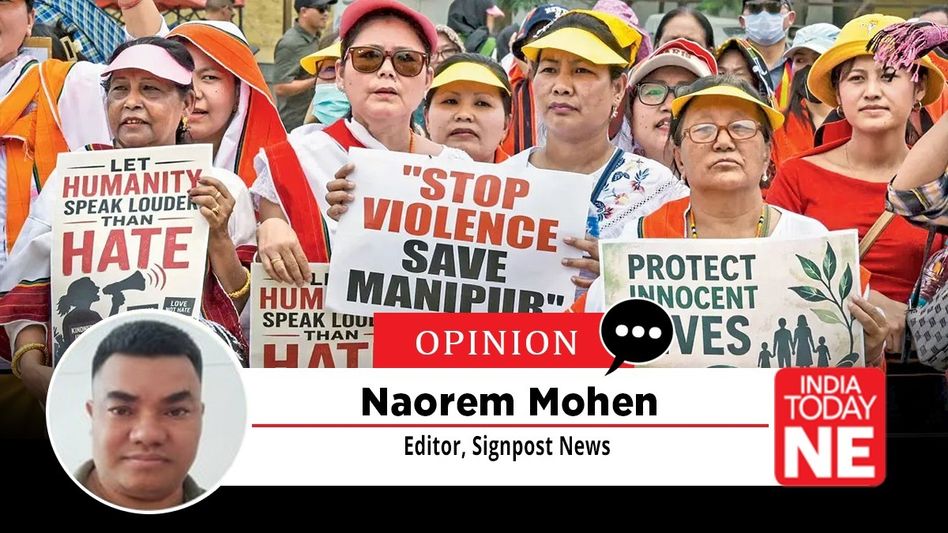
Since May 2023, hundreds of lives have been lost and tens of thousands displaced. Places once connected through roads, markets, schools and friendships have been separated by fear and armed boundaries. Houses may eventually be rebuilt with public money. Roads can be repaired. New settlements can be constructed. But who will rebuild trust?
That is where the five transformations become relevant—not as an unquestionable ideology, but as a framework worth testing against Manipur’s reality.
Social harmony must begin with human recognition
The first transformation, Samajik Samrasta, calls for social harmony. In Manipur, this is both the most urgent and the most difficult task.
Harmony cannot mean asking victims to forget what happened. It cannot be produced through staged photographs of leaders shaking hands while displaced families remain unable to return home. Reconciliation without justice will be temporary; justice without any attempt at reconciliation may leave society permanently divided.
The beginning can be more modest. It can begin when we refuse to describe an entire community through the crime of an individual. It can begin when the death of a civilian pains us even when the victim does not belong to our community. It can begin when teachers, journalists, religious leaders and cultural organisations stop converting every rumour into collective blame.
Manipur once possessed countless informal bridges—shared markets, government offices, schools, sports teams, transport routes and personal friendships. Many of those bridges have collapsed. They must be rebuilt carefully, without denying differences or legitimate political grievances.
Social harmony does not demand the erasure of identity. It asks whether our identities can exist without denying another person’s humanity.
The family must not become the first school of hatred
The third principle in the booklet—Kutumb Prabodhan, or family enlightenment—appeared especially meaningful on Teachers’ Day.
A child’s first teacher is not found in a school. The first lessons are heard at home. If children repeatedly hear that another community is inherently treacherous, inferior or dangerous, no peace committee formed ten years later will easily remove that lesson. The next conflict is prepared quietly around dining tables, in neighbourhood conversations and now, increasingly, through family WhatsApp groups.
Families in Manipur therefore carry a responsibility larger than their private lives. We must tell our children what happened, but we should not turn history into inherited revenge. We can preserve the memory of suffering without teaching the next generation to reproduce it.
This responsibility also falls upon teachers. Education that produces degrees but cannot teach a student to distinguish evidence from propaganda has failed society. A capable Manipur will require young people who question rumours, recognise manipulation and understand communities beyond the stereotypes circulating on social media.
Perhaps the most meaningful Teachers’ Day pledge today is not that students will merely respect their teachers. It is that adults will become more responsible teachers of the young.
Manipur’s ecology does not recognise ethnic boundaries
The second transformation is environmental protection—Paryavaran Sanrakshan. At first glance, it may appear distant from Manipur’s political crisis. It is not.
The hills and the valley are parts of the same ecological body. Rivers carry water across community boundaries. Forest degradation in one area affects agriculture, temperature and water security elsewhere. Floods do not ask for the ethnicity of a household before entering it. Neither forest fires nor plastic waste stop at a district boundary.
Loktak Lake, the surrounding wetlands, Koubru, Thangjing hills, those forest cover, springs and agricultural land are not possessions of one generation. They are a shared inheritance.
Environmental restoration could become one of the few areas where communities begin cooperating without first settling every political disagreement. Protecting a river, restoring a spring, preventing forest fires and reducing single-use plastic are not grand peace accords. Yet such shared work can reintroduce the habit of cooperation.
Manipur cannot be called capable if its people defend territory but destroy the soil, water and forests that make the territory habitable.
Self-reliance must create livelihoods, not isolation
The fourth transformation speaks of Swa—selfhood, self-reliance and pride in indigenous culture.
For Manipur, self-reliance should not be understood as rejecting the outside world. Nor should “local” become a slogan used to conceal poor quality or favouritism. It should mean building the capacity to produce, create and compete from within the state.
Our farmers, weavers, artisans, filmmakers, writers, sportspersons and young entrepreneurs already possess ability. What they lack is an ecosystem that connects production with technology, finance, branding and markets.
Buying a locally woven cloth, supporting local food producers or paying fairly for indigenous craftsmanship may appear to be a small act. Collectively, such choices keep money circulating within Manipur and give young people a reason to build their futures here.
Self-reliance must also include intellectual and cultural confidence. Manipur’s languages should find space in digital technology. Its folk narratives should enter cinema and new media. Its traditional knowledge should be studied, documented and allowed to engage with modern science.
Economic interdependence once connected communities through markets and trade. Rebuilding those relationships may, in time, do more for peace than speeches delivered from protected stages.
However, self-reliance must never be turned into community-based economic exclusion. A boycott directed at an ethnic group is not Swadeshi. It is another form of division.
Civic duty applies to citizens—and to the State
The fifth transformation, Nagarik Kartavyabodh, is a sense of civic duty: respect for the Constitution, law and public discipline.
This may be Manipur’s hardest test. We cannot demand the rule of law only when our community is the victim and defend lawlessness when the accused belongs to our side. No grievance gives a mob the right to burn a home. No political demand gives an armed organisation the authority to decide who may travel on a public road. No sense of patriotism can justify extortion, intimidation, collective punishment or taking the law into one’s own hands.
Civic duty means verifying information before forwarding it. It means protecting public property, respecting queues, keeping roads usable and recognising that disagreement is not treason.
But civic duty cannot be demanded from citizens alone. The State has constitutional duties too. It must protect life without discrimination, investigate crimes impartially, reopen public spaces, rehabilitate displaced people and make institutions worthy of public trust.
A government cannot lecture citizens about duty while failing to discharge its own.
Change must become conduct
Panch Parivartan will not resolve Manipur’s territorial disputes, disarm militant groups or replace the need for political dialogue and justice. It is not a substitute for accountable governance.
Its value lies elsewhere. It reminds us that a society is not transformed only through resolutions, packages and official announcements. It changes when principles enter daily conduct. Social harmony must become friendship across boundaries. Environmental concern must become conservation. Family values must prevent inherited hatred. Self-reliance must produce livelihoods. Civic duty must restrain both mob power and State arbitrariness.
The RSS may inspire different political responses in different people. Those debates will continue. But ideas should also be judged by what they ask us to do.
Manipur has spent more than three years asking what Delhi, the government, the security forces and rival communities must do. Those questions remain necessary. Yet another question can no longer be avoided: what must each of us change within ourselves? Teachers showed many of us that learning is meaningful only when it changes how we live.
A capable Manipur will not be built merely when one side becomes stronger. It will be built when society becomes strong enough to reject hatred, lawlessness and permanent separation. And that transformation must begin somewhere close, perhaps at home.
(Disclaimer: The views expressed in this article are those of the author and do not necessarily reflect the views of India Today NE or its affiliates)