Libraries as Knowledge Infrastructure: Capacity Building at Manipur University
The training programme at Manipur University is more than an academic event. It is a reminder that public libraries remain central to education, inclusion and democratic access to knowledge.

- Jul 31, 2026,
- Updated Jul 31, 2026, 2:10 PM IST

The training programme at Manipur University is more than an academic event. It is a reminder that public libraries remain central to education, inclusion and democratic access to knowledge.
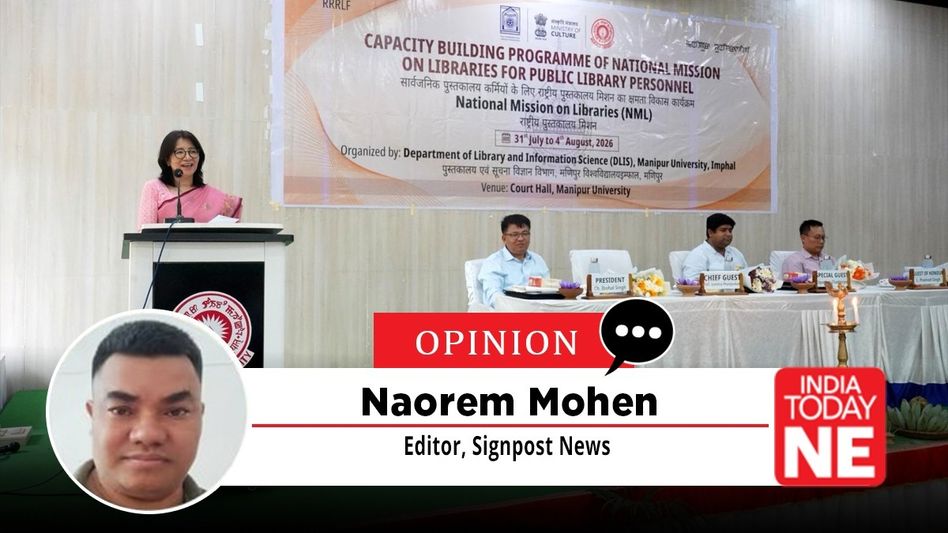
The inauguration of the Capacity Building Programme on the National Mission on Libraries for Public Library Personnel at Manipur University on July 31, 2026, deserves to be understood beyond the formalities of an academic function. Organised by the Department of Library and Information Science, Manipur University, and sponsored by the National Mission on Libraries, Raja Ram Mohan Roy Library Foundation, Ministry of Culture, Government of India, the five-day programme has brought renewed attention to one of the most important but neglected public institutions in Manipur: the library.
At one level, it is a training programme for library personnel. At another level, it is a serious reminder that libraries are not ordinary buildings with bookshelves. They are public knowledge institutions. They support education, citizenship, memory, culture, research and social inclusion. In a state such as Manipur, where educational aspiration is high but access to organised knowledge remains uneven, the public library must be treated as essential infrastructure.
The speeches delivered at the inaugural function reflected three connected concerns. First, libraries continue to matter as public institutions of knowledge. Second, library professionals must acquire new skills in the age of digital information. Third, Manipur’s public library system has a history of promise, but also a record of incomplete implementation.
Prof. Sumitra Phanjoubam, Vice-Chancellor in charge of Manipur University, placed the discussion within a larger educational and social frame. By describing libraries as sacred spaces and gateways to knowledge, she reminded the gathering that reading is not only an academic habit. It is a civilisational habit. A person who reads gains access to ideas, experiences, histories and possibilities beyond the limits of geography and circumstance.
This point carries special meaning for Manipur. In many parts of the state, access to quality books, reference materials, journals, digital databases and structured reading spaces remains limited. For students in remote areas, for young people preparing for competitive examinations, for researchers working on local history and culture, and for ordinary citizens seeking reliable information, a public library can become a quiet but powerful institution of opportunity.
Libraries are instruments of public equality. A good public library allows a student, a job seeker, a researcher, a farmer, a retired person and a child to enter the same space of knowledge without being judged by income, profession, social background or location. It gives citizens access to books, records, newspapers, digital resources and trained guidance. This is why the strengthening of libraries must not be viewed only as a cultural activity. It belongs equally to educational policy, social policy and democratic governance.
The challenge is that the meaning of a library has changed. A good building and a collection of books remain important, but they are no longer sufficient. Libraries today must manage physical collections, digital catalogues, online resources, community outreach, assistive services for persons with disabilities and user friendly access systems. The librarian is no longer only a custodian of books. The librarian is an information professional, a digital guide, a public educator and, in many places, the first point of access to formal knowledge.
This is where capacity building becomes essential. Training public library personnel in library automation, ICT tools, web based services, digital cataloguing, social media outreach and inclusive services is not a technical luxury. It is a basic requirement for making public libraries relevant to the present generation. A library that cannot help users navigate digital knowledge will gradually lose its public relevance. A librarian who is not supported with training and modern tools cannot be expected to meet the needs of students and citizens in an information society.
Dipanjan Chatterjee, Financial Advisor of the National Mission on Libraries, provided useful details in this regard. He stated that the programme at Manipur University is the 57th capacity building training programme under the mission, and that more than 2,500 public library professionals have already been trained across the country. These figures show that library development is now being approached as a national capacity issue, not merely as a matter of shelves, furniture and buildings.
He also explained the four components of the National Mission on Libraries. These include setting up modern public libraries, developing the National Virtual Library of India, now renamed as the Indian Culture Portal, conducting qualitative and quantitative surveys of public libraries, and training public library professionals. This framework is important because it recognises that library development cannot be reduced to a single activity. Infrastructure, technology, data, content and human capacity must move together.
The funding support extended to Manipur under the mission is significant. The State Central Library, Imphal, has received Rs 2.23 crore, while the District Library, Senapati, has received Rs 87 lakh. These funds cover infrastructure upgradation, technology upgradation, facilities for Divyangjan users, procurement of resources, advocacy and outreach programmes. These figures matter because they show that library development in Manipur is not merely an aspiration. Resources have been allocated. The real question is how effectively these resources are used.
Funding is important, but funding alone cannot build a strong library system. Money must lead to measurable improvement in public service. A renovated building must attract readers. New equipment must be used. Digital systems must function. Catalogues must be updated. Facilities for Divyangjan users must be practical, not symbolic. Outreach programmes must reach schools, colleges, localities and villages. The success of library funding depends on implementation, monitoring and public use.
Manipur’s own history of public libraries gives the present programme a deeper meaning. L. Pramod Singh, Chief Librarian of the State Central Library, Imphal, recalled that the library movement in Manipur began in the early 1900s with the Imphal Public Library, associated with Nongmeikapam Gopal Singh and supported by a donation from Krishna Lal Saroj of Paona Bazar. The later emergence of the Imphal Reading Club, the Manipur Public Library at BT Road and the evolution of district library institutions show that the idea of public reading has deep roots in the state.
This history deserves more attention. Public libraries in Manipur were not simply administrative creations. Many began through community commitment, voluntary initiative and civic imagination. The existence of 101 NGO run public libraries, along with government public libraries, points to a strong social desire for reading spaces. In many localities, these libraries have served students and ordinary readers despite limited funding, weak infrastructure and inadequate professional support.
The library movement in Manipur must therefore be seen as both institutional and community based. Government libraries provide the formal structure. Community libraries provide social energy. Both are needed. A state that values education cannot allow its public libraries to survive only through goodwill, occasional grants or individual dedication. It must create a reliable system of planning, staffing, funding, training and accountability.
Prof. Ch. Ibohal Singh, Head of the Department of Library and Information Science, Manipur University, drew attention to a serious institutional weakness. He recalled that Manipur became the sixth state in India to have public library legislation. This is a matter of distinction. But he also pointed out that the legislation has not been implemented in its true spirit for more than three decades. This gap between law and practice lies at the heart of the public library question in Manipur.
Legislation without implementation creates symbolic progress but limited public benefit. A library Act should ideally provide a framework for planning, funding, staffing, coordination, professional standards and expansion of services. When such a framework remains inactive, libraries depend on irregular support, isolated grants and individual enthusiasm. This weakens continuity. It also affects the morale of library professionals who are expected to serve the public without adequate systems.
The constitutional position of libraries as a state subject further increases the responsibility of the state government. Central institutions such as the Raja Ram Mohan Roy Library Foundation and the National Mission on Libraries can provide support, training and financial assistance. But long term public library development depends on state level planning, local implementation and institutional accountability. The state must not treat libraries as peripheral cultural assets. They are public knowledge infrastructure.
The inclusion of topics such as KOHA, ICT tools, Google Sites, social media outreach and services for Divyangjan users in the five-day training programme is encouraging. These are practical areas. A public library that uses automation can manage its collection better. A library with a simple website can make information available before users physically visit. A library that uses social media responsibly can inform citizens about new books, reading programmes and public services. A library that provides facilities for Divyangjan users affirms the principle that access to knowledge must be inclusive.
The larger implication is clear. In a society where information is abundant but reliable knowledge is unevenly distributed, public libraries can help citizens distinguish between noise and knowledge. They can support students preparing for examinations, children developing reading habits, researchers seeking local records and communities trying to preserve cultural memory. For Manipur, this is especially relevant. Public libraries can become spaces where education, language, local history, culture and civic awareness meet.
There is also a connection between libraries and peace. A society that reads widely learns to think beyond immediate prejudice. Reading does not automatically solve conflict, but it creates conditions for reflection, empathy and informed citizenship. In Manipur and the Northeast, where communities carry memories of conflict, displacement, identity anxieties and administrative neglect, libraries can serve as neutral civic spaces. They can allow young people to encounter histories, cultures and perspectives other than their own.
This is why the role of libraries must also be linked to the larger national goal of Viksit Bharat @2047. Development cannot be measured only by roads, airports, bridges, industries and digital connectivity. It must also be measured by the quality of human capability. A developed society requires informed citizens, skilled youth, confident readers and institutions that make knowledge accessible to all. Public libraries can contribute quietly but substantially to this national goal, especially in states where educational access remains uneven.
For Manipur, library development must also include preservation of local knowledge. The state has a rich tradition of manuscripts, oral histories, community memories, cultural practices, local languages and regional scholarship. Libraries can become centres for documentation and preservation. They can help ensure that local knowledge is not lost in the rush toward digital modernity. A modern library system must therefore combine technology with cultural responsibility.
The way forward requires seriousness at several levels. The training of personnel must be followed by institutional support. Libraries that receive trained staff must also have functioning systems, updated collections, digital tools, inclusive access and regular outreach. The Manipur Public Library Act must be revisited not as an old legislative achievement but as an unfinished governance responsibility. NGO run libraries should be mapped, supported and connected to a wider public knowledge network without weakening their community character.
Manipur University also has an important role. As a centre of higher education, it can support public library development through research, training, documentation and professional guidance. The Department of Library and Information Science can build a bridge between academic knowledge and community library practice. This inaugural programme is a useful beginning, but its real value will be measured by what changes in libraries after the training is over.
The speeches at the inaugural function conveyed a shared message: libraries remain vital, but they must adapt. A library that does not change with the needs of society risks becoming a storehouse. A library that trains its personnel, modernises its services and reaches out to citizens becomes a living public institution.
For Manipur, the strengthening of public libraries is not only about bookshelves, buildings or catalogues. It is about widening access to knowledge in a society where education remains one of the most important routes to dignity and opportunity. The capacity building training programme at Manipur University has opened a timely conversation. The responsibility now is to ensure that the conversation leads to institutional action.