
NHRC finally says it out loud: A National Highway cannot be an ethnic border
For thirty months, a national highway in India functioned like an international border—until a single citizen’s complaint forced the system to wake up. Now, with a deadline ticking toward January 4, the question is whether Manipur will finally reclaim its own road.

- Dec 11, 2025,
- Updated Dec 11, 2025, 5:25 PM IST

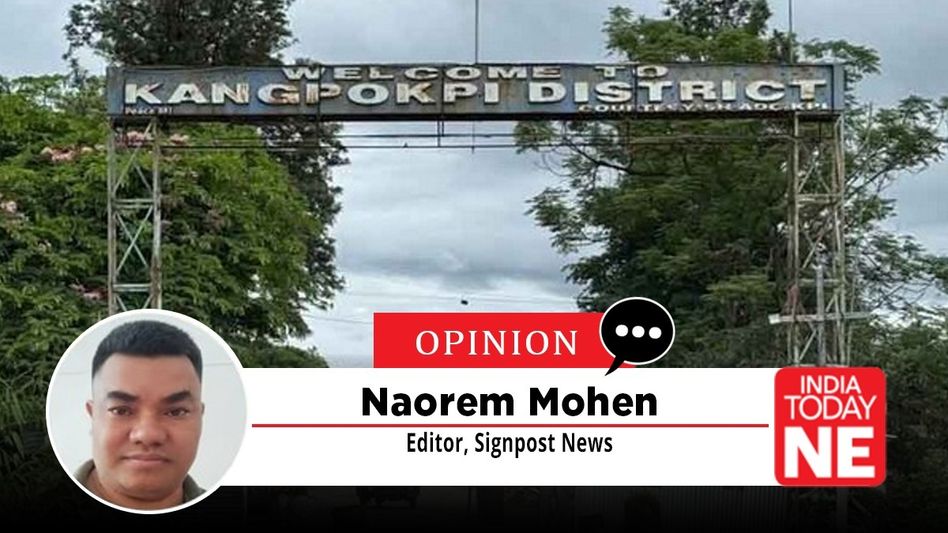
The National Human Rights Commission (NHRC) has today issued a scathing reminder that national highways cannot be held hostage by ethnic fault lines. In a strongly-worded order (Case No. 29/14/16/2025), the Commission has directed a fresh, time-bound inquiry into the continuing blockade of National Highway-2 in Kangpokpi district and demanded a comprehensive action-taken report by January 4, 2026.
The NHRC did something the Presidential Rule governance of Manipur have stubbornly refused to do for thirty months. NHRC treated the ethnic blockade of National Highway-2 as a continuing human rights emergency rather than an inconvenient ethnic dispute to be “managed.”
The Commission has the knowledge that lakhs of people in the Imphal Valley, specially Meitei have been under siege since May 2023, and it becomes a historic rebuke. A lone citizen, Asem Roshan Singh from Mayang Imphal, filed a simple email complaint on June 25, 2025.
Six months later, that email has achieved what endless all-party meetings, parliamentary speeches, and high-profile “peace committees” could not: it has forced the Commission to cut through jurisdictional hide-and-seek and directly order the District Magistrate and Superintendent of Police of Kangpokpi – the very district where the highway is held hostage – to investigate and report within weeks.
The facts laid bare in the order are damning. An escorted medical team led by former RIMS superintendent Dr Yengkhom Mohen Singh was attacked on 8 March 2024.
Kangpokpi District administrations should now answer why a national highway inside India remains a no-go zone for Indian citizens on the basis of their ethnicity, and they must answer by January 4, 2026.
This is what real accountability looks like. No press conferences, no photo-ops with central forces, no promises of “confidence-building measures” that evaporate the moment cameras leave. Just one citizen, one email, one constitutional body refusing to look away.
While Manipur’s elected representatives – cutting across party lines – have spent the last two-and-a-half years perfecting the art of eloquent helplessness, Asem Roshan Singh has shown that a single determined citizen can still make the Republic stir from its slumber. His complaint is not just about one highway; it is about whether the Indian Constitution still runs beyond Sekmai and Phougakchao Ikhai, or whether large parts of the Northeast India have quietly seceded into ethnic fiefdoms where armed non-state actors decide who may travel on Indian soil.
Today, the NHRC has answered: the Constitution still runs everywhere. Asem Roshan Singh’s complaint is a constitutional cry for help: he charges that the ethnic gating of NH-2 violates Articles 14, 15, 19(1)(d) and 21 by imposing collective punishment on an entire community, turning the fundamental right to move freely throughout India into a deadly privilege granted or withheld on the basis of ethnicity.
In a measure of how far things have fallen, he has been forced to beg for what should be unthinkable – a government-subsidised airlift scheme so that cancer patients, students and daily-wage earners can escape the valley they are being illegally confined to, at a time when a one-way ticket to Guwahati costs more than many families earn in a month.
The NHRC’s decisive intervention is long overdue, yet it sharpens the indictment against both the State and the Union: how many more escorted convoys must be ambushed, how many more infants must die for want of oxygen, before Delhi and Imphal treat the reopening of a national highway as an absolute, non-negotiable duty rather than a concession to be bartered in backroom ethnic negotiations?
The bitter farce of the “September breakthrough” only deepens the betrayal. On 4 September 2025, the Ministry of Home Affairs issued a triumphant press note declaring that the Kuki-Zo Council (KZC) had, after talks in New Delhi, agreed to throw open NH-2 to all traffic and essential supplies – perfect timing for Prime Minister Narendra Modi’s scheduled visit to Manipur nine days later.
The Centre-stage photographs and headlines hailed a major step towards normalcy.Eleven days later, on 15 September, the KZC publicly tore up the script. Branding the Centre’s announcement a “misinterpretation” that had caused “unnecessary confusion,” the council declared there had never been any agreement to reopen the highway.
Their position was categorical: until a final political settlement is reached between the Meitei and Kuki-Zo communities, “no one from either side must cross into the respective areas under any circumstances.” Any attempt to do so, they warned, would invite “serious consequences” and further jeopardise peace.
What the Centre had marketed as a historic opening was, in reality, nothing more than a request for Kangpokpi residents to “cooperate” with security forces escorting vehicles – a cooperation that has never materialised for Meitei travellers.
The KZC’s allies, the Kuki National Organisation (KNO) and United People’s Front (UPF), quickly echoed the same line: the road was never “blocked” by them; they were merely protecting their areas from intrusion.In other words, the national highway remains an ethnic border in all but name, policed not by the Indian State but by armed community councils who decide which Indian citizens may pass and may not use Indian soil.
The much-celebrated September “breakthrough” was exposed as a public-relations mirage, leaving valley residents exactly where they were – besieged, impoverished, and abandoned by the very authorities sworn to protect their constitutional rights.
Earlier, the High Court of Manipur has also swung into action. In a Public Interest Litigation (PIL) filed by women’s rights activist Thokchom Sujata, president of Imagi Meira, the court has issued notices to the Union of India, State of Manipur, the Chief Secretary, DGP, and top officials of the Army, Assam Rifles and CRPF.
In PIL/36/2025, Thokchom Sujata has delivered a devastating indictment: the “buffer zones” created in May 2023 as temporary security measures have hardened into permanent, ethnically enforced borders that have unlawfully imprisoned the entire Meitei population inside the Imphal Valley for over thirty months. Invoking Articles 14, 19, 21 and 301, she calls these zones exactly what they are—an unconstitutional partition of Manipur along community lines.
Meitei community, including even sitting Members of Parliament, journalists, students and critically ill patients, are routinely stopped and turned back by security personal. She points out that Meiteis are physically barred from crossing key checkpoints:
- Phougakchao Ikhai on NH-2 (Imphal–Dimapur)
- Keithelmanbi on NH-37 (Imphal–Jiribam)
- Pallel on the Imphal–Moreh AH-1 highway.
“Lakhs of Indian citizens have been illegally confined within the Imphal Valley,” the petition states, “stripped of their fundamental right to move freely throughout the territory of India.”
Taken together, the NHRC’s uncompromising order on the Kangpokpi blockade and the Manipur High Court’s notices on the buffer-zone PIL have ripped away the last pretence: Manipur is no longer functioning as a single state under one Constitution. Two ordinary citizens—Asem Roshan Singh before the NHRC and Thokchom Sujata before the High Court—have forced India’s institutions to confront a reality that governments and political parties have spent thirty months desperately papering over.
The message from both forums is now unmistakable: ethnic no-go zones have no place in the Republic, and the siege of the Imphal Valley must end. The twin interventions — one by the NHRC on the humanitarian fallout, the other by the High Court on the constitutional illegality of ethnic “no-go” zones — have together exposed the fiction that Manipur is still one state under one Constitution.
In the suffocating silence that has gripped Manipur for over thirty months, two ordinary citizens of the State have done what an entire political class has failed to do: they have refused to look away. Thokchom Sujata and Asem Roshan Singh have become the unappointed but authentic voice of three million people trapped inside what has become an open-air prison.
Both are asking the same question: How long will the Indian State allow a national highway and an entire community to be held hostage by armed non-state actors?
While elected representatives – MPs, MLAs, and Ministers – have restricted themselves to carefully worded press statements, condolence visits, and the occasional fiery speech in Delhi drawing rooms, Sujata and Roshan have dragged the State and the National Human Rights Commission, demanding nothing less than the restoration of the Indian Constitution itself on the soil of Manipur.
History will remember that when the highways were ethnically partitioned and the valley was turned into a giant ghetto, it was not a Governor, not a Union Home Minister, and certainly not any of the loudest “saviours of Manipur” in Parliament who stood up first – it was Sujata who walked into the High Court and called the buffer zones an “unlawful partition of the State,” and it was Roshan who forced the NHRC to override bureaucratic excuses and order a fresh probe into Kangpokpi’s continuing siege.
They have done this at personal risk, without security, without government advertisements praising their patriotism, and without the luxury of shifting responsibility to the “other community.” In their courage, the three million silent, exhausted, and often hopeless people of Manipur have finally found a voice that refuses to be silenced.
This is not the result of war or natural disaster. It is the deliberate outcome of armed blockades and de facto ethnic borders that neither the PR governance nor the Union Home Ministry has shown the will to dismantle.
The NHRC and the Manipur High Court have now put the Union and State governments on notice. Evasive reports, jurisdictional buck-passing, and cosmetic “confidence-building measures” will no longer suffice.
Law-abiding citizens of the State are not asking for charity. They are demanding the restoration of their constitutional birthright: the right to travel freely, safely and without fear on every inch of their own country.
MORE NEWS












Copyright©2026 Living Media India Limited. For reprint rights: Syndications Today
