No Community Too Small: Rethinking Identity and Manipur's Shared Future
The conflict has not only separated communities geographically but has also deepened disagreements over history, ancestry, territory and belonging. Historical narratives that once belonged largely to academic discussions have increasingly become part of public and political confrontation.

- Oct 13, 2026,
- Updated Oct 13, 2026, 12:08 PM IST

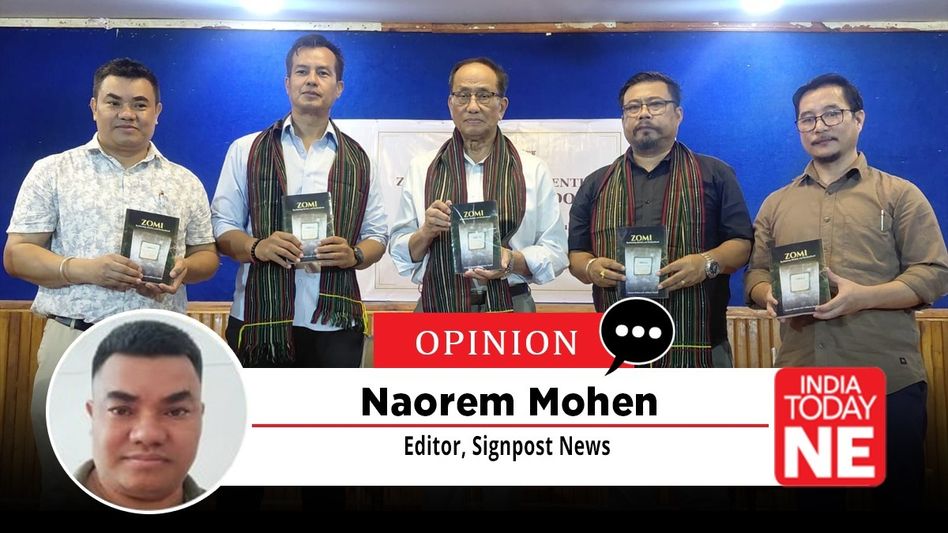
When my co-author Anthony Naulak and I released Zomi: Reclaiming Identity and Brotherhood at the Manipur Press Club on October 12, I had hoped the book would encourage a serious discussion about the historical roots of the Paite-Zomi community and its relationship with Manipur. What emerged from the launch, however, was a question extending far beyond the publication itself: how can Manipur protect its smallest communities while creating conditions for a shared future?
The question carries particular significance at a time when the state continues to struggle with the consequences of Manipur conflict that began on May 3, 2023. The conflict has not only separated communities geographically but has also deepened disagreements over history, ancestry, territory and belonging. Historical narratives that once belonged largely to academic discussions have increasingly become part of public and political confrontation. In such circumstances, even an attempt to document the past can be interpreted through the anxieties of the present.
Perhaps the most significant message at the launch came from former UNLF chairman R.K. Sanayaima Singh, widely known as Meghen, who drew attention to the responsibility of protecting and promoting Manipur's small and endangered ethnic communities. Referring to communities such as the Tarao, he emphasised the importance of preserving their distinct cultural traditions and historical heritage, regardless of their numerical strength. He also recognised that communities sharing historical or cultural connections should be free to come together voluntarily and develop a broader collective affiliation, provided that the process respects their individual characteristics and choices.
His observations deserve attention because the survival of a community cannot be measured by population alone. A small ethnic group may possess a language, customary institutions, ancestral memories and cultural practices representing centuries of human experience. Their disappearance would diminish not only the community concerned but also Manipur's wider cultural inheritance.
Such losses do not always result from visible conflict. A language may gradually lose its speakers, traditional knowledge may cease to be transmitted, and the memories of elders may disappear without documentation. Protecting vulnerable communities therefore requires sustained investment in language preservation, cultural education, historical research and the transmission of knowledge between generations.
Meghen's remarks also raise a question relevant to the wider Northeast, where related communities have maintained separate ancestral traditions while developing broader cultural affiliations. The challenge is to ensure that such associations emerge through consent rather than pressure, and that smaller groups retain the freedom to preserve their distinctive heritage. This is not simply a question of ethnic classification. It concerns cultural survival, community choice and the responsibilities of a society towards its most vulnerable members.
The discussion surrounding Zomi: Reclaiming Identity and Brotherhood becomes meaningful within this larger context. The book examines the historical roots of the Paite-Zomi community and its connections with Manipur, particularly amid contemporary narratives questioning those relationships. It seeks to encourage further investigation rather than claim to settle every historical disagreement.
Meghen's wider reflections on Manipur's past also invited a reconsideration of the relationships between the hills and valley. Their histories have involved political arrangements, trade, cultural exchanges, customary relationships, conflict and cooperation over generations. These connections do not mean that every community experienced history in the same way, nor should they be used to overlook historical inequalities or contemporary political differences. They do, however, challenge interpretations that treat the peoples of Manipur as though they developed in entirely separate historical worlds.
My decision to co-author this book with Anthony grew from a concern that has troubled me for some time: the increasing tendency to interpret Manipur's history selectively, sometimes in ways that question the historical existence or belonging of entire communities. I have never believed that recovering the history of one community requires diminishing the historical position of another.
The role of the Meitei kings in governing a kingdom inhabited by diverse communities, and in protecting, accommodating and encouraging their customs and traditions at different periods, deserves serious scholarly examination. These relationships should be studied through royal chronicles, archival documents, oral traditions and other available evidence rather than interpreted solely through the political disagreements of the present.
For me, the purpose of the book is not to establish the superiority of one historical narrative over another. It is to encourage a more careful examination of relationships that have often been neglected, misunderstood or presented without sufficient evidence. Manipur's history is complex enough to accommodate different experiences, provided that historical claims remain open to scrutiny and correction.
Historian Dr. Takhellambam Bhabhananda reinforced this distinction in his review of the book. He observed that the term Zomi carries linguistic, cultural, ethnic and political significance, but the existence of a collective identity does not by itself establish exclusive territorial ownership or political sovereignty. Such questions require separate examination through historical evidence and relevant legal and constitutional frameworks.
His observation that “History must be evidence-based, not identity-driven” deserves particular attention in Manipur, where interpretations of the past are increasingly invoked to support contemporary political positions. The same standards of verification must apply to every community, irrespective of its population or influence.
Dr. Bhabhananda also described Manipur as a composite civilisation shaped by generations of interaction among different peoples. This perspective does not require a romanticised account of the past. The state's history contains cooperation and conflict, accommodation and disagreement, and these experiences must be examined together. A credible historical narrative should be capable of acknowledging complexity without becoming an instrument of ethnic exclusion.
Dr. Kiran Yendrembam, who presided over the book launch, brought another important perspective to the discussion by emphasising that the recovery of a community's history should be guided by intellectual honesty rather than contemporary political considerations. He drew attention to the responsibility of historians and writers to examine available records, oral traditions and historical relationships carefully, instead of allowing selective interpretations to shape public understanding of the past.
His observations were particularly relevant to Manipur, where historical disagreements have increasingly become entangled with ethnic tensions. He also underlined the importance of encouraging further research, constructive criticism and scholarly dialogue, recognising that no single publication can provide definitive answers to every question concerning identity, migration or historical belonging. What I found especially meaningful in his remarks was the reminder that understanding another community's past does not require us to surrender our own, and that serious historical engagement can create opportunities for mutual respect even when differences in interpretation remain.
Anthony approached the subject from another important direction by highlighting the limitations of written records and the value of oral traditions, clan genealogies, village names, customary institutions, traditional songs and collective memories. His argument that the absence of extensive documentary evidence should not automatically be mistaken for the absence of history is especially relevant to the Northeast, where much of the experience of smaller communities survives outside conventional archives.
He urged historians, universities and younger researchers to examine royal chronicles, colonial records, historical maps and village genealogies alongside oral histories, while documenting the knowledge of elders before it disappears. Such work could help fill important gaps in Manipur's historical record, provided that oral accounts are critically evaluated and compared with other sources.
Anthony also connected the publication's larger message with a practical humanitarian commitment. He announced that a portion of the proceeds from book sales would be used to assist internally displaced persons (IDPs) in Imphal, Churachandpur and Kangpokpi.
The proposed contribution may be modest compared with the scale of the displacement crisis, but it points towards an important responsibility. Families affected by the violence have endured different experiences of loss, insecurity and separation, and their rehabilitation remains one of the state's most urgent challenges. Any serious effort to rebuild trust must eventually address these human realities rather than remain confined to historical debate.
A book cannot restore destroyed homes, reopen roads or resolve competing political demands. Nor can historical research substitute for public security, accountability, rehabilitation and political dialogue. These require sustained action by public institutions and engagement among communities whose experiences and aspirations may differ considerably.
What historical scholarship can contribute is a more informed public conversation. It can challenge misleading narratives, recover neglected relationships and help distinguish documented evidence from political assertion. In a society where competing versions of the past increasingly influence perceptions of the present, this contribution should not be underestimated.
The more lasting significance of Zomi: Reclaiming Identity and Brotherhood will therefore depend on what follows its publication. Will historians examine its arguments critically and contribute additional evidence? Will universities create opportunities for scholars from different communities to investigate Manipur's interconnected histories? Can smaller ethnic groups receive the institutional support necessary to document their languages, customary practices and ancestral memories before these are lost?
A practical roadmap could begin with collaborative research involving historians, anthropologists, linguists and scholars of customary institutions. Historical records could be digitised and translated, oral histories systematically documented, and research materials made accessible to readers across linguistic and community boundaries. Universities and cultural organisations could create forums where disagreements are examined through evidence rather than treated as expressions of ethnic hostility.
Education has an equally important role. Younger generations should have opportunities to learn about communities other than their own, including the historical relationships that shaped trade, settlement, governance and cultural exchange across Manipur. Such learning would not require students to accept a single authorised interpretation of the past. Its purpose would be to encourage curiosity, critical thinking and respect for experiences beyond their immediate communities.
The protection of endangered communities also requires practical measures beyond historical documentation. Language programmes, community-led cultural archives and support for traditional knowledge could help preserve aspects of Manipur's heritage that are particularly vulnerable to disappearance. These initiatives should be shaped by the communities concerned, rather than imposed through administrative convenience or the preferences of more influential groups.
Writers and researchers have responsibilities of their own. Recovering neglected histories should not become an excuse for creating new distortions, just as defending established narratives should not prevent the examination of evidence that challenges them. A publication should be judged by the strength of its sources and arguments, not simply by whether its conclusions satisfy a particular community's expectations.
I would consider my book to have made a meaningful contribution if it encourages this kind of engagement, including criticism and further research. Historical understanding grows through questioning, comparison and the willingness to revise conclusions when new evidence emerges. The purpose of scholarship should not be to close debate but to make it more informed.
Manipur cannot return to May 2, 2023, simply by remembering how its communities once lived together. Too much has happened, too many lives have been lost, and too many families continue to carry the consequences of violence. Yet the state cannot afford to remain permanently imprisoned by competing interpretations of its past.
The challenge is to create conditions in which historical disagreements can be examined honestly, vulnerable communities can preserve their cultural inheritance, and people can begin rebuilding relationships without being required to abandon their distinct experiences or aspirations.
A book cannot accomplish this transformation on its own. But if Zomi: Reclaiming Identity and Brotherhood encourages serious historical inquiry, meaningful dialogue and greater attention to the survival of smaller communities, it will have served a purpose extending beyond documenting the history of one people.
No community is too small to deserve recognition, no cultural heritage should disappear through neglect, and no disagreement over the past should permanently close the possibility of a shared future.