No One Believed Then: Biren Singh's Repeated Warnings About Foreign Involvement in Manipur
When ethnic violence erupted in Manipur in May 2023, the narrative largely centered on deep-rooted internal grievances. Amid this chaos, former Chief Minister N. Biren Singh stood out with a persistent and controversial refrain.

- Mar 17, 2026,
- Updated Mar 17, 2026, 7:18 PM IST

When ethnic violence erupted in Manipur in May 2023, the narrative largely centered on deep-rooted internal grievances. Amid this chaos, former Chief Minister N. Biren Singh stood out with a persistent and controversial refrain.
The crisis was not purely domestic but was being fueled, instigated, or perpetuated by foreign hands and external elements.
From the early months of the conflict, N Biren Singh repeatedly asserted that "foreign hands" were behind the unrest. In October 2023, he declared that people in Manipur had lived in relative peace before external forces intervened, perpetuating the violence through covert support.
He pointed to the porous Indo-Myanmar border as a pathway for illegal immigration, arms smuggling, and militant activities that inflamed local divisions. These claims were often met with outright skepticism or dismissal.
Many in the Indian bureaucracy, fellow politicians including MLAs, ministers, and MPs from various parties, sections of the media, and even parts of civil society viewed them as deflection tactics, ways to shift blame from governance failures, alleged community favoritism, or provocative policies under his administration.
Reports from human rights organizations highlighted concerns over state repression, ethnic polarization, and the need for accountability rather than external conspiracy theories. N Biren Singh's emphasis on "illegal immigrants" and "narco-terrorists" was seen by some as inflammatory rhetoric that deepened divides rather than resolved them.
Yet Biren Singh did not waver. He consistently reiterated his position across interviews, press statements, and public addresses. "As the chief minister, I have been consistently claiming from the beginning that the current crisis in Manipur is due to outsiders, foreign hands," he stated in September 2024, echoing similar remarks made earlier.
In another instance, he emphasized that "outsiders and foreign hand" were involved since the strife began, noting that while some believed him, others did not. The narrative gained further traction with subsequent developments. Reports emerged linking the Manipur violence to cross-border militant networks, including drone attacks and weapon supplies potentially tied to Myanmar-based groups.
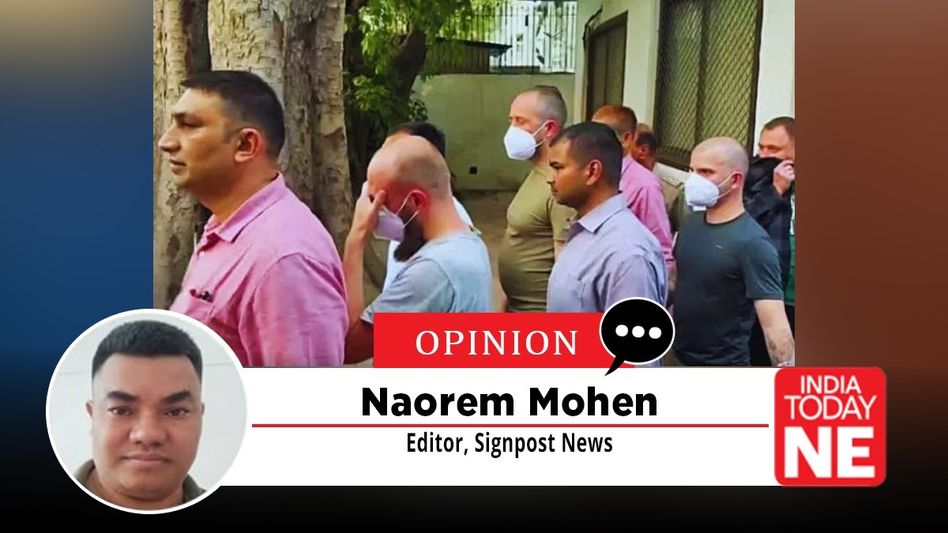
Now, the National Investigation Agency (NIA) made high-profile arrests of seven foreign nationals, including six Ukrainians and one American citizen, accused of conspiring to commit terrorist acts against India under the Unlawful Activities (Prevention) Act (UAPA).
These individuals allegedly entered India on valid visas, illegally proceeded to restricted border areas in Mizoram without the required Protected Area Permits, crossed into Myanmar, and met with ethnic armed groups hostile to India.
Investigations revealed they were involved in providing terrorist training, particularly in weapons handling, drone operations, and advanced tactics, to militants in Myanmar, with possible linkages to insurgent outfits in India's northeast.
They reportedly arranged for a large consignment of drones to be delivered from Europe to Mizoram, intended for use in destabilizing activities across the border, potentially exacerbating conflicts in regions like Manipur.
The suspects were arrested at airports in Lucknow, Delhi, and Kolkata as they attempted to depart India. A special NIA court in Delhi remanded them to 11 days of custody for further interrogation, highlighting concerns over cross-border threats, illegal entries into protected zones, and the routing of advanced technology like drones to support militant operations that could impact India's security in the northeast.
A turning point had already come earlier in September 2024 with the arrest by the Assam Rifles of a Myanmarese national named Thanglinkap, identified as a cadre of the Kuki National Army (Burma) or KNA(B). Captured in Chandel district, he was allegedly involved in reconnaissance along border routes from Moreh to Churachandpur, aiming to supply arms to militants in Manipur.
N Biren Singh hailed the operation as validation. "This clearly indicates the involvement of foreign elements," he said, appreciating the Assam Rifles for providing evidence that supported his long-held suspicions.
He also shared that his warnings about foreign-fueled arms flows and militant support had been doubted but were now being substantiated. Biren Singh, lauded the NIA's March 2026 actions and revisited his earlier statements.
He shared a September 2024 video clip where he had cited foreign involvement following the KNA(B) arrest, framing these events as proof that his repeated claims were not baseless.
The recent arrests highlighted transnational dimensions where porous borders enabling arms and technology transfers, ethnic ties across frontiers, and potential external actors exploiting local conflicts.In hindsight, Biren's persistence appears prescient to supporters.
Security analysts have long noted the northeast's vulnerability to external interference, especially amid Myanmar's post-2021 coup instability, where insurgent groups operate with cross-border linkages.
The evidence from arrests suggests that while internal ethnic tensions were the spark, external elements may have amplified or sustained the fire through logistics, training, or ideological support.
However, the "foreign hand" theory does not erase domestic factors. The conflict's roots lie in longstanding issues within Manipur, and critics maintain that overemphasizing outsiders risks overlooking accountability for local leadership and policies that may have exacerbated divisions.
N Biren Singh's administration faced accusations of polarizing communities, and his resignation in February 2025 amid ongoing unrest exposed the challenges in resolving the crisis.
Still, the sequence, from Biren Singh's early 2023 assertions, through the 2024 Assam Rifles operation, to the 2026 NIA crackdown, illustrates a pattern where initial disbelief gave way to partial corroboration.
No one believed then, when the warnings seemed convenient or conspiratorial. Today, with concrete arrests exposing foreign nationals, drone smuggling, and cross-border militant ties, those repeated claims demand a reevaluation.
The Manipur crisis remains complex, requiring both internal reconciliation and robust border security. His unyielding focus on external involvement, once dismissed, now serves as a reminder that in volatile border regions, ignoring transnational threats can prolong suffering.
Acknowledging foreign dimensions does not absolve local responsibilities but completes a fuller picture of what fueled, and sustain, the turmoil in Manipur for the last three years.
The views expressed in this article are those of the author and do not necessarily reflect the views of India Today NE or its affiliates.