
One Pleads to Return, Another to Stay: Contrasting Voices of Manipur’s IDPs to CM Khemchand
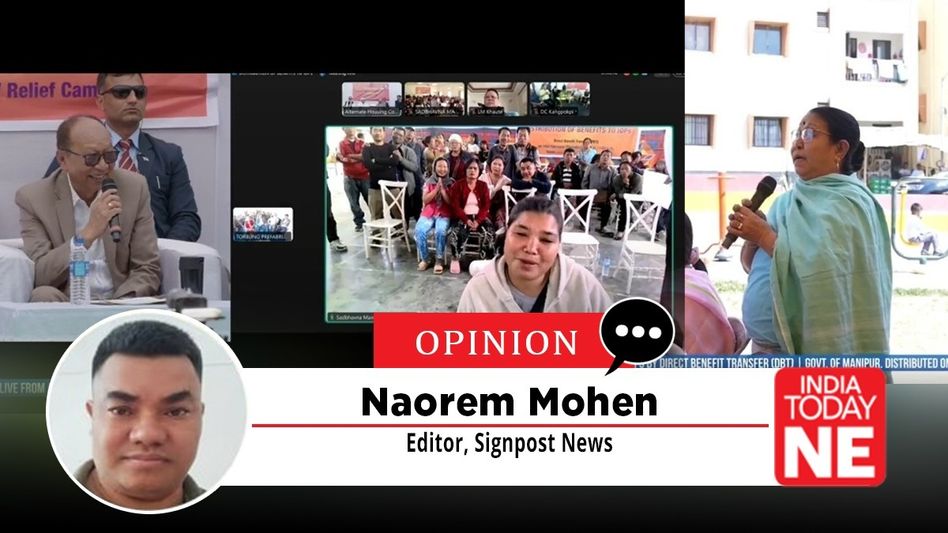
On the afternoon of February 19, 2026, something quietly historic unfolded inside the Alternate Housing Complex at the National Games Village Relief Camp in Langol, Imphal West.

- Feb 20, 2026,
- Updated Feb 20, 2026, 2:55 PM IST

On the afternoon of February 19, 2026, something quietly historic unfolded inside the Alternate Housing Complex at the National Games Village Relief Camp in Langol, Imphal West.
For the first time since ethnic violence tore through Manipur on May 3, 2023, internally displaced persons (IDPs) from both the Meitei and Kuki communities were brought, albeit in a hybrid format, onto the same platform to speak directly to the newly selected Chief Minister by Centre.
Chief Minister Yumnam Khemchand Singh sat among Meitei families in the valley camp, listening in person, while large screens linked him virtually to Kuki IDPs in relief camps scattered across Churachandpur and Kangpokpi districts.
What was billed as a routine distribution of financial aid quickly became something far more human. An emotional reckoning, almost three years into one of India’s longest-running internal displacements.
Two voices, captured in that single afternoon, have since lingered in public memory and private conversations across the state.
A middle-aged Meitei woman, displaced from Moreh, the bustling trade town on the India-Myanmar border stood before the Chief Minister with tears streaming down her face. Her voice cracked as she described life inside the camp: “We are like birds in a cage here. They give us just enough to survive every day. " She was saying they are not living, they are only existing. She pleaded again and again to be allowed to return home.
In a moment of raw desperation, she bent forward, offering to touch the Chief Minister’s feet, a traditional gesture of utmost humility and supplication in Manipuri culture, begging for safe passage back to Moreh. She said through sobs, “Let us allow to return home once.”
For nearly three years she had carried the memory of her house, her small shop or farm, her neighbours, the familiar rhythm of border-town life. None of it could be replaced by camp rations or monthly stipends. There was no “alternative home” waiting for her in the Imphal valley. Moreh was not just a place; it was her entire world.
Across the video link from Churachandpur, another voice emerged, lighter in tone, more pragmatic. A Kuki woman, speaking from one of the relief camps, addressed the Chief Minister with a gentle smile. She thanked him for the aid already received and then, almost conversationally, requested that the Direct Benefit Transfer (DBT) payments continue “for more days” so families could sustain themselves longer.
She did not speak of missing her homes in Imphal or express her desire of returning to Imphal. The request was framed around survival in the present, extending financial support so that daily needs could be met without constant anxiety. Medical access, school for children, and basic household expenses remained the immediate priorities.
Also Read CM Yumnam Khemchand Must Act: Reining in Paolienlal Haokip Is Essential for Lasting Peace
The tone was not one of despair, but of quiet realism: life in the hills, even in a camp, had become the new baseline.These two moments, one drenched in tears and supplication, the other calm and forward-looking, distilled the deepest asymmetry at the heart of rehabilitation challenge.
One side cries out to be released from the cage; the other asks for the cage to be made more bearable for a while longer.
The occasion itself was anchored around a substantial financial package. The government released approximately ₹32 crore through DBT to nearly 19,000 registered IDPs. Each eligible person received a one-time special assistance of ₹2,420 credited directly to their bank accounts, money meant to replace worn-out mattresses, blankets, cooking utensils, infant formula, and other essentials that had deteriorated after years of institutional living.
This latest disbursement was not an isolated gesture. It continued a long chain of financial support that began under the previous administration of Chief Minister N. Biren Singh. Between June 2023 and October 2024, the earlier government disbursed ₹1,000 per IDP on five separate occasions
The continuity is undeniable. What changed on February 19, 2026, was the staging. The new government chose to combine aid delivery with direct, emotional, face-to-face (and screen-to-screen) engagement. IDPs spoke to MLAs, to the Chief Minister himself, and were photographed with senior leaders – elements that generated far greater public visibility and media attention than the more administrative, low-key distributions of previous years.
Yet behind the optics lay the deeper human story. The Moreh woman’s metaphor of “birds in a cage” resonated far beyond that single room. It spoke to the lived reality of thousands of Meitei families displaced from border towns and hill-adjacent villages, which are uprooted from their primary homes, with no secondary residence or land to fall back on in the valley.
Their longing is existential. Camp life provides calories, shelter, and minimal security, but it strips away agency, identity, dignity. Children grow up knowing only tarpaulin walls and queues foe their basic rights. Elders watch years slip away without seeing their fruit trees or prayer corners again.
The plea to “touch the feet” was not mere theatricality; it was a culturally loaded expression of complete vulnerability and trust placed in the highest authority present.
By contrast, the Kuki request for extended DBT days reflected a different calculus. Many families originally from Imphal or other valley pockets have, over the past three years, adapted to hill-based existence.
In that context, asking for more days of financial support is not ingratitude, it is pragmatic survival planning. Yet it also highlights the unintended consequence of prolonged aid. When cash flows continue without a clear pathway or timeline for return, it can inadvertently reinforce separation rather than bridge it.
Chief Minister Khemchand responded to both voices with measured empathy. He promised not to let the tears “go in vain.” He assured foolproof security arrangements for any Kuki individual needing to travel to Imphal for medical treatment.
The February 19 event delivered concrete gains, like cash in accounts, security promises made public, educational gaps flagged for urgent attention. More subtly, it humanised the “other side” after years of mutual demonisation.
However, it also laid bare the uneven urgency of return. One group begs to be freed from the cage; the other asks for better feed inside it.To break this impasse, the state must now move decisively toward reciprocal, voluntary, and genuinely safe returns.
Kuki families who wish to reclaim their Imphal homes deserve facilitated pathways, security escorts, community welcome gestures, confidence-building dialogues, just as Meitei families from Moreh deserve the same for their border-town properties.
Reports and public statements from several Meitei peace-oriented civil society groups and local leaders have already signalled willingness to receive returning neighbours with goodwill. If normalcy is visibly returning to the valley core, and official clarifications confirm there are no formally designated “vulnerable” or “red zones” deep inside Imphal, then indefinite reliance on hill camps or extended DBT becomes harder to justify as a long-term strategy.
A related issue is the persistent talk of “buffer zones.” Deputy Chief Minister Nemcha Kipgen, who joined the February 19 meet virtually, has spoken to the National media of the need to retain buffer arrangements in certain pockets “where wounds remain deep,” describing her position as “both yes and no.”
Yet state and central authorities have repeatedly clarified that no official “buffer zones” exist in Manipur’s administrative framework; what people call buffers are temporary security cordons enforced by central forces along sensitive fringes since mid-2023 to prevent armed clashes.
If the valley interior harbours no entrenched red zones requiring permanent separation, then prolonged calls for buffers, however well-intentioned, risk hardening ethnic lines rather than dissolving them. Temporary safeguards must remain temporary; otherwise they become self-fulfilling prophecies of division.
The road ahead remains long and fragile. Over 300 lives lost, tens of thousands displaced, livelihoods shattered, children denied classrooms, families separated by invisible walls, missing still untraceable.
Government aids and funds keeps bodies alive; only return and reconciliation can restore souls.Chief Minister Khemchand’s February 19 outreach, humble, direct, human offers a rare opening. If followed by transparent security protocols, joint return-planning committees involving both communities, phased voluntary movements, enhanced transitional support in camps, and sustained inter-community dialogue, it could mark the beginning of real healing.
If fear continues to dictate where people can or cannot live, then the installation of an elected government begins to look more like a change of management than a change of reality for the displaced.
The real test lies ahead. Can this government move beyond symbolic outreach and monthly DBT credits to engineer the hard conditions for mass, voluntary, two-way returns? Can it facilitate Meitei families from Moreh, Churachandpur and Kangpokpi to go back without fear, while simultaneously enabling Kuki families from Imphal and other valley locations to reclaim their properties and restart life there with community acceptance?
The Moreh woman’s tears and the Churachandpur woman’s quiet request are not opposing demands; they are twin cries for dignity. One asks to be let out of the cage. The other asks for the cage to stop hurting so much. Both deserve answers that lead, eventually, to open sky, together!
The views expressed in this article are those of the author and do not necessarily reflect the views of India Today NE or its affiliates.
MORE NEWS









Copyright©2026 Living Media India Limited. For reprint rights: Syndications Today
