Senkok Senyai: The Sacred Divine Panthou's Blessing That Carries the Hopes of Thousands
Thousands gathered at Meitei Laikol in Manipur for the opening of the 32nd Panthou Sanglen Laipung Halao Thouni Ilaat and to receive Senkok Senyai. For devotees, the sacred coin represents blessing, reassurance and hope shaped by education, livelihood and dignity.

- Oct 11, 2026,
- Updated Oct 11, 2026, 4:13 PM IST

- Devotees brought Kwaklei flowers, rice and produce as sincere offerings
- Organisers said people from varied communities joined the annual observance
- One mother's testimony linked her children's education to long-held faith
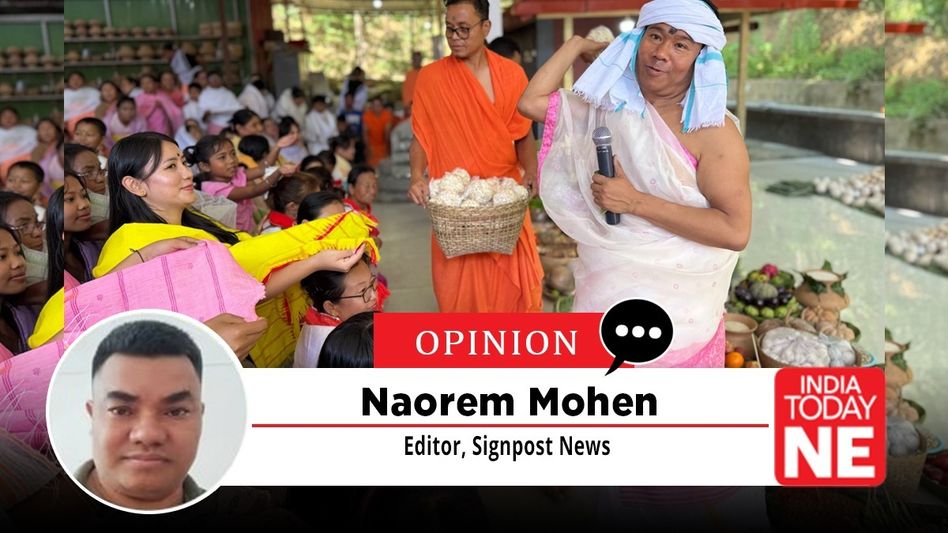
Thousands of devotees gathered at Panthou Ishaikol Nung, Nongpok Chingu Thong, Thalo Sipi Lok, Meitei Laikol, Selloi Langmaiching in Imphal East of Manipur on Sunday, October 11, 2026, for the opening of the 32nd Panthou Sanglen Laipung Halao Thouni Ilaat. The annual religious celebration, held on the first day of Mera in the traditional Meitei lunar calendar, began with prayers, offerings and customary observances.
From early morning, devotees arrived carrying Kwaklei flowers, rice, fruits, vegetables and other offerings to seek the blessings of Divine Panthou. According to the organisers, the gathering included people from different communities and religious backgrounds. Traditional music, devotional performances and the seven Salai flags representing the ancestral lineages of the Meitei people formed part of the ceremony. The observances will continue for another ten days.
For many devotees, however, the occasion held a deeply personal meaning. They had come to receive Senkok Senyai, the sacred coins bestowed by Divine Panthou, which followers regard as symbols of blessings, prosperity and well-being.
The coins themselves have little to do with material wealth. Their importance lies in what devotees believe they represent. For families who have endured poverty, uncertainty and hardship, Senkok Senyai has become a source of spiritual reassurance and hope.
That belief was reflected in the experiences shared by several devotees during the celebration. They spoke of improvements in their children's education, family circumstances and livelihoods, which they attributed to Divine Panthou's blessings. Their accounts offered a glimpse into the place Senkok Senyai occupies in their daily lives.
What does prosperity mean to a mother who once struggled to provide two meals a day for her children? Or to a woman selling vegetables in a market, uncertain whether she would earn enough to meet her family's expenses?
For such families, prosperity is not necessarily measured by the money they possess. It may mean seeing a child enter college, returning home after a day's work with sufficient earnings, or simply knowing that the household can manage its needs.
One woman who attended the celebration recalled the difficult years when poverty had made even the provision of two daily meals a struggle for her family.
Her circumstances, she said, had since improved. Her son is now pursuing engineering studies, while her daughter has completed a master's degree.
For a mother who once worried about feeding her children, their education represents an achievement she could hardly have taken for granted during those difficult years. She spoke with gratitude about the changes in her family's life and attributed them to the blessings of Divine Panthou.
Her understanding of prosperity was shaped by what she had experienced. She did not speak of acquiring great wealth or possessions. What mattered to her was that her children had been able to pursue higher education and that the family was no longer living under the same difficulties.
Her account was a personal testimony of faith, not a claim that could be independently established as a consequence of receiving a sacred coin. Yet it explained why Senkok Senyai meant so much to her. The coin was associated with her prayers, her children's progress and her gratitude for the life her family now leads.
Similar feelings were expressed by women vendors from Lamphel Super Market, who had travelled to Meitei Laikol carrying offerings.
Among them was Ningthoujam Ongbi Thaibemma, who recalled the difficulties the market had faced in earlier years. There had been a time, she said, when business was uncertain and customers were few. Vendors often waited for buyers, unsure whether they would sell enough to cover their household expenses.
Thaibemma described the present situation differently. According to her, sales had improved and the market had gained greater public recognition. She believed these changes had come through the blessings of Divine Panthou.
The women had attended the celebration together, bringing fruits, vegetables, flowers and other offerings. Their purpose was not merely to take part in the ceremony but also to express gratitude for what they regarded as improvements in their livelihoods.
Thaibemma also spoke about Divine Panthou's guidance concerning the establishment of a sacred space for Ima Keithel Lairembi in connection with the market.
For the women vendors, this religious association had become part of their shared experience. Their faith was connected not only with their individual households but also with the market where they worked and earned their living.
A market is more than a place of buying and selling for women who depend on it every day. Their earnings support their families, pay for their children's education and meet household needs. When business improves, the benefits are felt at home.
It was in this sense that Thaibemma and her fellow vendors spoke about prosperity. They believed Divine Panthou had blessed their market and helped them overcome earlier difficulties. Their gratitude was expressed through offerings made according to their means.
Kwaklei flowers held a special place among the offerings brought by devotees. Alongside the flowers were fruits, vegetables, rice and other agricultural produce. These were not necessarily expensive gifts. Many were ordinary things that people could bring from their homes or earn through their own labour.
The act of offering them reflected a simple understanding of devotion. What mattered was not the monetary value of the offering but the sincerity with which it was made.
Another devotee spoke about the growing number of people attending Divine Panthou's religious programmes. She believed that more people were becoming aware of Divine Panthou and the blessings associated with him.
Her observation reflected the faith of a follower who had witnessed changes in attendance over the years. The gathering of more than 3,000 people, as reported by the organisers, also showed the continuing appeal of the annual observance.
The importance of Senkok Senyai becomes clearer when these personal experiences are considered together. A coin ordinarily has a fixed monetary value. It can be spent, exchanged or saved. Senkok Senyai, however, is not treasured by devotees for what it can purchase. They preserve it because they believe it carries Divine Panthou's blessings.
For one family, those blessings may be associated with a child's education. For another, they may be connected with a business that has begun to improve. Others may pray for good health, employment, peace within the family or relief from financial difficulties. The hopes differ, but the belief that brings devotees to Meitei Laikol is much the same.
There is a broad parallel in the Hindu practice of preserving coins associated with Goddess Lakshmi, who is worshipped as the goddess of wealth and prosperity. Such coins are often kept in homes and business establishments as symbols of good fortune.
Senkok Senyai belongs to a distinct religious tradition associated with Divine Panthou. The comparison is useful only in understanding how a coin can acquire spiritual importance beyond its monetary value. For devotees, Senkok Senyai is not ordinary currency. It is a blessing to be received with reverence and preserved with care.
The timing of the celebration also carries religious meaning. The first day of Mera in the traditional Meitei lunar calendar is associated with particular observances, including the offering of Kwaklei flowers. During the programme, the religious significance of these flowers was explained in relation to the season and the practices followed by devotees of Divine Panthou.
Followers believe that offering Kwaklei with sincerity allows them to place their prayers and aspirations before the divine.
The flowers also connect the religious observance with the natural environment. Their seasonal association, use in religious adornment and place among the offerings reflect the relationship between nature and traditional religious practice.
Other elements of Meitei cultural life were equally visible during the celebration. The seven Salai flags represented the ancestral lineages of the Meitei people. Traditional performances and devotional songs accompanied the observances, while offerings of agricultural produce recalled customs that continue to be practised across generations.
The setting of Meitei Laikol at Selloi Langmaiching, with its traditional features and natural surroundings, formed part of the religious atmosphere. Efforts to avoid plastic materials also reflected concern for maintaining the environment in which the celebration was held.
The gathering was not confined to devotees from one community. People from different religious and community backgrounds attended, including members of the Kabui community. They came with their own experiences, prayers and reasons for seeking blessings. Their presence deserves attention in the circumstances prevailing in Manipur.
The willingness of people from different backgrounds to gather in a shared religious space has its own meaning.
It allows people to meet one another outside the divisions that have come to dominate much of public life. Such occasions may not resolve political disagreements or repair the damage caused by conflict, but they can leave room for human contact and mutual respect.
The testimonies shared at Meitei Laikol also invite a closer look at what people mean when they speak of prosperity.
In ordinary economic terms, prosperity is often associated with income, savings, property and financial security. These are important measures, particularly for families struggling to meet their daily needs.
But prosperity can also be understood through the changes that matter most to a household. For the mother who once struggled to provide two meals a day, her children's education has become a measure of how far the family has come.
For the women vendors of Lamphel Super Market, better sales and the ability to support their households represent improvements they had long hoped for. For another family, prosperity may mean recovery from illness, freedom from debt, peace at home or the chance to live without constant anxiety about tomorrow.
Such hopes are not unusual. They belong to the everyday lives of people who work, raise children, care for elderly family members and try to build a more secure future. Faith often becomes part of how people understand these experiences.
When circumstances improve, devotees may regard the changes as blessings. When difficulties continue, prayer can provide reassurance and the strength to carry on. This does not mean that religious belief alone determines whether a family becomes prosperous.
The improvements described by devotees during the celebration remain personal accounts understood through their faith. They do not establish that receiving Senkok Senyai guarantees wealth, educational achievement or success in business.
A child's education depends on effort, family support, opportunity and access to learning. A vendor's earnings are affected by customers, market conditions, prices and the wider economy. Health and household security are also influenced by circumstances beyond any individual's control.
These realities need not be placed in opposition to religious belief. For devotees, the spiritual importance of Senkok Senyai lies in the confidence, gratitude and reassurance they associate with it. Their faith gives personal meaning to changes in their lives, even when those changes also involve hard work and other practical factors.
The sacred coin represents a blessing, but the prayers attached to it concern familiar human needs. Devotees want their children to receive an education, their businesses to survive, their families to remain healthy and their homes to be secure.
They seek the means to live with dignity.These aspirations carry particular weight in present-day Manipur, where prolonged conflict, displacement and disruptions to livelihoods have made ordinary security difficult for many families.
For people living through such uncertainty, prosperity cannot be understood only as the accumulation of wealth.
The ability to live peacefully, send children to school, earn an honest livelihood and plan for the future without fear may matter far more than material possessions.
A family that has lost its source of income may consider the restoration of a livelihood a blessing. Parents whose children's education has been disrupted may hope simply for the opportunity to continue their studies. For those living under prolonged insecurity, a peaceful home can itself represent prosperity.
These concerns help explain the emotional attachment that many devotees have developed towards Senkok Senyai. The coin may be small, but the hopes associated with it are not.
As the 32nd Panthou Sanglen Laipung Halao Thouni Ilaat continues through the coming days of Mera, devotees will return to Meitei Laikol carrying their prayers and offerings.
Some will seek Senkok Senyai for the first time. Others will return with memories of difficulties they believe they have overcome through Divine Panthou's blessings.
Their circumstances will not be identical. Some may be struggling financially, while others may have seen improvements in their family lives. There will be those praying for their children's future and those expressing gratitude for what they believe they have already received.
For the mother who once found it difficult to feed her children, the progress of her son and daughter is reason enough to be grateful. For Ningthoujam Ongbi Thaibemma and the women vendors of Lamphel Super Market, the improvement they perceive in their livelihoods has strengthened their devotion.
These experiences explain why Senkok Senyai continues to hold a special place in the religious lives of Divine Panthou's followers.
For those who receive Senkok Senyai with devotion, the sacred coin is a reminder of the difficulties they have faced, the blessings they believe they have received and the better life they continue to hope for.
And perhaps that is where its deepest meaning lies: not in the promise of riches, but in the ordinary human desire to see one's children prosper, earn a decent living and face tomorrow with a little more hope.