Strengthening Research Culture: Why Manipur University’s New Push Matters
From reviving Research Update to bringing research ethics, multidisciplinary studies and postgraduate research into the conversation, Manipur University’s Research Scholars’ Meet is an attempt to carry an old academic tradition into a new generation.

- Sep 03, 2026,
- Updated Sep 03, 2026, 11:46 AM IST

From reviving Research Update to bringing research ethics, multidisciplinary studies and postgraduate research into the conversation, Manipur University’s Research Scholars’ Meet is an attempt to carry an old academic tradition into a new generation.
For more than three decades, a small idea has survived inside Manipur University. Researchers should not work in isolation. They should meet, exchange ideas, question one another and, above all, share what they discover.
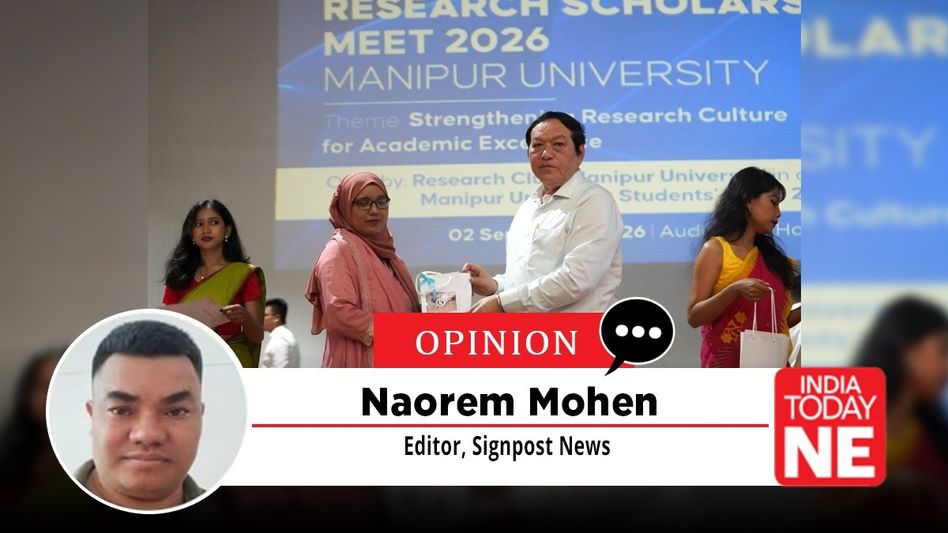
That idea had brought a group of like-minded scholars together around 1990–91 to form the Research Club. On September 2, it returned to the centre of the university’s academic conversation under a theme that sounded simple but carried a larger purpose — “Strengthening Research Culture for Academic Excellence.”
Much has changed between 1990 and 2026. Research itself has changed. What has not changed is the difficult part: building an environment in which a young scholar learns not merely how to earn a degree, but how to ask a question worth pursuing.
The Research Scholars’ Meet offered some indication of how Manipur University is trying to build that environment.
The launch of Research Update, the university’s research journal, was one such effort. Eighteen scholars who had earned their PhDs were felicitated, along with 22 awardees, four achievers and eight contributors to the journal.
Recognition matters. Research is often slow and largely invisible work. Years may pass between choosing a problem and producing something worth publishing. A university acknowledging that journey also tells younger scholars that academic work has value.
But recognition was only one part of the conversation. Vice-Chancellor in-charge Prof. R.K. Hemakumar Singh spoke of academic quality through a simple analogy. Admission is the “inlet”; academic output is the “outlet”. What enters a university will eventually influence what comes out of it.
It explains his emphasis on merit and transparency in admission and on attracting more JRF and NET-qualified candidates to research.
There is another important thought in this. A university cannot demand quality only at the end of the academic journey. It has to create the conditions for quality from the beginning. The same applies to research.
Prof. Hemakumar reminded scholars that meaningful research and publication take time. He also spoke of collaborative research — increasingly important when expertise, facilities and resources cannot always be found within one department or with one researcher.
And research, ultimately, has to travel beyond the dissertation. A thesis may earn a degree. Research acquires a larger meaning when the knowledge it produces enters academic debate or finds relevance in society.
The Vice-Chancellor also referred to the university’s ongoing efforts to take forward the four-year Integrated Teacher Education Programme, or ITEP, including the ordinances, faculty, infrastructure and regulatory requirements involved. It is another indication of a university adjusting its academic structures to a changing higher-education environment.
One of the more significant ideas at the meet concerned postgraduate students. Prof. Angom Dilip Kumar Singh, Director of the Research and Development Cell, spoke about strengthening the research component of postgraduate education in the context of the National Education Policy.
That shift deserves attention. Research should not suddenly begin on the day a student registers for a PhD. The habit of identifying a problem, examining evidence and writing academically can begin much earlier.
A meaningful research component at the postgraduate level can become that first training ground. Prof. Dilip Kumar also brought research ethics into the discussion. It is difficult to think of a more timely subject.
Information that once took days to locate can now be accessed in seconds. Artificial intelligence has made it possible to generate and process enormous amounts of material almost instantly. The technology will continue to improve.
The responsibility of the researcher, however, does not disappear with technology. If anything, it becomes greater. Academic integrity, responsible use of sources, ethical research practice and honesty in publication will increasingly determine whether knowledge can be trusted.
Prof. Ch. Ibohal Singh’s emphasis on multidisciplinary research takes the argument in another direction. The world outside a university is not divided into departments.
An environmental problem may also be an economic problem. Language preservation increasingly intersects with technology. Public health has social and cultural dimensions. Questions of development can involve geography, history, livelihoods and governance at the same time.
Manipur offers enough examples. The complexity of the State itself makes multidisciplinary scholarship particularly valuable. Researchers looking at the same problem from different disciplines may see things that neither could see alone.
Collaboration, therefore, need not only mean two researchers working together. It can also mean two disciplines learning to speak to each other.
Perhaps the most interesting moment of the Research Scholars’ Meet came when Prof. M.C. Arunkumar looked backwards.
He recalled the beginnings of the Research Club around 1990–91, when like-minded researchers came together to create a common academic platform. Sahitya Akademi Award winner Yumlembam Ibomcha Singh was among those associated with initiating the effort.
There was no Google Scholar then. There were no smartphones carrying libraries in a pocket. Artificial intelligence belonged more to imagination than everyday academic life.
Yet researchers understood something fundamental. They needed to talk to one another. More than three decades later, that need has not disappeared.
A researcher may spend months alone with data, books, field notes or experiments. But ideas become stronger when they are presented, questioned and challenged. That is where the revival of Research Update can acquire meaning beyond the publication of another university journal.
It can become a place where the university’s research is visible, where young scholars learn the discipline of publication and where academic conversation continues after seminars and research meets have ended.
The Research Club can perform a similar role outside the pages of the journal. Neither needs to become grand immediately. Academic institutions earn credibility slowly — one serious discussion, one good paper and one committed researcher at a time.
That may also explain why the theme chosen for September 2 deserves to remain after the auditorium has emptied.
A research culture cannot be inaugurated. Nor can it be created by launching a journal or holding an annual meet. These can, however, create the spaces from which such a culture grows.
Manipur University already has one advantage. The idea is not new here. Scholars began that conversation more than three decades ago.
Research Update, stronger postgraduate research, research ethics, multidisciplinary inquiry and collaboration are, in many ways, attempts to carry that conversation into another generation.
The theme was “Strengthening Research Culture for Academic Excellence.” The important word was perhaps not excellence. It was culture. Excellence may be the result. Culture is what a university has to build every day.